
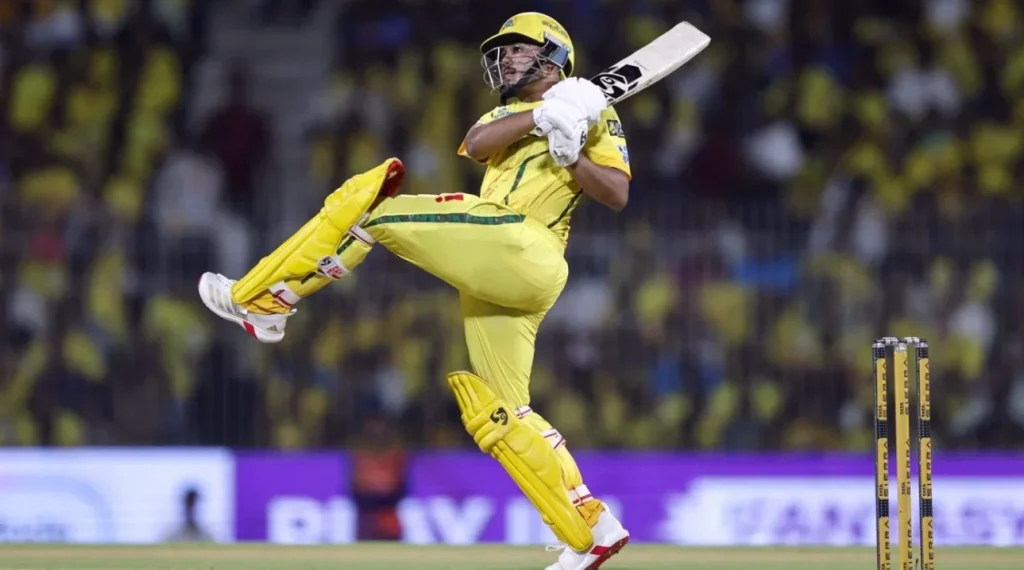
Ayush Mhatre’s rise at Chennai Super Kings has gone from “mid-season gamble” to a genuine selection headache. Brought into the franchise as a replacement last year, the 17-year-old became the youngest player in CSK history. Now, at 18 and after featuring in just over ten IPL matches, he is already shaping as one of the side’s most reliable batting options—most notably during CSK’s clash against Kolkata Knight Riders on Tuesday.
Mhatre’s momentum vs KKR
CSK’s innings began with a bright start from Sanju Samson, who struck three consecutive fours and reached 22 off 12 balls. Yet Mhatre had already stolen the tempo from the other end, scoring at a faster clip while facing five fewer deliveries. His aggressive acceleration—at a strike rate exceeding 220—made Samson’s 150-ball pace look slow by comparison, as CSK surged ahead early and kept control through the first six overs.
Mhatre’s 17-ball 38 was the key to that early distance. It gave CSK the luxury of easing slightly in the middle overs and still finishing the job in a convincing manner against KKR.
The big over: Green’s bounce, Mhatre’s timing
The turning point arrived in the fourth over, when Mhatre punished Cameron Green with a sequence of 4, 4, 6, 6. While the two sixes ignited Chepauk and brought the kind of roar that travels across the stadium, it was the opening four that underlined why Mhatre is viewed as a standout prospect.
Green sent down a firm ball on a length outside the off stump, with the Chepauk surface—marked by black and red soil—offering just enough movement to test batters. Mhatre initially looked set to pull it towards midwicket, but he altered his grip in a fraction of a second. He then met the ball cleanly, countering the subtle away swing, and drove it straight into the gap between extra cover and mid-off. Even though Green had struck it at around 140 kph, Mhatre adjusted quickly enough to place it perfectly.
Powerplay dominance and the yorker challenge
Much like Rohit Sharma, Mhatre appears to get extra time—both in the mind and at the crease—paired with timing that makes fast decisions look effortless. By the close of the powerplay, KKR’s bowlers were left with little choice but to chase the yorker.
Vaibhav Arora tried first, but the delivery came out as a full toss. Mhatre dispatched it over midwicket. On the next ball, Arora nearly landed the outside-off yorker, yet Mhatre still found the gap, flat-batting it again between extra cover and mid-off. Samson, stationed at the other end, noticed the quality immediately and offered a thumbs-up—an instinctive reaction from a batter who knows exactly how difficult it is to score cleanly off a yorker length.
How the innings built
- Mhatre struck his seventh boundary from 13 balls.
- He then added a further four for eight boundaries in 14 deliveries.
- In his attempt for another big hit off the last ball of the powerplay, he was dismissed—caught at deep midwicket.
- Despite the wicket, the crowd at Chepauk on Tamil New Year’s Day responded with round after round of applause, reflecting how emphatically he played.
Where CSK could reshuffle the batting order
The destructive clarity of Mhatre’s powerplay work naturally raises a tactical question: should CSK consider moving him up the order and altering the top three? If Mhatre were promoted from No. 3 to open alongside Samson, with Ruturaj Gaikwad dropping to No. 3, it could change the balance of CSK’s innings structure.
There is a performance contrast that makes the debate louder. In IPL 2026, Mhatre has kept a powerplay strike rate of 170. Gaikwad, meanwhile, has batted at 104 in the same phase. Gaikwad is also the only player among 20 batters who have faced at least 40 balls in the powerplay to have a strike rate below 130. Last season, Mhatre had already opened after Gaikwad was ruled out due to injury.
Why pace matters to Mhatre
Even allowing for a small sample, Mhatre’s numbers suggest he particularly thrives when the ball is coming on quickly. Since his IPL debut last season, he has produced a strike rate of 194.85 against pace across 12 innings.
- Only Vaibhav Sooryavanshi—described as unusually gifted—has a higher strike rate against pace in this same period.
- The comparison is made with the minimum requirement of 130 balls faced in that stretch.
Implications for Gaikwad and CSK’s selection thinking
With opening batters’ strike rates climbing rapidly across the league, the pressure shifts to Gaikwad. The argument for CSK is that if they keep Gaikwad at No. 3—behind the opening pair of Mhatre and Samson—they could use him as the stabilising option if early wickets fall.
There’s also a cricketing logic beyond numbers: Gaikwad brings more experience and has faced a wider variety of spin scenarios than Mhatre. CSK, however, are typically reluctant to disturb a side that is winning. Even so, Mhatre has given the management plenty to consider with his third notable innings in just his last four visits to the crease.
