
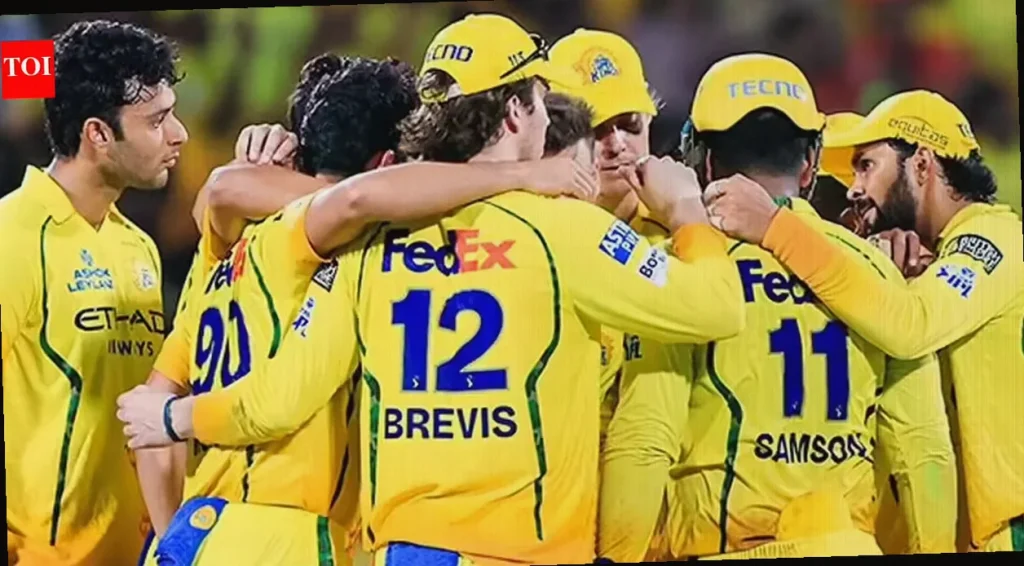
Five-time IPL champions Chennai Super Kings have reached a stretch that feels unfamiliar: a third straight season without a playoff berth. Once they were viewed as near-guaranteed contenders for the Top 4, the franchise’s recent decline has been sharp, and the discomfort has been visible for weeks rather than days.
Even with a wildly uneven run, CSK kept themselves alive until their last league match against Gujarat Titans. The requirement was simple—win to preserve a slim chance—but the outcome was brutal. In Ahmedabad, they suffered the heaviest loss of their IPL history, going down by 89 runs.
The defeat closed the season and, in many ways, reflected the bigger pattern. Their bowling looked fragile at crucial moments, batting lacked consistency, and the side never fully settled into a rhythm. From a franchise that once made the playoffs 10 consecutive times, CSK have now missed qualification five times in the last seven years.
The only real comfort is that during this phase, the two seasons they did reach the playoffs ended in the ultimate prize. Still, that record cannot mask the central worry: a team synonymous with stability is now searching for direction.
Quick facts
- CSK missed the playoffs for the third consecutive season.
- Their final league game vs Gujarat Titans ended in an 89-run defeat in Ahmedabad.
- They finished with six wins and 12 points from 14 matches.
- Home record: four wins at Chepauk.
- Away record: two wins on the road.
- In the last seven seasons, CSK have missed qualification five times.
- They have previously qualified twice in this window and won the title on both occasions.
CSK’s 2026 numbers
Seven wins are typically treated as the minimum benchmark for a playoff spot, and CSK fell short. Their final tally read six victories and 12 points across 14 matches.
Chepauk, which has often served as their strongest base, did not provide the rescue they needed. Four wins at home and only two away meant they were always going to struggle in a tightly contested season where margins are thin.
The last-match loss to Gujarat Titans only underlined how far they have drifted from the side that lifted the title in 2023. What looked like a familiar blueprint earlier in the decade has not held together this time.
Main reasons behind CSK’s struggles in IPL 2026
Injuries were the first major blow. The campaign never settled because fitness concerns repeatedly forced changes to the XI, breaking any attempt at building momentum.
MS Dhoni missed the entire season due to a calf strain, depriving the team of both experience and on-field leadership when pressure moments arrived. Jamie Overton—arguably CSK’s strongest overseas contributor that year—also suffered a thigh injury during the business end and returned to the UK.
Ayush Mhatre, one of the breakout names of the season, faced a hamstring tear after only six appearances. The list of interruptions continued: Ramakrishna Ghosh was ruled out after a foot fracture in just one match, Khaleel Ahmed sustained a quadriceps tear early, and Nathan Ellis missed the season with a recurring hamstring problem.
With the playing group constantly shifting, CSK were often forced into unfamiliar combinations. Heavy reliance on less-experienced players and temporary setups made it harder to survive the long grind that defines the IPL.
Another issue was that CSK’s overseas core never clicked as a unit. Apart from Jamie Overton and, to a limited extent, Noor Ahmad, the international contingent struggled to stamp authority across the tournament.
Overton stood out with 14 wickets and useful runs lower down the order before injury cut his run short. Noor Ahmad took 13 wickets, but he did not deliver the kind of sustained dominance that changes matches during key phases.
More critically, several other overseas investments did not repay the faith. Dewald Brevis struggled despite extended backing, Matt Short never quite found his footing, and Spencer Johnson failed to deliver the impact that was expected after replacing Nathan Ellis.
CSK kept reshuffling their overseas choices across the season. But those constant changes pointed to a larger problem—there was no stable overseas group around which the franchise could build a consistent structure.
CSK also played a season without rhythm, and the timing of their defeats made it worse. They started with three consecutive losses and finished with another three straight defeats.
There was a short resurgence in the middle, when CSK won three games in a row and briefly revived playoff hopes. Yet every time momentum looked within reach, a new setback arrived—driven by injuries, uneven performances, and unsettled combinations that pushed them back again and again.
Unlike the peak CSK years, when the team rarely looked flustered, the 2026 version often appeared to react rather than control. The identity that usually steadies them in chaotic spells was missing.
CSK report card (IPL 2026)
Despite the disappointing campaign, several players offered genuine reasons to believe.
Sanju Samson, in his first season with CSK, became the batting backbone. He amassed 477 runs at a strike rate above 165 and struck two centuries, frequently carrying the lineup during difficult stretches.
Among the younger group, Kartik Sharma and Ayush Mhatre impressed. Mhatre stood out particularly with fearless strokeplay, recording a strike rate close to 178 despite limited opportunities.
With the ball, Anshul Kamboj emerged as CSK’s most dependable wicket-taker, finishing with 21 wickets in a challenging bowling year. He faded slightly towards the end, but the promise shown was enough to suggest he can be a long-term option.
Jamie Overton’s contribution before injury also mattered. His ability to contribute with both bat and ball gave CSK a balance they missed for much of the season.
Top batters
Matches / Runs / Average / Strike Rate / 100s-50s
Sanju Samson: 144 / 774 / 43.36 / 165.62 / 2-1
Kartik Sharma: 112 / 953 / 32.78 / 136.57 / 0-2
Ayush Mhatre: 62 / 133 / 13.50 / 177.87 / 0-2
Top bowlers
Matches / Wickets / Average / Economy / Best
Anshul Kamboj: 14 / 21 / 25.23 / 10.52 / 5-22
Jamie Overton: 10 / 14 / 17.78 / 8.94 / 4-18
Inconsistent performers
CSK’s season was shaped by players who produced sparks but failed to sustain impact. Ruturaj Gaikwad endured a tough year, finishing with 337 runs but never looking fully in command at the top. His strike rate of 123.44 reflected a broader batting problem—too little urgency when the game demanded acceleration.
Shivam Dube scored 270 runs in 13 matches, delivering several aggressive cameos and keeping a strike rate of 158.82. However, the team continued to miss innings that truly changed matches and decided outcomes.
Among the bowlers, Noor Ahmad and Akeal Hosein delivered periodic strong spells but could not dominate consistently on tracks where CSK would usually lean on spin. Hosein’s mid-season omission also disrupted the balance of the side, compounding the difficulties already created by injuries.
Mukesh Choudhary, with eight wickets from eight games, also had moments with the new ball. Yet inconsistency prevented him from becoming a dependable option week after week.
Total failures
A separate group of players struggled to justify the chances they received or the roles assigned to them, exposing weaknesses in how the squad was assembled and how backups were planned.
Gurjapneet Singh (four wickets from eight matches), Khaleel Ahmed (two wickets from five matches), and Spencer Johnson (two wickets from three matches) had trouble with both wicket-taking and economy. That left CSK without a stable pace attack for much of the season.
The batting disappointments were equally damaging. Dewald Brevis produced 151 runs in 11 games but never got into a rhythm, ending with an average below 19 despite extended backing. Sarfaraz Khan scored 161 runs in eight matches and Urvil Patel added 129 in seven, but both were limited to isolated cameos rather than innings that tilted games.
Urvil’s strike rate was above 200, which showed his ceiling, but his inconsistency made him unreliable during pressure situations. Prashant Veer also failed to make a lasting impact, scoring 90 runs from six matches in limited opportunities.
What next for CSK?
CSK’s situation points to the need for a tactical reset. After three consecutive league-stage exits, the franchise must rethink its approach for IPL 2027.
For years, CSK built success through stability, experienced players, and extracting maximum value from Chepauk. But in 2026, that formula stopped delivering reliable returns. Their spin-heavy strategy no longer guaranteed control at home, while the constant injury-driven reshuffling prevented the team from developing rhythm.
Modern IPL sides increasingly rely on aggressive batting depth and pace attacks that can adapt. CSK appear to have fallen behind in both areas. Outside Anshul Kamboj, they lacked a consistent, wicket-taking fast-bowling option, and their batting often struggled to accelerate under pressure.
That forces an important decision: continue leaning on the older model, or shift towards a younger, more flexible way of building the squad.
Can Gaikwad lead the next era?
Ruturaj Gaikwad’s third season as captain was far from smooth. He was unable to guide the side into the playoffs in all three of his captaincy seasons.
Injuries, Dhoni’s absence, and constant reshuffling made leadership particularly difficult. There are also questions about his tactical adaptability and batting intent. His 337 runs came at a strike rate of 123.44—numbers that did not carry the authority expected from a modern IPL captain.
CSK still appear inclined to treat Gaikwad as the face of their transition into the post-Dhoni era. The challenge will be whether he can evolve into a more proactive leader who helps shape a fresh identity for the franchise.
At the very least, the rise of players like Ayush Mhatre, Kartik Sharma, and Anshul Kamboj provides a foundation. If CSK can build around that group, the transition becomes more than just a slogan.
How can CSK become contenders again?
To return as genuine contenders before the 2028 mega auction, CSK will need IPL 2027 to be planned with long-term clarity rather than quick fixes.
The top priority should be rebuilding the pace unit around Anshul Kamboj and securing durable overseas fast-bowling talent after repeated injury setbacks to Nathan Ellis and Jamie Overton. They also need more firepower in the middle order and reliable finishers, because too much of the pressure this season fell on Sanju Samson.
Still, the positives from 2026 can serve as the starting point. Mhatre, Kartik Sharma, and Kamboj showed that the next generation is already present within the squad. The immediate task now is to form a stable core around them instead of leaning too heavily on ageing experience.
