
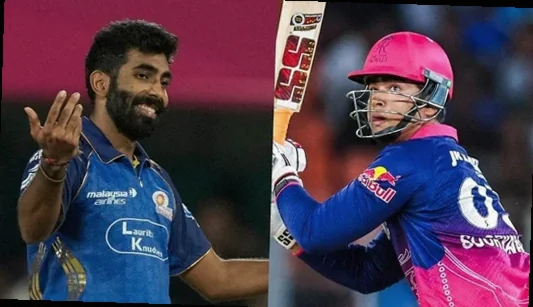
Dale Steyn left a lasting impression after watching 15-year-old Vaibhav Sooryavanshi take on Jasprit Bumrah in an audacious IPL 2026 clash between Rajasthan Royals and Mumbai Indians at Guwahati. The youngster struck on the very first ball he faced, smashing Bumrah for a six, then backed it up a couple of deliveries later to win the opening battle in a way that looked brutally one-sided. While five balls is too small a sample to declare a definitive “winner,” Steyn felt the impact was already impossible to ignore—because the world’s leading fast bowler had clearly been made to look uncertain.
Sooryavanshi’s fearless burst vs Bumrah
For Steyn, the standout feature wasn’t just the boundary count, but the mindset. Ten years into his international career, Bumrah is typically the kind of bowler who demands respect with precision and pace. Yet, in Steyn’s view, Sooryavanshi managed to unsettle him in a manner that suggested Bumrah had fewer answers than usual. It marked the fourth straight game in which Bumrah failed to take a wicket, but by the time the contest ended, the conversation had shifted away from the bowler’s overall spell and onto the statement Sooryavanshi and his opening partner, Yashasvi Jaiswal, made with the bat.
- In the opening phase of the matchup in Guwahati, Sooryavanshi struck Bumrah immediately, clearing the ropes off the first ball faced.
- He continued the momentum shortly after, hitting another boundary just a couple of deliveries later.
- Bumrah’s wicket drought stretched further—his fourth consecutive game without a wicket—yet the dominant story became Sooryavanshi’s ruthless hitting alongside Jaiswal’s batting.
Speaking on ESPNcricinfo’s TimeOut show, Steyn explained why that first-ball moment carried so much weight. He suggested that Sooryavanshi’s approach forces bowlers to think in the way they do not like to—namely, fearing that even a delivery that is normally “in the slot” could be punished for six. Steyn pointed out how rare it is for Bumrah to be hit in that manner, adding that the great pacer was likely already calculating the consequences of getting it wrong.
Steyn also described what he noticed in the aftermath of the hits. Even when Bumrah was struck for a big score, Steyn felt the bowler’s reaction suggested a sense of inevitability—almost like Bumrah understood that once he missed the right area, Sooryavanshi was going to make him pay. In Steyn’s words, the youngster’s lack of fear was central to how he was able to take control so quickly.
Steyn acknowledged that fantasy match-ups can’t recreate real match conditions—he couldn’t say exactly how he, at his peak, would have approached a batter like Sooryavanshi. But he stressed that no bowler has managed to fully escape his dominance. He referenced how last season’s version of this narrative involved Shardul Thakur, Mohammed Siraj, and Ishant Sharma, and how this time it was Bumrah—described as the best fast bowler in the world—who became the latest casualty of Sooryavanshi’s confidence.
Steyn added that the result might have looked slightly different in a longer 20-over contest rather than a brief window of deliveries. Even so, he believed the essential truth about Sooryavanshi would remain unchanged: his approach is steady, unflinching, and unaffected by reputation or pace.
Closing his remarks, Steyn underlined the tactical lesson batters like Sooryavanshi deliver to the bowling side. If a bowler offers even a half-volley, Sooryavanshi will hit it out of the ground; alternatively, if the bowler drags the length back and lands a good ball, the batter might be punished in return. But if the bowler misses the mark, the distance between “mistake” and “damage” is minimal—whether the opponent is Bumrah or any other pacer. Steyn’s final verdict was clear: that fearless, punishing brand of batting is exactly why Sooryavanshi’s display resonated so loudly.
