
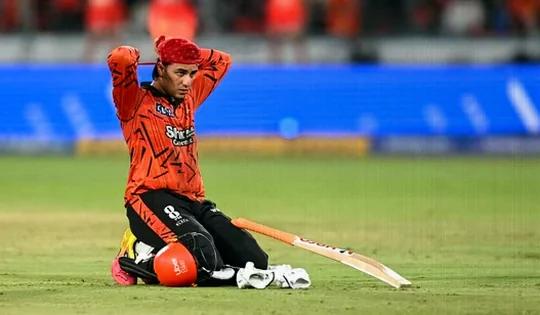
The “Travishek” threat on a flat surface—especially when teams are playing at home—has rarely looked more dangerous. With both openers listed as left-handers, Delhi Capitals leaned into the standard playbook by using an off-spinner during the powerplay. The logic was hard to ignore: the same pattern had been visible at the recent T20 World Cup, where Abhishek Sharma’s difficulties against off-spin and its variety were already well documented.
The India opener, who had been building toward a World Cup run with a fiery rise in form, was quickly met with a harsh reality check. He was dismissed three times in the powerplay by off-spinners, turning what should have been a smooth start into a recurring problem. The statistics only reinforced the concern: against right-arm off-spin, his average sat at 9.67, and his strike rate was 107.41—numbers that hinted at how uncomfortable he was against that specific angle and pace of bowling.
Axar Patel’s new-ball call backfired
In that context, Axar Patel’s choice to hand the new ball to Nitish Rana in the second over looked like a calculated, and somewhat risky, adjustment. Rana was turned to over Auqib Nabi as the early bowling option, but the move did not pay off. Rana kept things under control for the opening five deliveries, until a small mistake in length—fractionally too short and landing on the stumps—allowed Abhishek to punish him with a boundary.
Axar then continued with the plan, bringing Rana back for the fifth over. This time, the part-time off-spinner was not given any room to settle. Abhishek struck twice in consecutive deliveries, first driving inside-out over cover after getting hold of a tossed-up ball, and then rocking back to pull a short one over long-on. Travis Head added to the damage with a six off the last ball of the over, leaving Rana to concede 20 runs in that spell.
Looking back, Abhishek probably wasn’t ever going to be seriously tested by a part-time off-spin look on a track like that. Even so, the bigger point was how well he has handled this season’s off-spin challenge overall. This year, he has struck 34 runs from only 13 balls against the same type of bowling without losing his wicket—an emphatic reminder that the earlier weakness has not defined his game for long.
Improvement seen at the T20 World Cup
Abhishek did have a clear vulnerability, but it’s been obvious that he has worked on it. That progress surfaced again during the T20 World Cup itself, where his mindset and shot selection showed a more complete response to bowling plans. The clearest illustration came in last month’s final in Ahmedabad, where his approach against Glenn Phillips stood out.
Former South Africa captain Faf du Plessis pointed to the strategic evolution in Abhishek’s batting. He noted that the opener now recognizes what opponents are setting up—slower deliveries, broader attacking lines, and packed fields on the off-side—then reads the plan early and moves accordingly to attack the leg side with greater ease.
Du Plessis said, “He’s now seen what teams do, slower balls, wider lines, packed off-side fields. Tonight, he anticipated that plan, moved across and accessed the leg side better. That shows the work he’s put in tactically.”
Anil Kumble echoed the same theme, highlighting how Abhishek has turned that understanding into execution. Kumble stressed that Abhishek’s preferences have always been clear—he likes pace—and that when a side like New Zealand tried to counter him by bowling slower and wider, he responded by shifting across and playing straighter. Kumble also referenced how Abhishek handled at least one heavy off-spin phase before moving on to challenge the seamers.
Kumble added, “That’s his game plan, he likes pace. New Zealand had a clear plan: slower and wider. He countered by moving across and playing straighter. He survived that one over of off-spin and then took on the seamers.”
Rana’s comeback, Abhishek’s finish
Nitish Rana did get another chance later, returning to bowl the 10th over and conceding only six runs. However, his final spell became the turning point for the chase of momentum. Abhishek dismantled him for 23 runs, including three sixes and a four, as he marched toward his third-fastest T20 century—an innings that ultimately put the “Travishek” reputation on full display.
