
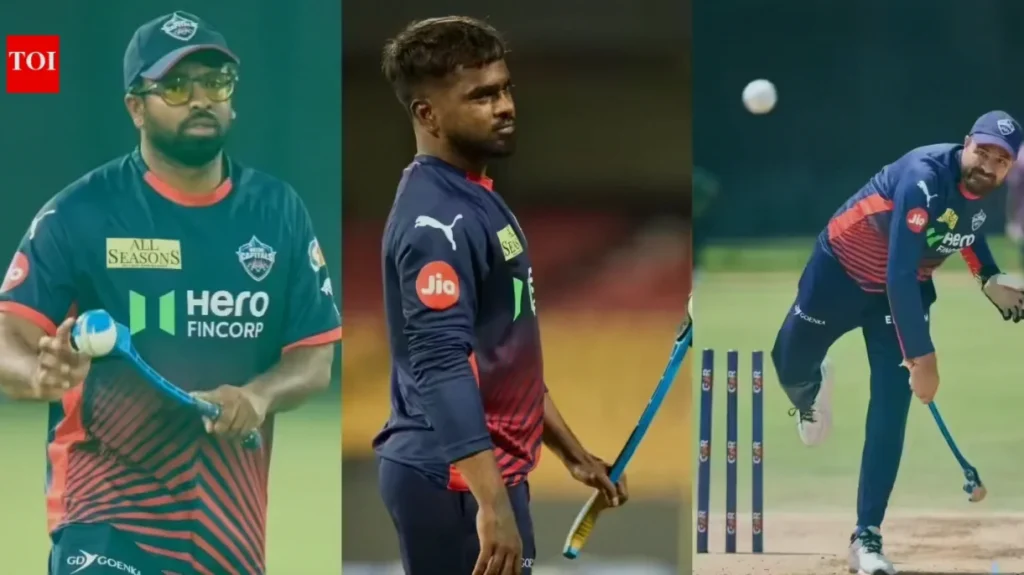
New Delhi: As T20 cricket keeps speeding up and batters are clearing the boundary rope with increasing ease, the value of throwdown specialists has risen sharply across modern franchise setups. In practice, they don’t just help players face pace at high tempo; they also create the repetition that lets batters refine a specific stroke—something that’s difficult to replicate with a regular bowling unit. Today, it’s common to see support staff arrive with oversized batting gloves and robo-arms at nets, while international assignments often come with dedicated throwdown nets. Within the IPL environment, however, the emphasis is less on novelty and more on sheer volume. Since no bowler can genuinely reproduce match-day intensity ball after ball in training, throwdown specialists increasingly form the “engine room” of team preparation. For Delhi Capitals, three such specialists are central to the process, each bringing a distinct skill set—yet united by the same goal: to get the speed guns firing and the batters ready.
Inside Delhi Capitals’ throwdown group
Cricketing preparation in the franchise league is built on detail, and that begins in the nets. Delhi Capitals’ squad relies on three throwdown experts who approach the craft differently—through unique bowling profiles, varied sidearm angles, and an emphasis on delivering the right ball into the right zone at the right tempo.
Aniket Berde
Aniket Berde, 35, hails from Kalyan in Mumbai. Before joining Praveen Amre’s academy in 2013, he played club cricket in his hometown. At the academy, he bowled to players including Ajinkya Rahane, Robin Uthappa, Shreyas Iyer, Shams Mulani and Aakarshit Gomel.
Berde’s standout trait is his ambidexterity. He writes and fields with his left hand, but bats and bowls with his right. Explaining his path into the role, Berde said that he began as a right-arm throwdown bowler, but noticed that many others were already working predominantly as right-arm throwdown specialists. “What makes me unique is that I’m a right-hand bowler, but I throw with my left hand,” he said. “So, I started doing throwdowns with my left hand slowly. Now, I can throw with both hands.”
His development didn’t happen overnight. Up to 2016, he continued with right-hand-only throwdowns. After that, he spent the following two years working to strengthen his left-hand ability. He also described how the move to sidearm mechanics required learning a new toolset. “Earlier, we used to bowl with our hands; we did not have a sidearm,” he said. “But, as I got a sidearm, I started learning how to bowl with it. Then one day, I saw Raghu bowling with Ajinkya (Rahane) sir. After that, I started bowling with my right hand.”
From there, Berde gradually built the method in stages. “First, I started with my right hand to bowl with a sidearm. Little by little, I developed that. Gradually, I started with my left hand as well,” he explained. “So, when I tried with my left hand, I was told that I could continue. Now, I mostly bowl with my left hand.”
Berde’s entry into cricket came later than usual. He was introduced to the sport at 18 and didn’t receive many immediate opportunities. With chances limited as he aged, he made the practical call to coach while still keeping his playing options open. As playing opportunities reduced, he leaned into the increasing demand for throwdown specialists and sidearm-focused bowlers. He has been with Delhi Capitals for the past year and has also spent three seasons with the Dubai Capitals in the ILT20.
Darshan
Darshan is the most experienced of the three throwdown specialists within Delhi Capitals. He joined the setup eight years ago, after having represented Jammu & Kashmir at the U-16 and U-19 levels.
His initial attempt to break into the capital came around 2012, but a serious back injury in 2014 interrupted that journey. Two years later, he moved away from playing and shifted his entire focus toward coaching and throwdowns.
Darshan is 32 and comes from the Ramban district, roughly 150 kilometres from Jammu. After his playing days ended, he worked and trained at the Sonnet Club in Delhi. In 2016, an opening arrived with Delhi Capitals.
When asked what separates an effective throwdown specialist, Darshan stressed that it’s not only about raw speed. “It doesn’t matter if you bowl 150 or 160 kmpg,” he said. “What matters is how many balls you’re bowling into a good length area, how much in-swing and out-swing you get if you bowl a red ball. Or if you bowl with a white ball, you get more yorkers. It matters more what you bowl.”
His experience extends beyond the IPL as well. Darshan has worked in the ILT20 with the Dubai Capitals, the Legends League, the Asia Cup, and with the J&K domestic team. He also shared an example from his time with J&K: “In 2021, I worked with the J&K team for two years. The team was doing well then also. We were playing a lot of tournaments in the off-season.”
He added context about conditions and club cricket in the region. “We were going abroad to play cricket. The problem with J&K is that there is little club cricket. There is more matting cricket. If club cricket comes, it will be better. There are more bowlers because they play on the mat. If you play on the astro(turf), it will be better. There is good talent there.”
Sai Pendam
Sai Pendam began speaking to reporters with a blend of energy and hesitation, first urging his colleagues to answer before he stepped forward himself. He is from Manikonda district in Telangana and is just about five feet tall, but height has never limited his ambitions.
His switch toward sidearm and throwdown work began after corruption ended his career trajectory as an off-spinner. When he started as a sidearm specialist in 2021 at the Adnan Cricket Academy in Hyderabad—on the insistence of his friend Ganesh—the learning curve was steep. Pendam recalled being encouraged to trust his ability: “He (Adan) told me that I have a lot of talent. You can do it. You can go to a higher level. I started from there.”
Within a month, he began experiencing pain in his shoulders and even considered stepping away from sidearm coaching. “At one time, I thought that I will leave sidearm (coaching),” he said. “He told me that nothing would happen. He told me that this is how it starts. He told me that if I get used to it, I won’t have any problems.”
Once he settled into the routine, Pendam focused on the opportunity to work with players. “After that, I got the chance to make players practise. I didn’t want money. I just wanted a chance. I was waiting for that chance,” he explained.
That chance arrived during a camp where he was spotted by Delhi Capitals head coach Hemang Badani, DC Director of Cricket Venugopal Rao, former India wicketkeeper Wriddhiman Saha and Ruchir Grandhi from the GMR Group.
Since then, Pendam has been involved in multiple campaigns and leagues. Over the past three years with the GMR Sports fold, he has taken part in ILT20 seasons, IPL assignments and the Legends Cricket League.
