
There’s a particular kind of frustration that only a bowler understands. One moment, your captain is asking you to take the penultimate over—then, as you’re walking in to start your run-up, he changes his mind and tells you to stand down. The disappointment stings, your ego takes a hit, and you have to steady yourself. A short while later you line up again, this time for the final over with the chase in motion. The opposition needs 11 runs to win, and your role is suddenly impossible to ignore.
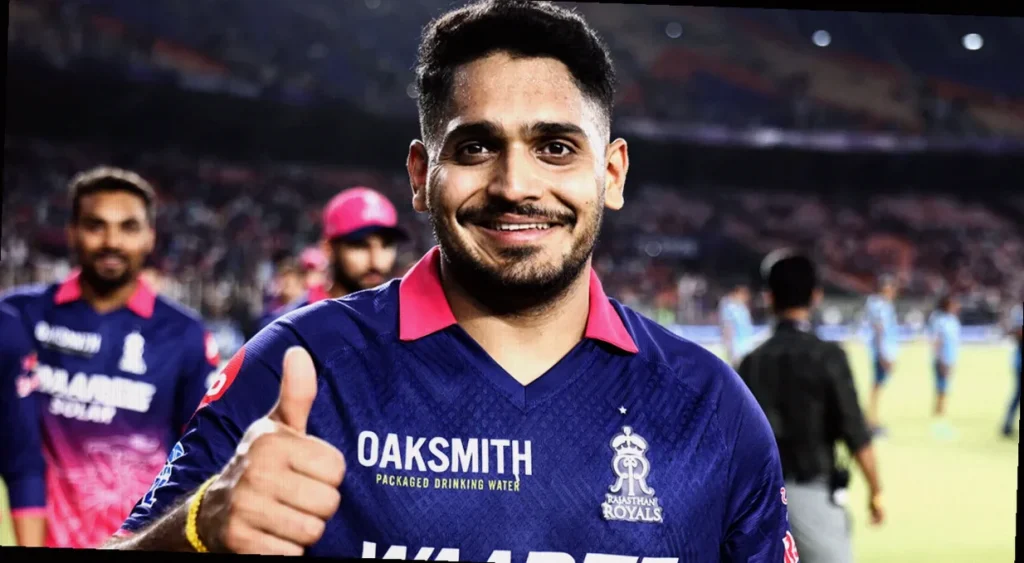
Nicknamed “Sniper”, Tushar Deshpande delivered when it mattered most, firing in pinpoint yorkers to guide his side to a six-run win. He didn’t just execute the plans—he celebrated them loudly, thumping his chest and letting everyone know he felt in total control of the turf.
Tushar Deshpande went through a rollercoaster of feelings during that Rajasthan Royals chase against Gujarat Titans in Ahmedabad last month, a match that ended in a thrilling victory for the Royals.
Speaking a few weeks later in Kolkata, Deshpande recalled how the moment changed for him. “I didn’t have that celebration planned,” he said. “The aggression in me had already been building from one over earlier. I came in to bowl the 19th over. Riyan [Parag], our captain, told me, ‘Tu daal,’ meaning you bowl. But when I started moving into my run-up, he then said, ‘Ruk, Jofra ko daalne de.’ [Wait, let Jofra bowl it.] That was the kind of hurt that sticks.”
Deshpande added that being kept out of the over affected his confidence at the exact moment he felt he was most ready. “I got a bit dejected—why not me? I was confident I could bowl the 19th over. Yorkers are my strength, and the situation demanded yorkers,” he said. “I told myself at the top of my mark that I can do the job, but at that moment Parag took the ball away from me.”
After the game, Parag explained the thinking behind the switch to Deshpande. The captain pointed out that Jofra Archer’s pace could produce a wicket, particularly with two lower-order batters at the crease: Rashid Khan and Kagiso Rabada.
Deshpande said he understood the logic once he heard it. “The way Jofra bowled gave us the cushion of a few extra runs. Archer didn’t take a wicket, but he conceded only four, so the margin to defend became extremely tight,” he explained.
When Archer completed the first two deliveries of the over, Parag signalled Deshpande to prepare for the last over. Deshpande described himself as “very pumped up”. “This is my chance—‘Mujhe kar ke dikhana hai,’ I have to show what I can do,” he said. “I wasn’t thinking about anything else like, what if I fail, or what if I can’t defend.”
The conditions also demanded clarity. Deshpande said the red-soil surface played placid, and the slower ball wasn’t gripping as it should while dew added another complication for the bowlers. “I told Parag I would stick to yorkers,” he said.
His first attempt at a yorker was to Rabada, but it went wrong early. “My first delivery was a wide yorker to Rabada that turned into a full toss, and the umpire called it wide,” Deshpande said. He didn’t deviate from his plan. The next ball—the first legal delivery—also went for a full toss, and Rabada managed only a single.
With Rashid Khan on strike, Deshpande chose not to bowl the slower option, despite it being a common tactic against Rashid. “I decided against the slower ball,” he said, explaining that it carried too much risk at that stage. “That delivery was high risk.”
Parag’s field setting helped shape the next phase. After Deshpande had seen Rashid open the bat late to deflect a wide yorker from Sandeep Sharma for four in the 18th over, Parag pushed third man closer to the boundary. Deshpande agreed it was a smart decision. “I bowled a yorker on middle and off, and Rashid opened the bat face, but he could only get a single,” he said. “Another yorker followed by another single to Rabada.”
Then came the turning point. “Then it was a dot ball,” Deshpande recalled. “On the fifth one, Rashid tried a wild heave over cover, but it was caught brilliantly at deep point.” He added the dismissal was also a product of his communication. “He was expecting another yorker, but I had told Riyan I’ll bowl a bit wider. Rashid went for the big hit, and the leading edge went to Jofra.”
With Gujarat needing six off the final delivery to force a Super Over, Deshpande produced another dot ball, sealing the six-run win for Royals. The result mattered because Titans had looked on course when they required just 15 from the last two overs, only to fall short in the final moments.
Deshpande’s season didn’t begin smoothly. In his second campaign with Royals, he missed the first match of the 2026 IPL due to a freak injury, and he described the incident with a hint of disbelief. “I was speaking to my wife on the phone,” he said. “I put water in the kettle to boil. When I poured the water into the glass and picked it up, I forgot it was boiling hot. It spilled on my hand, and I dropped the glass. It fell straight on my right foot.”
He said blood came out from two of his toes, but he still tried to push himself to play. “I taped it up because I was desperate to get into the game,” Deshpande said. “It was against my old team, Chennai Super Kings, so I wanted to be there.” He told Royals head coach Kumar Sangakkara that he had handled tougher situations in the past, but Sangakkara urged him to think in practical terms rather than emotionally. “He gave me clarity: this is not the last game of the season, it is the first,” Deshpande said.
Royals had picked him up at the 2025 mega auction after he had undergone ankle surgery the previous year. He went on to take nine wickets in ten appearances during a season in which the Royals finished ninth in the points table. Deshpande also admitted he entered the tournament feeling unprepared. “I was underprepared coming into the tournament,” he said.
Coming back home after that season, Deshpande said he made a personal adjustment in his approach. “I learned I need to come up with something new this season or present a better version of myself, so that batters can’t read me,” he explained. “Earlier IPL seasons, I relied on wide yorkers and slower bouncers. This time I needed to add something more—something I could use under pressure without bluffing.”
That work, he said, has centred on bowling yorkers with consistency. Deshpande used the same ideas in domestic cricket for Mumbai, not only in white-ball competitions but also in the Ranji Trophy. There, he was the leading fast bowler for the side, taking 25 wickets in 15 innings at an average of 25.76. “If you look at how I bowled in domestic tournaments, it’s yorker, yorker, yorker, and then a variation,” he said. “In IPL, where 200 is easy to score, I want to bowl a high-percentage ball that gives me results and benefits my team. That ball is the yorker.”
Deshpande also said the responsibility Royals have given him this season has been more demanding than what he used to do at CSK. “At CSK, I would often bowl two overs in the powerplay, and then two at the death,” he said. “Last season with Royals, I was moved around quite a bit—sometimes bowling with the new ball, sometimes after the powerplay, and sometimes only getting one over in a spell.”
He added that the difference this year is role clarity. “But now, since I’ve got role clarity before the start of this season—shut out the powerplay, one in the middle, and maybe two at the back end—that has helped me build confidence,” Deshpande said. “I’m coming at the back end of the powerplay when batters are set and looking to attack the bowling. My role is clear: finish the powerplay well and bowl high-percentage balls to specific fields.”
Deshpande credited support at CSK for pushing him to refine rather than keep experimenting. “At CSK, the management—bowling coach Eric Simons, consultant Dwayne Bravo, and former captain MS Dhoni—helped control my desire to try too many different things,” he said. “They made me focus on the plan. That foundation eventually helped me earn an India debut two years ago.”
For Deshpande, this IPL has also been a season of learning, having played five of Royals’ ten matches so far. In Royals’ last-month match against Royal Challengers Bengaluru in Guwahati, he was replaced by Brijesh Sharma, an uncapped fast bowler from Jammu and Kashmir, in what was communicated to him as a tactical move.
Deshpande said he learned about the change on match day after the toss. “I found out on the match day, after the toss, about the swap,” he said. “The Guwahati wicket was slow and low, where change of pace would be more effective. The team management thought we’d go with Brijesh because he has good variations.”
He described Brijesh’s strengths as key to the decision. “He bowls very good change of pace and has good cutters,” Deshpande said. “So I told myself, fair enough—whatever the team requires, I’ll be there. If it’s a tactical change, then okay.”
He admitted it still affected him initially. “At first it did get me down a bit,” he said. “I was told at the last minute. Normally we plan in advance, so for some time I kept asking myself: what did I lack that they chose Brijesh instead of me?”
Deshpande said he quickly moved past the doubt. “If I had cribbed, I would have messed up my mindset,” he said, before apologising for using an expletive. “So I decided, yes, it’s a tactical change—let’s stick to the mindset, the things I’m doing that help me bowl better or bowl at my best. I was happy with the way Brijesh bowled and we won that match.”
Not receiving a consistent run has weighed on him, Deshpande said. “It has played on my mind,” he admitted, especially because he believes he’s one of Royals’ main options and that he has shown he can perform in high-pressure situations—something he also demonstrated at CSK. He has had open discussions with Sangakkara and Shane Bond, the bowling coach, seeking both support and a clearer understanding of why he should be among the first choices.
Deshpande turns 31 next week. He recently became a father and has been using his days off in this IPL to return to Mumbai to spend time with his four-month-old son. Even with the new routine, he remains focused on his ambition of earning more India call-ups. His two T20I appearances came in Zimbabwe in 2024, but the ankle surgery pushed him down the pecking order among fast bowlers competing for places.
Earlier this year, after completing the full 2025–26 domestic season and producing some notable performances, he was invited to a three-day training session at the Centre of Excellence in Bengaluru. The camp, led by Zaheer Khan, mostly focused on first-class bowling and included a group of six fast bowlers.
Deshpande said he is restless to play for India again, but he understands that selection comes from steady output. “Since I came back from ankle surgery—from the last IPL and then the full domestic season this time in every format—performance is what I’m focusing on,” he said. “It’s about me improving every single day.”
He added that while dreams are important, he can’t spend all his energy chasing one outcome. “I can’t keep chasing only the dream that I want to play for India,” Deshpande said. “Yes, I want to play for India again—the goal is still there and it will always be there.” He recalled that since his first-class debut, he has aimed to take 100 wickets for India, and he said he remains confident he can return to that path. “I always have self-belief that I will make it again,” he said. “That’s the expectation I have from myself, and I think this is what I deserve. I’ve worked for it. I’m ready now.”
