
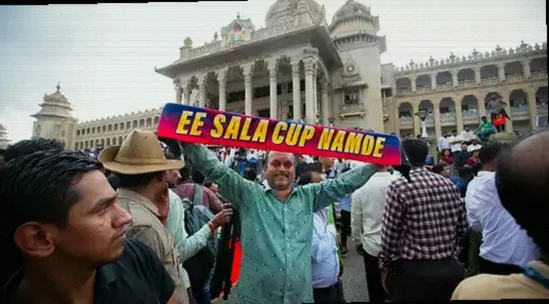
The Indian Premier League has said hosting a “marquee” showpiece like the final at the Chinnaswamy Stadium in Bengaluru has become difficult due to the evolving local arrangements involving the association and the state government. Speaking on Thursday, IPL chairman Arun Singh Dhumal explained that the league felt Ahmedabad was the most practical venue for an event that draws supporters travelling from across the world.
Why the IPL final was shifted from Bengaluru
Dhumal said the decision followed a review of Bengaluru’s preparations and ticketing commitments, especially after a new law introduced provisions related to complimentary passes for legislators. He noted that while the final was originally set to be played in Bengaluru, the IPL sought clarity from the state association about how the new legal requirements would be implemented.
“Since this is a high-pressure match and fans will be travelling globally for it, we thought it appropriate to stage it in Ahmedabad,” Dhumal said. He added that the league received a detailed note on the obligations the local body would have towards its members and how the new law, now in effect, could influence ticket availability.
After assessing those commitments, the IPL concluded that only a small number of tickets would realistically reach the wider public. Dhumal pointed out that similar patterns were observed during league fixtures as well, where the public’s access was limited because a significant portion of tickets went toward government-linked and other mandated allocations.
Ahmedabad chosen for the final and an ICC Board meeting
Dhumal, now in his fourth year as IPL chairman, stressed the move is a one-off adjustment and said the usual scheduling conventions would return from next season onward. He outlined the standard framework the IPL follows: the league-winning side hosts the final, while the runners-up stage the two qualifiers.
- The final was moved to Ahmedabad due to the “extraordinary” ticketing and accommodation situation for fans that would have faced challenges via Bengaluru’s arrangements.
- Dhumal said the league would resume its normal match allocation pattern from the next season.
- He added that a broader ICC Board meeting has been planned in Ahmedabad, with the BCCI also looking to host international delegates at the Narendra Modi Stadium.
- The Narendra Modi Stadium was highlighted for having extensive corporate and hospitality infrastructure to receive visitors arriving from around the world.
- An ICC Board meeting that was earlier scheduled in Qatar could not take place because of the ongoing war in West Asia, and that gathering is now expected to be held in Ahmedabad.
Dhumal also acknowledged the downside for Royal Challengers Bengaluru if they reach the final—namely losing the home advantage they earned by winning the previous season’s title. Still, he said IPL tried to protect that principle by ensuring the opening match was played in Bengaluru despite obstacles posed by the government following an incident from last year.
“Definitely,” Dhumal said, referring to the disadvantage of RCB missing a home final. “That is why we did our best to ensure that the opening game was held in Bangalore, despite all the challenges they faced from the government following the incident that happened last year.”
He added that the IPL aims to keep the usual norms, including holding both the opening game and the final in Bengaluru when possible. However, with the new law and the commitments the local body needed to honour, the IPL concluded it would be hard to provide adequate fan access. “We cannot have fans at the receiving end in a tournament of this scale,” he said.
BCCI to tighten PMOA compliance, and talks on home-and-away structure
Dhumal also confirmed that the BCCI will issue updated guidelines for IPL teams, owners, players, and officials. He said board secretary Devajit Saikia had already announced the same earlier, and that the board has received information about certain guidelines not being followed, particularly around PMOA areas and other prescribed norms.
“Accordingly, we have decided to issue guidelines for stricter adherence to all those rules and parameters so that the officiating standards of the IPL are not compromised,” Dhumal said.
Looking ahead, the IPL chairman reiterated that the BCCI is considering returning to the full home-and-away format for all 10 teams after the current broadcast cycle ends next year. He described the proposed schedule as featuring nine home games, nine away games, and a total of 94 matches across the season.
- The BCCI is open to reverting to a complete home-and-away structure for all 10 teams after next year’s broadcast cycle.
- The expected overall plan would include nine home fixtures and nine away fixtures per team, with 94 matches in total.
Dhumal said the league could not increase match counts earlier due to bilateral commitments in the previous FTP cycle. He also argued that expanding the schedule within the existing window would likely force more double-headers, which he said is not favourable for broadcasters or fans.
He explained that a larger window is needed first, after which the number of matches could rise from 74 to 94. Dhumal added that such a structure would allow the IPL to ensure an equal number of home and away games for each team against every opposition.
Impact Player rule under review if needed
Finally, Dhumal said the regulators are open to revisiting the Impact Player rule, which has drawn opposition from several team managements and players. He said debate is natural whenever a new concept is introduced, but also noted that the rule has worked effectively for the tournament.
At the same time, he said the IPL will consider a review if the league believes it is in the tournament’s interest—though any reassessment would be aimed at evaluating and improving competitiveness rather than changing for the sake of change.
