
In cricket, there is rarely a single “right” answer to how a team should bat in a given match situation, because the context decides the method. In IPL 2008, only six batters finished the season with 200-plus runs at a strike rate above 150. IPL 2026 is still ongoing, yet 25 batters have already reached those same thresholds.
Key takeaways
- IPL 2008 saw just six players end with 200+ runs and a strike rate over 150; IPL 2026 already has 25 such batters.
- Dhruv Jurel has produced 290 runs at a strike rate of 151.04 across 10 innings, including three fifties.
- Rajasthan Royals’ recent losses came despite totals of 228, 223 and 225, with Jurel contributing 51 off 35, 16 off 20 and 42 off 30 respectively.
- RR captain Riyan Parag explained their decision to promote Ravindra Jadeja above Donovan Ferreira after RR’s third wicket fell in the 12th over.
- The discussion centres on whether RR’s No. 3 template and their approach to overs before Ferreira’s entry are leaving runs behind in 2026.
Jurel’s numbers—and the No. 3 question in 2026
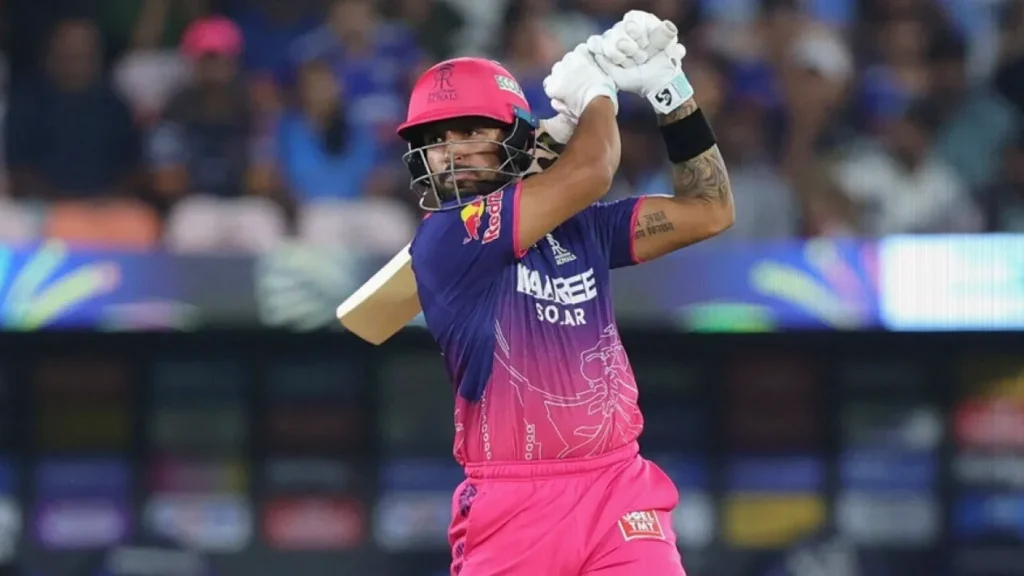
Dhruv Jurel is among those 25 batters. He has amassed 290 runs at 151.04, with three half-centuries from ten innings. In a season like IPL 2008, those figures would have stood out immediately; in 2026, they don’t carry the same impact.
Jurel bats at Rajasthan Royals’ No. 3, a position that requires constant adaptability. The modern ideal is close to a “third opener” role: someone who can keep the boundary flow going after the powerplay while also accelerating against both pace and spin. In other words, the No. 3 should provide both power and range so that scoring remains consistent across different phases.
RR clearly believe Jurel has those traits, and anyone who has watched him play would understand why. Still, the debate has surfaced through the team’s most recent matches, where the No. 3’s output has not translated into consistent wins.
Three losses despite 220-plus totals
Last week against Sunrisers Hyderabad (SRH), Jurel struck 51 off 35, yet Rajasthan made 228 and still lost. Then, three days later, in RR’s chase of 223 against Punjab Kings (PBKS), he managed 16 off 20 as Rajasthan slipped into a post-powerplay rut against spin.
On Friday versus Delhi Capitals (DC), Jurel scored 42 off 30 as Rajasthan posted 225 and again lost. Two consecutive defeats after making 220-plus totals is a red flag for any side, hinting that runs may have been missed in the middle overs. The DC match, in particular, featured two distinct stretches where RR’s intent looked questionable.
The Jadeja promotion—and the “entry point” plan
The first phase began with RR lifting Ravindra Jadeja above Donovan Ferreira after RR lost their third wicket in the 12th over of their innings. In terms of form, Ferreira would normally be among the batters you want facing balls in the later part of an IPL innings. Jadeja has had one of the most accomplished all-round careers in the league, but the fear factor for bowlers isn’t quite the same when compared with the explosive finishing that Ferreira brings.
Rajasthan’s logic, as outlined by captain Riyan Parag after the match, fits the franchise’s long-held approach. RR have often valued “entry points” and timing in their batting plans. Four years earlier, they promoted R Ashwin as a kind of pinch-anchor, then retired him out at a moment when they felt time was running short before sending Parag in, whom they later viewed as an end-overs power-hitter. Kumar Sangakkara coached RR during that period and is back in the role this year. Parag is now the captain.
Parag said the promotion was partly designed to create a left-right combination at the crease. But he insisted it was mainly about the timing of when Ferreira would be brought in: “There [were] eight-nine overs to go, and we wanted to delay it [Ferrerira’s entry point] a little bit and like just get a few [overs at] like eight-nine an over from the spinners, and then go from ball one when the seamers started to bowl.”
There is, of course, a strong argument for ensuring your best death-overs hitter is already in place when the final overs arrive. Ferreira’s impact backed that up in this game, with his unbeaten 14-ball 47. A small group of batters worldwide can hit the ball with the kind of clean power and timing that allowed Ferreira to clear the boundary off T Natarajan’s low full-tosses in the last over.
What stood out, however, was how RR approached the overs before Ferreira came in. Jadeja’s struggles against spin are well known, yet Parag’s comments suggested RR were not even asking him to force the issue during that period.
This is an older way of building a T20 innings for a team batting first. In the IPL especially—where chasing often provides an advantage at many grounds—choosing not to attack for one or two overs can quickly lead to a subpar total. RR have learned over their last two innings that 228 and 225 can both fall short in IPL 2026.
And if RR appeared to play with reduced ambition while Jadeja was at the crease, they were also doing something similar through the 102-run partnership between Parag and Jurel.
Parag and Jurel’s stand: controlled, but perhaps too cautious
The clearest example arrived in the ninth over. RR began it on 71 for 2, having lost Yashasvi Jaiswal and Vaibhav Sooryavanshi early. The rebuild looked complete by then, and the shift in tone seemed to come when Parag struck Axar Patel for two huge sixes right at the start of the ninth over.
Axar was under heavy pressure, and this over offered a chance to push him into further mistakes and squeeze more from the fielding restrictions. Instead, Parag and Jurel tried to rotate the strike only in the final four balls, finishing the over with two singles and two dots.
The next over, bowled by Kuldeep Yadav, yielded just six runs. Once again, the intent from both ends was to work or punch the ball into the deep and pick up ones or twos rather than press for boundaries. It was also notable that it was a new bowler taking the ball and settling without being forced into danger.
Even though Parag occasionally stepped out to try to accelerate the scoring, Jurel appeared comfortable acting as the second option. That style—where one batter is not consistently pushing the pace—is becoming rarer in the modern IPL. If you aren’t attacking from both ends, except in specific situations where a batsman is trying to engineer a favourable matchup, you are often leaving runs behind in the middle.
Jurel’s early-over strike rate and the wider role expectations
It is difficult to know whether this is purely a matter of instruction from the dugout or simply Jurel’s own batting instincts, but he has carried this pattern through much of IPL 2026. Among batters who have faced 100-plus balls in the first ten overs, Jurel’s strike rate ranks third lowest in the tournament—behind Rishabh Pant and Ruturaj Gaikwad, both of whom have been widely discussed as struggling. His balls-per-boundary rate is also among the worst, with Ajinkya Rahane sitting just above him on that measure, despite Rahane’s outside-powerplay issues being well documented.
This is not meant as a criticism of Jurel’s raw talent or ceiling. The point is that he is not batting in the manner expected of an IPL No. 3 in 2026, at least not yet. Still, the next step is absolutely within reach. The league regularly produces examples of top-order batters who initially didn’t meet the role’s demands, only to add new gears later. Shreyas Iyer and Devdutt Padikkal are two such cases.
Even KL Rahul, who for years held back in the middle overs to build toward a big finishing phase, has shifted this season. He has struck at 211.01 in overs 7 to 16, suggesting that he too no longer believes the old approach is the best way to win in T20 cricket.
However, on Friday night, Rajasthan still showed signs of clinging—at least at key moments—to an outdated template. That places them in an interesting position: RR have developed some of the most exciting homegrown talent in the competition. Jaiswal, Sooryavanshi, Parag and Jurel are all RR projects if not always finished products of the franchise’s system, and Sanju Samson spent his formative years with the team.
Yet their in-match decision-making can sometimes look behind the times.
