
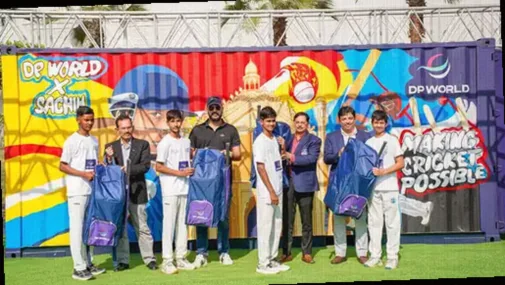
DP World has steadily built a cricket identity that goes beyond logo placement, using its ICC association and a wider “Beyond Boundaries” programme to make tangible contributions to the sport. The Dubai-based logistics firm frames its cricket work as a partnership rather than a traditional commercial arrangement, arguing that sustained involvement can create stronger links with audiences and participants.
Beyond Boundaries: kits, containers and grassroots access
As part of its Beyond Boundaries initiative, DP World pledges to provide 10 cricket kits for every 100 runs scored during global competitions. Daniel van Otterdijk, the company’s chief communications officer, emphasised the intent behind the effort—stating that the firm avoids the word “sponsorship” and prefers to describe the relationship as a “partnership.”
Launched in 2023, the programme has already delivered more than 3,300 cricket kits and 14 repurposed shipping containers. These have been rolled out across eight countries and four continents, including India, South Africa, Namibia and the United Kingdom, with the goal of helping create playing opportunities for thousands of young cricketers.
What the kit includes
- Helmet
- Bag
- Gloves
- Abdomen guard
- Bat
- Ball
Van Otterdijk described the kit as fully functional rather than symbolic: “Essentially everything a youngster needs to elevate his or her game to the next level. It’s a fully functional cricket kit.”
DP World’s delivery footprint in India
In India specifically, the initiative has delivered six containers and 1,550 kits across Lucknow, Delhi, Mumbai, Ahmedabad and Chennai. The company’s wider aim is to support grassroots cricket by ensuring that emerging players have the basic equipment required to practise and progress.
ICC involvement and logistics behind major tournaments
DP World’s cricket footprint is not limited to equipment programmes. Van Otterdijk highlighted the company’s growing relationship with the ICC, noting that it began with smaller commitments—such as one or two championships or a World Cup—and expanded over time into multiple formats including T20 cricket, 50-over cricket, the World Test Championship and women’s cricket.
He also underscored grassroots cricket as a key focus, describing DP World’s ICC role as both “major and integral.”
Twenty20 World Cup operations in India and Sri Lanka
During the recent Twenty20 World Cup held in India and Sri Lanka, DP World moved roughly 55 metric tonnes of cargo between venues. The shipments included broadcasting and support equipment, along with the wider set of supplies needed so matches could be staged and viewed smoothly.
Van Otterdijk pointed out how much work goes unseen during global tournaments, referencing the complex behind-the-scenes infrastructure—screens, camera systems, cables and the continuous set-up required at stadiums across locations such as Ahmedabad, Mumbai, Delhi, Colombo and others.
He also noted the tournament structure: a 55-game World Cup played across eight venues in two countries, with the trophy ultimately lifted by India in Ahmedabad.
Cricket partnerships beyond the ICC
While DP World’s ICC connection is central to its cricket brand, the firm also maintains additional ties across the sport. Alongside its ICC partnership, it has an arrangement with the Asian Cricket Council (ACC) as the title sponsor of the Asia Cup. The company is also linked with the ILT20 and SA20 leagues. On the franchise front, DP World’s regional partnerships include both the men’s and women’s teams of Delhi Capitals.
Why it chose one franchise instead of backing the IPL directly
Asked why DP World selected one franchise rather than attaching itself directly to the Indian Premier League (IPL) as a whole, van Otterdijk offered a customer-connection rationale. He said the company continually asks how best to connect with customers, stakeholders and the people it wants to engage, and he argued that franchise-level involvement can deliver a stronger emotional bond—because fans experience winning and losing alongside players.
He acknowledged that the Tata Group’s role as the title sponsors of the IPL is not something to criticise, but added that the firm’s research indicated it could strengthen relationships with customers more effectively through the involvement that comes with a team.
He further explained that, during the two-month IPL window, DP World wants to be fully immersed in the cricket ecosystem through its franchise investment.
UAE roots, India’s importance and the “UAE-India Bridge”
DP World’s deep cricket involvement is particularly notable given that cricket is not the most popular sport in the UAE. Van Otterdijk addressed the question by pointing to cricket’s global standing and—more directly—India’s role as the game’s nerve centre.
He said cricket is the second most popular sport in the world, then challenged the premise about the UAE by shifting focus to the company’s customer base. He noted that in the UAE, nearly half the diaspora comes from India, and many businesses there have Indian links through ownership, origins or strong roots.
- In the UAE, nearly half the diaspora comes from India.
- Many companies operating in the UAE have Indian origins, Indian ownership or strong Indian roots.
- DP World connects business leaders with counterparts at major Indian organisations.
Van Otterdijk also referenced the “UAE-India Bridge,” described as a direct cargo link between the two countries. He reiterated that India is by far the company’s most important market and said DP World is therefore heavily invested not only in India as a country, but in India as a global economic entity.
Beyond the commercial dimension, he argued that DP World’s cricket involvement helps create relevance in civil society in India. He said the company has become one of the prominent brands associated with cricket, and that this status means it becomes part of the fabric of society in India.
