
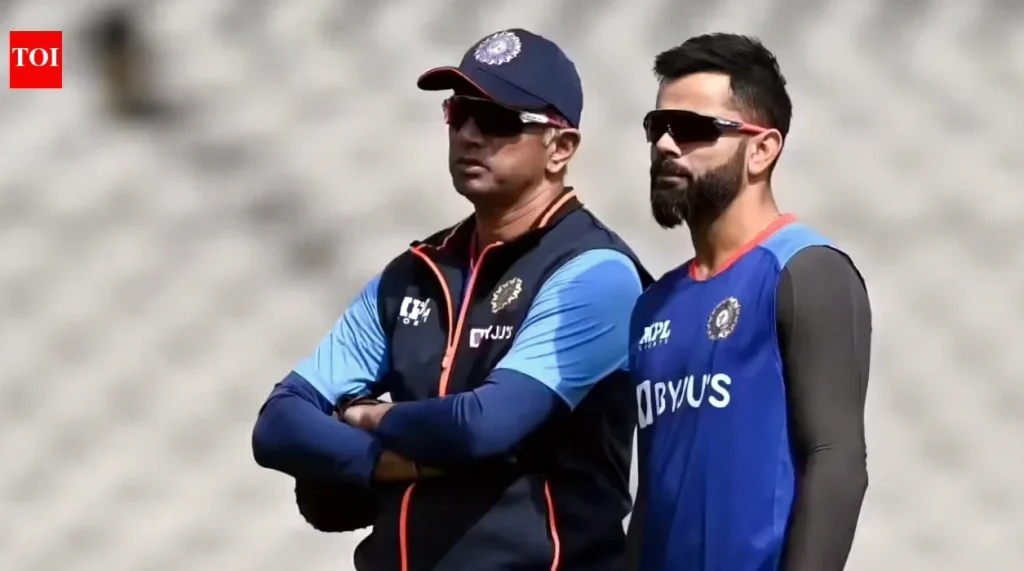
Former India head coach Rahul Dravid has pushed back against the notion that Indian cricket should move away from star-driven narratives, saying every sport needs heroes and that individual excellence often translates into collective success. The comments came in response to Gautam Gambhir’s recurring view that the spotlight should shift away from standout individuals and toward team outcomes.
Dravid’s view on “superstar culture”
Dravid argued that players earn legendary status only through sustained performance and match-winning contributions. He noted that in a cricket-mad country like India, athletes face intense attention—both praise and criticism—and that enduring greatness is usually the result of consistently delivering on the field.
Speaking on the Scoop podcast, Dravid said, “Any sport needs its heroes, and I don’t think people become heroes without performances. You can’t capture the imagination of a nation if you don’t deliver on the field, especially in India, where you get a lot of praise for what you do, but also a lot of brickbats. There’s a lot of scrutiny and constant focus on you. So to become a legend or a superstar in India means you’ve done a lot of things right, and in the process, you’ve also helped your team win.”
Reflecting on his playing era alongside Sachin Tendulkar, Sourav Ganguly, VVS Laxman and Virender Sehwag, Dravid said Indian cricket reached new heights during that time, with multiple star performers operating within the same side.
India’s Test struggles and the road to recovery
Dravid then addressed India’s more recent challenges in Test cricket during Gambhir’s tenure. He said it would not be straightforward to fill the gaps left by players who have recently retired, including Rohit Sharma, Virat Kohli and Ravichandran Ashwin.
While acknowledging the difficulty of replacement at that level, Dravid expressed confidence that India’s Test mindset can return and that the team will remain competitive across formats. He added that a turnaround may take time, but recovery is achievable.
“The passion to do well in red-ball cricket is definitely there. We’ve had a couple of series where we haven’t performed as well as an Indian team, and that can happen. We are also missing a few key players, with some of the big names having recently retired – Rohit, Virat and Ashwin – and it is not easy to replace players like that. But Indian cricket remains very strong. I still believe the Indian team will be competitive in every format it plays. It may take a little time, but hopefully this season we will be able to turn things around,” Dravid said.
How the busy calendar affects red-ball preparation
Dravid also pointed to the modern scheduling demands as a major factor behind how hard it is for players to balance formats. He said red-ball cricket is still highly valued by those who want to succeed there, but the sheer volume of white-ball matches makes it tougher to prepare properly for Tests.
He explained that while players understand the importance of the longest format and feel personal satisfaction when they succeed in it, they often have less time to build the specific preparation that was available during his generation.
“Red-ball cricket is still very important. There are still players who want to play red-ball cricket. Among players, there is a strong sense that it is probably the toughest format of the game and something that brings a lot of personal satisfaction when you succeed in it. But there is also a lot of white-ball cricket being played, and we have to be realistic about that. Many of these players today are having to juggle multiple formats, and it is not always easy because they may not get as much time to prepare for red-ball cricket as my generation did. We effectively had fewer formats, and when I think about the preparation that went into some of the Test series I played, I feel the current players, not because they don’t want to, but because of the volume of cricket, are sometimes unable to find that same balance.”
