
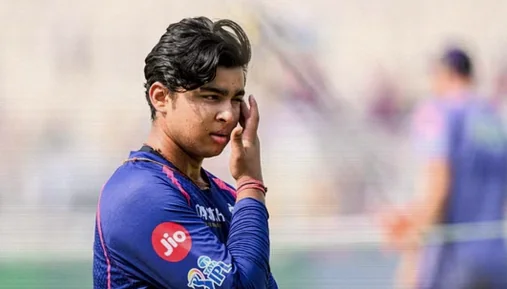
How do you stop Vaibhav Sooryavanshi? That question is being asked in changing rooms and on practice wickets by nearly every bowler who has had to face him. From youth cricket to the international stage, the 15-year-old has not spared anyone, and even if there were doubts about his form after a fiery Indian Premier League campaign last year, he has only built on it—strengthening his case as the next major name in Indian cricket. The excitement around him has grown so quickly that some supporters are growing impatient with the idea of keeping him away from the Indian set-up for too long, and that frustration is spilling into debates around the BCCI. In this IPL so far, Sooryavanshi’s numbers have been eye-catching: 52, 31, 39, 78 and 46, taking him into the top five of the Orange Cap standings with 246 runs across six matches.
His brand of batting has become almost impossible to plan for. “Bowl it full and he’ll smash it,” is one refrain, while another is just as blunt: “Bowl it short and he’ll plunder you.” Bring spin into the equation and he still finds boundaries, with the same confidence refusing to shrink even when the pitch offers little room. Even length becomes a weapon—when the ball is served in his preferred zones, the result is usually a sudden storm of sixes. That’s the challenge Sooryavanshi presents: the common assumption that opponents will soon find a repeating blueprint to contain him simply hasn’t held. Instead, the teenager has added a fresh dimension to his game, looking complete even in situations where top-order batters often struggle. Apart from a first-ball dismissal—when he was out on his very first delivery against Praful Hinge of Sunrisers Hyderabad—he has again looked unstoppable.
Still, every batter has a flaw, and former England quick Steven Finn believes there is a way to trouble Sooryavanshi—though not through standard tactics. Finn, who represented England in 36 Tests, 69 ODIs and 21 T20Is, suggested that dismissing the youngster may require something less orthodox. In his view, the route to an early wicket isn’t necessarily about a familiar line-and-length battle, but about forcing him into unfamiliar choices and timing windows. If executed properly, the idea is that such an approach could lead to a quick breakthrough.
Finn’s thoughts were delivered on the “For the Love of Cricket” podcast in conversation with Stuart Broad. He said: “Well, probably… pull a car for a hamstring or something. But it looks incredibly hard, doesn’t it? Even just watching the videos of him training in the nets against Jofra Archer, who is trying everything. Full and wide, short, full and straight… and all of them were going to the boundary. But when someone likes to play as free-flowing as he does, you’d think a few in and around the tight line and the back of the length, or over the top of the stumps, try to protect the leg-side to begin with. And then if you could throw in like a full slow wide one and make him reaching for it out there on the back of three or four tight deliveries, you could catch him off guard, but at the moment it seems to be pot luck as to whether you get him or not.”
The difficulty Finn references was visible in Sooryavanshi’s near-historic moment against Royal Challengers Bengaluru on April 10. He was on the verge of what would have been the fastest ever IPL century, already building his innings with 78 runs off 25 balls when the record came within reach. With five deliveries remaining to break the mark set by “The Universe Boss” Chris Gayle, it looked like history was ready to happen—until Sooryavanshi perished with his batting still rising, holing out in the deep as the opportunity slipped away.
