
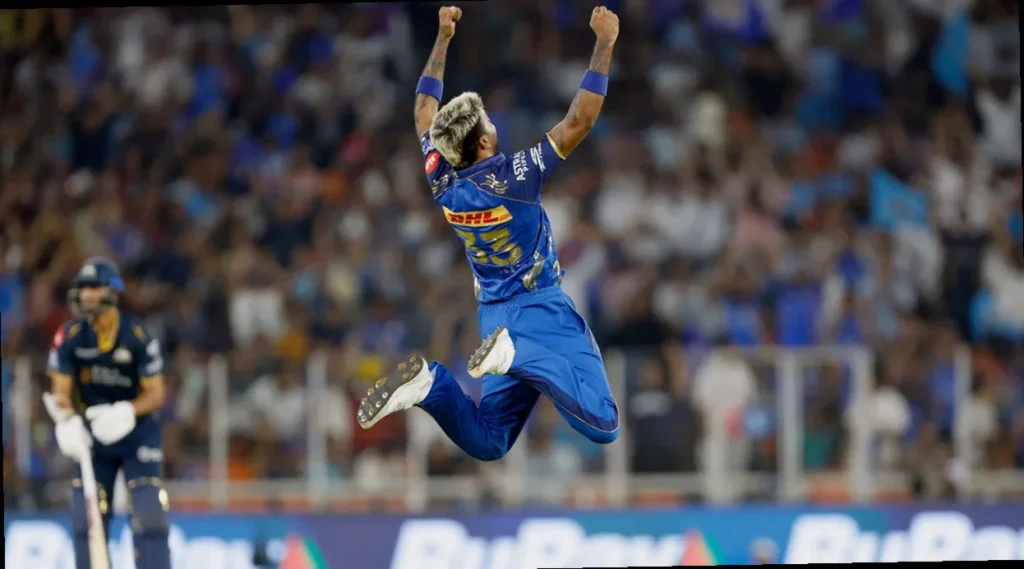
Hardik Pandya has often looked like the kind of IPL all-rounder who can tilt a match in minutes—wrestling control in the bowling death overs and then striking with audacity when the game demands momentum. Yet since his return to Mumbai Indians in 2024, that familiar aura has not consistently shown up in the tournament, leaving both fans and the franchise wondering whether something is missing in his league form.
In the current IPL season, Hardik has mustered 97 runs across six innings, striking at 140.57, while with the ball he has taken only three wickets in 15 overs. Those numbers stand in contrast to his international output for India this year, where he has scored 286 runs in 12 innings at a strike rate of 165.31 and grabbed 13 wickets in 13 innings.
There have still been moments when Hardik looked entirely at home in high-pressure cricket. When England required 39 runs from 12 balls in the 2026 T20 World Cup semi-final, he delivered a strong penultimate over, conceding nine and removing Sam Curran. In the 2024 T20 World Cup final, he also steadied the situation in the final stages, managing the 20th over when South Africa needed 16.
Since the start of 2026, Hardik has bowled 10 overs at the death for India across eight innings, taking five wickets while keeping his economy to 9.7. But in the ongoing IPL, the pattern is starkly different: across six innings he has bowled just two overs in that late phase, taking one wicket and leaking 13 runs per over.
His reluctance—or at least his reduced usage—at the death was clear during Mumbai’s match against Chennai Super Kings at the Wankhede Stadium. After conceding 38 runs in the opening two overs of his spell, Hardik did not return for the final over. Mumbai instead entrusted the last over to Krish Bhagat, who was making his way through a difficult situation against a well-set Sanju Samson. It is possible Hardik had been affected by the earlier damage Samson inflicted, but Bhagat was struck hard as well: he surrendered 15 runs in the 16th over, and then Samson added 16 more in the last over, lifting CSK’s final total to 207—an amount that proved decisive. Head coach Mahela Jayawardene later framed the decision as a chance for the young player “to step up.”
Looking beyond this season, the bigger story suggests Hardik’s IPL challenge may not be a simple, short-lived slump. During his captaincy years with Gujarat Titans in 2022 and 2023, he compiled 833 runs at an average close to 38 in 30 innings, and also contributed 11 wickets in 21 innings, guiding the side to a title and a runner-up finish. Since rejoining Mumbai, he has scored 537 runs from 31 innings, averaging 20.65. The striking difference is that his strike rate has improved from 133.50 to 150.40, which aligns with him taking on a finisher’s role for MI rather than batting higher up the order for GT. With the ball, he has also been more wicket-active—he takes a wicket every 18.4 balls compared to 30.2—but his economy rate of 10.7 during this period sits among the worst in the league.
The contrast between a faster batting tempo and improved wicket frequency has also shown up for Hardik when he plays for India, indicating that the central components of his all-round game are still there. Since 2024, he has appeared in 46 matches for India, scoring 940 runs at a strike rate above 155 and taking 41 wickets with an economy rate of 8.65. Even after his return in December 2025 in the Syed Mushtaq Ali Trophy, he produced an impact performance, smashing an unbeaten 77 off 42 balls to help Baroda chase 223 against Punjab. He followed that with two Player-of-the-Match displays for India in T20Is against South Africa.
That raises the obvious question: why does the equation look different for Hardik in Mumbai, even though he is also surrounded by several India team-mates? Is it the pressure that comes with expectations in a star-studded dressing room, or the added responsibilities that captaincy can bring? There is also the wider context—Mumbai have been searching for a stable XI halfway through the season, and that kind of uncertainty can affect rhythm, roles, and how matchups are managed across overs.
Still, Hardik has not been without flashes of what he can deliver. He started the season with promise, contributing at the death with both bat and ball during a successful chase of 221 against Kolkata Knight Riders. Against Royal Challengers Bengaluru, he opened his account with a six off his first ball and finished with 40 off 22. However, for all those bursts, he has completed his full quota of four overs only once this season.
Jayawardene has, on two separate occasions, pushed back on the idea that Hardik’s form alone is the main problem behind Mumbai’s struggles. MI sit ninth in the table with two wins after seven games, and the coach has pointed toward broader issues rather than singling out one player. “I don’t think his form is a concern. He started well in the first few games, he bowled really well. I think overall as a unit we haven’t been consistent. Overall bowling we haven’t been very good, we haven’t managed to pick early wickets, we haven’t managed to control things in away conditions as well. It’s an overall thing. It’s not one individual, as a team we have to improve.”
Hardik’s recent IPL returns remain difficult to decode, and for Mumbai Indians in IPL 2026, the franchise’s progress may well depend on whether he can rediscover the version of himself that so often shows up in India colours—especially in the overs where matches are decided.
