
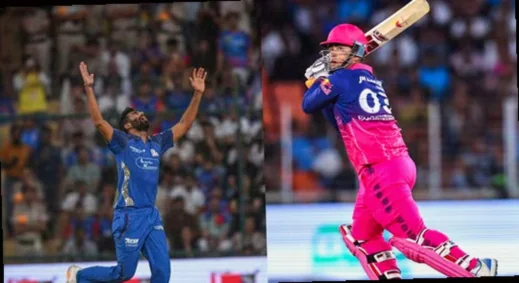
Rajasthan Royals’ unbeaten run has reached a point where the margin for error suddenly feels razor-thin, and the match-up driving all the attention is impossible to ignore: a fearless 15-year-old batter taking on Jasprit Bumrah, widely regarded as the most accurate fast bowler of his era. Vaibhav Sooryavanshi has arrived in IPL 2026 with no visible hesitation, and after two games he has already made his intentions plain—go after deliveries early, use the air to attack, and trust instinct rather than defaulting to caution. Against Mumbai Indians, though, that approach will be tested in a way very few batters can truly prepare for, because Bumrah’s execution rarely follows a script.
Former India captain Anil Kumble believes Sooryavanshi’s mindset is unlikely to be reshaped by the size of the challenge. Speaking on a pre-match programme on JioHotstar ahead of the RR vs MI fixture, Kumble said the teenager’s fearlessness is a defining trait and “I don’t think that’s going to change.” He added that the youngster looks to lift and hit the ball rather than simply rotate the strike, even when the bowling is of the highest standard. In Kumble’s assessment, the core idea remains the same irrespective of who is at the other end.
That confidence has already turned Sooryavanshi into one of the early talking points of the season. Rajasthan’s first two results have been powered by aggressive starts, and the way the teenager has gone about his work at the top has given the team a clear tone from the outset. Yet the very quality that makes him exciting also carries a specific danger—especially when the opposition includes a bowler who benefits from batting patterns, because predictability in aggression is exactly what Bumrah can punish.
Faf du Plessis, speaking alongside Kumble on the same panel, explained why Bumrah remains a tough proposition even for experienced campaigners. Du Plessis pointed out that Bumrah brings multiple attacking options into every spell: the new ball moves both ways, he has a sharp slower ball, and he uses the bouncer effectively as a weapon rather than a fallback. Du Plessis also stressed that planning for him is difficult because even in net sessions his variations don’t settle into anything that feels comfortably rehearsed.
That element of unpredictability is what makes this contest so intriguing. Sooryavanshi’s blueprint is built around taking control early, but Bumrah doesn’t tend to allow batters to settle into a steady scoring rhythm. Instead, his ability to manage pace, length and angle forces hitters into hesitation and rushed decisions, turning execution into the real challenge rather than simply reacting to the ball.
Even so, du Plessis highlighted a key balance that modern batters must maintain when the bowling gets ruthless. He noted that you never want to get trapped in a mindset of only surviving, but you also can’t abandon intent. The message is clear: against someone like Bumrah, the correct response isn’t to retreat into passivity—it’s to keep attacking with purpose, while still reading the situation precisely.
With that in mind, this match is likely to hinge on a narrow margin. Sooryavanshi is not expected to soften his approach, and Bumrah, equally, doesn’t give openings for unchecked aggression. The outcome could swing quickly if the youngster misjudges a slower-ball cue or a hard-length delivery, because one small read can change the trajectory of the contest almost immediately.
For Rajasthan Royals, the significance extends beyond a single duel. Positioned near the top of the standings, the game is an opportunity to confirm that their unbeaten start is built on more than early momentum. For Mumbai Indians, Bumrah is the most effective instrument to disrupt that flow at the beginning—making the confrontation with Sooryavanshi feel like the first major test of the season’s narrative. Sooryavanshi has already announced himself; now Bumrah arrives as the first true examination.
