
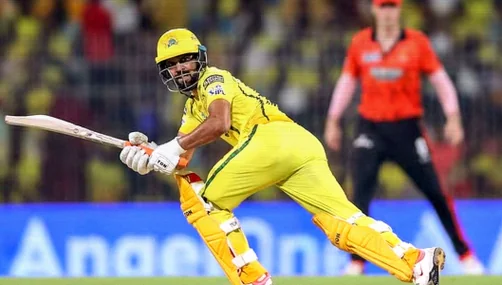
Ruturaj Gaikwad’s 15 runs from 21 balls versus Sunrisers Hyderabad proved costly for Chennai Super Kings, not just in the final tally but in how the innings functioned around him. In a T20, an opener who faces 21 deliveries and fails to hit a single boundary leaves behind little more than time spent, and CSK never managed to convert that time into momentum. The wicket may have offered resistance, yet the broader issue was a lack of attacking intent—something CSK required from a senior top-order figure.
Key takeaways
- Gaikwad scored 15 off 21 balls against SRH, with his entire output coming as singles and no boundaries.
- CSK’s batting tempo never forced SRH to change lengths, field placements, or protect any clear scoring option.
- Gaikwad’s slow start meant CSK’s middle order did not inherit a platform, only a rate problem.
- The same concern surfaced earlier in IPL 2026 when he made 74* off 60 versus Gujarat Titans, with the innings accelerating only late.
- CSK’s top-order options are evolving, with Urvil Patel and Ayush Mhatre bringing a more urgent, attacking look.
Why the SRH innings was more than a low score
The most damaging part of Gaikwad’s knock was the ripple effect it created for everyone batting after him. When a top-order batter gets out quickly, the team can still regroup with enough overs remaining. Here, the issue was different: time was consumed without creating an advantage. Gaikwad stayed at the crease long enough to shape CSK’s tempo, but he never reached the point where SRH had to reassess their approach or start defending specific ways of scoring.
His 15 runs were built entirely through one-run hits. There were no hard two-ball rotations that open up scoring opportunities, no cleanly struck aerial shots that unsettle the fielders, and no sequence where he took clear ownership of the run-rate. By the time he was dismissed, CSK had already lost deliveries that should have reflected intent rather than cautious survival.
Even acknowledging that the pitch can make batting difficult, CSK still needed the opener to play with purpose. A strong example of how intent can remain present on challenging surfaces was Ishan Kishan. He also struggled to get going, but he did not abandon attacking decision-making—something Gaikwad’s innings lacked.
Momentum trapped inside CSK’s own innings
CSK paid for the nature of the innings, not merely the number produced by their senior batter. The middle order never received a platform to build from; instead, it inherited a problem with scoring pace. In T20 cricket, rotation alone does not trouble the bowling side. If singles are coming but the batter is not threatening boundaries or changing the field, bowlers can continue executing their plans comfortably.
That is why SRH’s spell stayed “within plan.” Gaikwad’s batting did not force them out of their comfort zone, so the innings drifted into a state that looked steady while offering little progress. The risk of losing wickets always exists, but the deeper concern was that CSK were not moving forward through the overs—they were just consuming them.
Same pattern, broader worry: IPL 2026 tempo
This SRH showing fits into a wider question raised by Gaikwad’s IPL 2026 output. Earlier, against the Gujarat Titans, he had made 74 not out off 60 balls, and the same underlying issue appeared in a less obvious way. Even though that innings finished with a healthy total, it still unfolded too slowly for too long, with the late surge doing the heavy lifting for the scorecard. After 15 overs, his numbers were 48 off 48, before a final push improved the look of the innings.
Put side by side, the two innings looked different on the surface—one ended with a major score, the other did not—but they pointed to the same concern. Gaikwad’s best cricket typically brings structure first and then adds acceleration. In IPL 2026, structure has arrived frequently without enough of the subsequent burst. Too often, the innings appears to wait for him rather than being driven through him.
The rise of Mhatre and Urvil changes the debate
The conversation becomes even sharper because CSK now have fresh top-order options pressing the issue. Urvil Patel and Ayush Mhatre have shown enough promise to make the previous hierarchy feel less automatic. Their style adds movement early and comes with visible intent, offering something CSK need at the top—urgency rather than extended caution.
Neither player erases Gaikwad’s past achievements, but their emergence reduces the usual protection that reputation provides. CSK can no longer judge their top order purely through historical record. They must evaluate current pace, clarity of role, and how the balance of the batting group fits the next phase.
Ayush Mhatre’s presence is particularly significant because it gives CSK a younger, faster profile at the top. Urvil adds yet another attacking option. Together, they raise the question of whether Gaikwad’s “automatic” place in the XI still aligns with the direction CSK want to take in 2026.
Importantly, this scrutiny is not rooted in the idea that Gaikwad has become a poor batter. He has not. The real issue is whether his current version fits the needs of the team. A side that is rebuilding around younger batters cannot afford to have a senior opener absorb 21 balls for 15 while failing to display boundary intent—especially in matches where the innings required someone to take command.
Gaikwad’s class still deserves respect. Across IPL seasons, he has delivered when it matters, including a record that has seen him win the Orange Cap. He has previously guided CSK innings through control, timing, and high-quality selection of shots. What this season resembles, at least so far, is a disappointing run rather than a permanent decline.
That is why the conclusion should not be a harsh verdict on his entire career. Instead, it should be a firm demand tied to his responsibility in the batting order. Gaikwad can still act as an anchor who sets direction in CSK’s next batting rebuild. He can still support and guide players like Urvil and Mhatre, helping convert youthful aggression into a structured innings plan.
However, adaptation is required. He cannot play the role of an anchor who waits too long. Rotation cannot become a stand-in for intent, and CSK cannot keep absorbing the cost of caution at the top.
The SRH innings should sting because it was not a random off day. It was the kind of failure that forces teams to re-check roles. Gaikwad’s previous record offers him another route back, but his 2026 tempo cannot be the path forward for CSK.
