
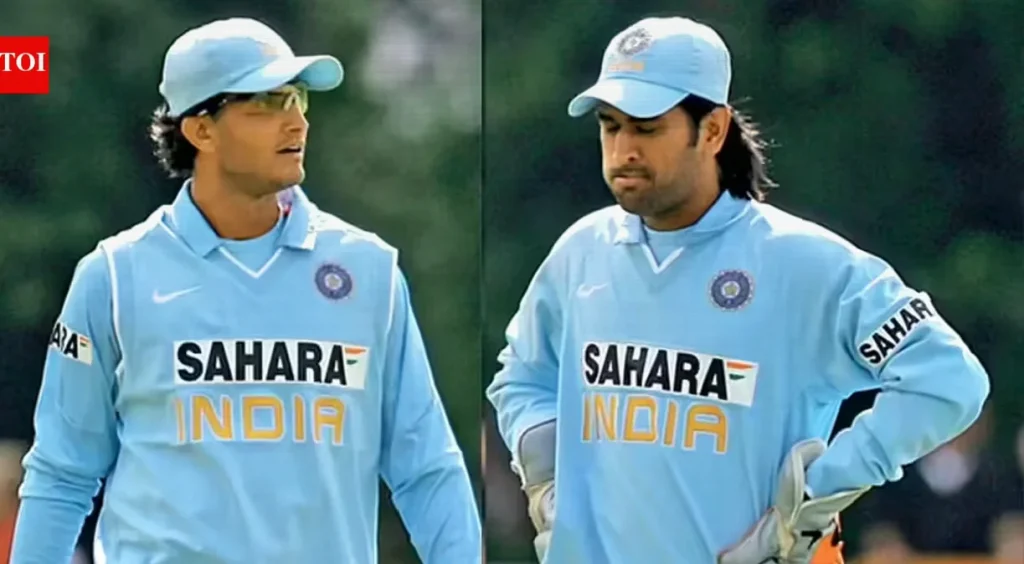
Long before MS Dhoni became synonymous with trophy-winning captaincy, Sourav Ganguly says the former India skipper had already started tracking the wicketkeeper-batter’s rise—pushing him rapidly through the pathway after seeing enough to act. Ganguly’s account, shared on Raj Shamani’s podcast, details how Dhoni’s inclusion was handled with intent, observation, and urgency.
Key takeaways
- Sourav Ganguly revealed he personally went to Jamshedpur to watch Dhoni before taking a final decision on his selection.
- He said he held back the call for a few days so he could assess Dhoni himself.
- Ganguly credited Saba Karim with first flagging Dhoni’s big-hitting ability, noting the frequency of sixes.
- Dhoni’s India A opportunity came after that assessment, leading to an immediate impact at Wankhede Stadium.
- Ganguly described the philosophy as fast-tracking standout talent rather than “cooking” it slowly in the system.
- He pointed to Dhoni’s early international breakthrough: a No. 3 promotion versus Pakistan in Visakhapatnam, where Dhoni made 148 off 123 balls.
Ganguly’s personal assessment before the selection call
Ganguly stressed that Dhoni’s rise was anything but accidental. The ex-captain said he did not want to rely solely on reports or recommendations; instead, he wanted to watch the wicketkeeper-batter’s game live and judge him directly. He described how he delayed the decision on Dhoni’s inclusion until he could evaluate him personally, adding that he “stalled that decision for a few days” to make sure he had the right picture.
In recalling his previous visits, Ganguly said he had gone to Jamshedpur to observe Dhoni when he was playing domestic cricket. He also pointed out that Dhoni was not even aware of the level of attention being paid to him, underlining how closely management monitored emerging talent at the time.
How Dhoni’s power-hitting caught attention
Alongside his own observations, Ganguly said the early signal for Dhoni’s impact came from former selector Saba Karim. He explained that Karim told him Dhoni “hits a lot of sixes,” which helped shape the initial perception of the player’s ceiling. Based on that assessment, Dhoni was picked for India A “straight from there,” and Ganguly said Dhoni then delivered strongly at Wankhede Stadium in his first match within the setup.
Ganguly’s recollection was that Dhoni made a hundred and was striking sixes at a pace that stood out even in that environment—an innings that, in Ganguly’s view, removed remaining doubts about the player’s readiness.
Fast-tracking talent and the early international turning points
Ganguly said the underlying management belief was simple: exceptional players should not be stalled for long stretches. He argued that talent needs the right level of challenge quickly, stating that they “had to take him” because waiting too long could be harmful. His explanation framed the risk of holding a player back as a form of stagnation—if someone is kept “cooking… slowly from behind,” they might not develop the way they should.
Dhoni’s ODI debut, Ganguly noted, arrived against Bangladesh in Chattogram in December 2004, where the outing ended in disappointment when Dhoni was run out for a duck. Even so, Ganguly said his conviction did not shift. He later promoted Dhoni to batting at No. 3 against Pakistan in Visakhapatnam, and Dhoni responded with a defining knock of 148 off 123 balls, effectively announcing himself on the international stage.
To sum up the approach, Ganguly offered what he called a straightforward principle: when a player competes against opponents above their level, their game rises; when they are placed against weaker competition, their development can flatten.
Ganguly said this mindset helped shape the pathways of several players, naming Yuvraj Singh, Harbhajan Singh, and Virender Sehwag—while, in his view, Dhoni was the clearest example of the strategy working at the highest level.
