
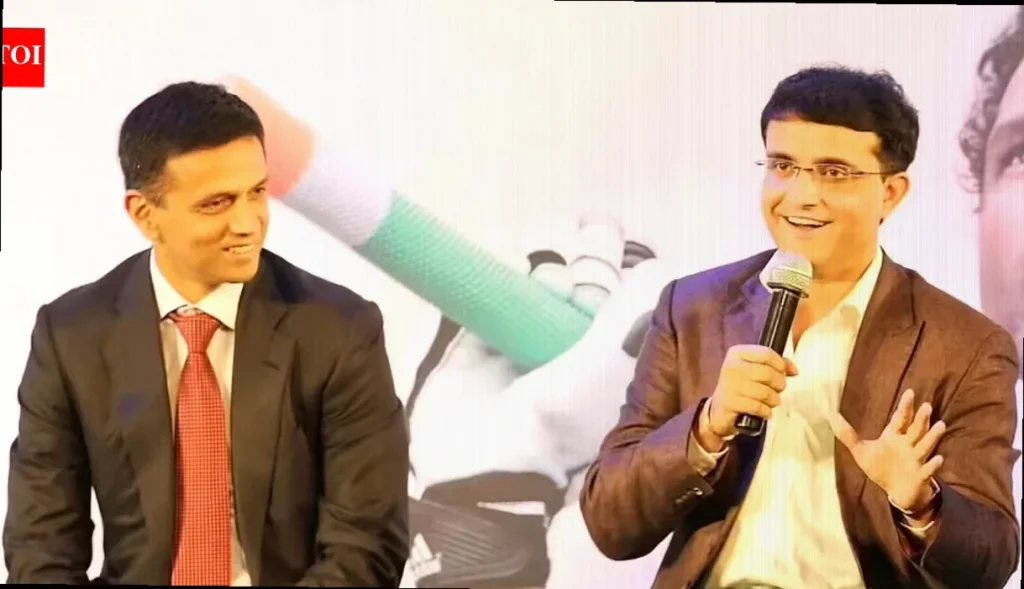
NEW DELHI: Former India captain Sourav Ganguly has lifted the lid on the internal pressure he faced from selectors during his captaincy spell, describing how he fought to keep Rahul Dravid firmly in India’s ODI plans despite doubts about the batter’s strike rate. Ganguly said the conversations around Dravid’s role were frequent and often uncomfortable, with some decision-makers arguing the team needed a more forceful batting option for the limited-overs format.
Speaking on Raj Shamani’s podcast, Ganguly recalled that Dravid’s place in the side was repeatedly challenged on the grounds of pace and scoring tempo. In Ganguly’s telling, selectors would come to him and stress that Dravid’s strike rate “isn’t good,” and that India should look for someone who could hit more aggressively in ODIs—capturing the sentiment with the phrase “marna padta hai,” meaning you have to be able to attack.
Ganguly, however, said he refused to be swayed. He insisted that letting Dravid go would have been a mistake that could have ended the batter’s white-ball career for good. “But I didn’t drop him. Because ‘chhod diya toh khatam ho jayega’,” Ganguly added, explaining that Dravid still had too much value to be discarded simply due to strike rate debates.
Instead of sidelining Dravid, Ganguly described a more hands-on approach—working with him directly to fine-tune his ODI game to match the format’s demands. “So I used to go to him separately and tell him, ‘Jam, thoda khelna hai’ (you have to play a bit),” he said. Ganguly suggested that Dravid’s intelligence and adaptability allowed him to adjust smoothly, continuing to contribute at the number 5 spot for India while also keeping wickets.
According to Ganguly, Dravid’s transformation into a wicketkeeper-batter was not just a personal evolution, but part of a wider attempt to restore balance to the ODI team—particularly during periods when India lacked a true all-rounder. “We needed a wicketkeeper who could bat, and that allowed us to play Mohammad Kaif as an extra batter,” Ganguly said, linking the tactical shift to the team’s selection logic.
He also pointed to how India compensated for the absence of a regular all-round option by distributing bowling responsibilities across the batting group. “We didn’t really have a proper all-rounder either. So Sehwag bowled, Sachin bowled, I bowled, and Yuvi bowled,” Ganguly revealed, describing a system where multiple players contributed with the ball rather than relying on a single specialist.
For Ganguly, the key was flexibility. He argued that successful teams are not built on rigid roles, but on creating workable solutions to match the conditions and the demands of the format. “Toh team ko banana tha na (we had to build a team),” he said, underlining that the captaincy challenge was about engineering a functional unit rather than sticking to one-size-fits-all templates.
Looking back on that period, Ganguly said the strategy was shaped by necessity as much as planning. “Good teams had all-rounders and keeper-batters, which we didn’t have at that time. Toh woh zaroori tha team banane ke liye (that was necessary to build the team),” he explained. In his view, the approach not only extended Dravid’s ODI career, but also made India more adaptable in white-ball cricket—an evolution that helped set the stage for a more dynamic side in the years that followed.
Ganguly’s account highlights how much internal debate and tactical decision-making behind the scenes can influence careers and team identity. More than just a selection story, it’s a reminder that backing players like Dravid—while reshaping how they fit into roles—can redefine a team’s structure long before modern cricket makes such flexibility a requirement.
