
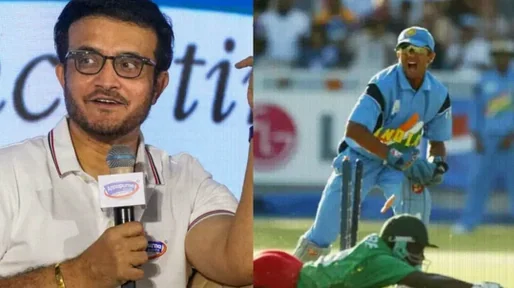
Sourav Ganguly’s recent reflections on Rahul Dravid do more than revisit a familiar chapter of Indian cricket. They also shed light on a high-stakes tactical call that protected Dravid’s ODI career while reshaping the team’s balance heading into the 2003 World Cup.
Key takeaways
- Ganguly said he continued backing Rahul Dravid in ODIs despite criticism about his strike rate.
- He linked the decision to preserving Dravid’s career momentum rather than letting selection pressure derail him.
- Ganguly explained that India lacked wicketkeeper-batters comparable to Sangakkara, Boucher, and Gilchrist.
- The plan involved turning Dravid into a wicketkeeper to add structure and extend India’s batting depth.
- He added that India’s ODI “all-round” resources were limited, so part-time bowling responsibilities were shared among several senior batters.
Ganguly on backing Dravid through ODI selection doubts
In remarks made on Raj Shamani’s podcast, Ganguly described the leadership approach he believed in: support players openly, while handling difficult realities privately. The incident he chose to illustrate this philosophy was Rahul Dravid.
Ganguly recalled a period when Dravid was being selected in ODIs, but voices in the system argued that his strike rate did not meet the required standard. He said selectors would sometimes suggest that another option should be chosen instead of Dravid. However, Ganguly insisted he did not push for Dravid to be dropped, explaining that removing him at that stage could have damaged the batter’s career trajectory.
Those comments point back to the early 2000s, when Dravid’s place in India’s ODI XI was genuinely under review. Even though he was already among the most respected batsmen in the country, ODI cricket was changing quickly, and the conversation increasingly shifted from technique to suitability.
During that time, teams were demanding more flexibility in batting, faster scoring, and stronger depth in the lower order. Ganguly stressed that the debate was not about Dravid’s ability with the bat—rather, it was about whether he fit the new demands of the format.
Why India changed Dravid’s ODI role
Ganguly then moved to the bigger structural issue, arguing that India’s lineup was under pressure because rivals had clearer role models in wicketkeeping-batting. He cited how Australia had Adam Gilchrist redefining what a wicketkeeper-batter could do, how South Africa had Mark Boucher, and how Sri Lanka had Kumar Sangakkara growing into the same kind of responsibility.
In contrast, Ganguly said India did not possess an equivalent option. He added that this often meant India’s batting stopped around the sixth over in terms of depth and impact, leaving them thinner compared to opponents.
To address that imbalance, Ganguly described a key tactical experiment: India decided to make Dravid the wicketkeeper. He said the reasoning was straightforward—if India did not have a wicketkeeper who could bat like those rivals, then the team would create that capability internally. Ganguly explained that the change was not treated as a quick fix; instead, it became a structural reset.
He said the shift began around India’s ODI rebuild phase in 2002 and then became central to the combination that carried forward into the 2003 World Cup. By assigning Dravid wicketkeeping duties, India created space for an additional specialist batter and improved balance across different parts of the side.
Ganguly also linked the move to lineup flexibility, saying it allowed India to include players like Kaif and push the batting depth out to seven. In his telling, that was part of the wider purpose: building a batting unit that could go further and remain coherent under ODI pressure.
Limited all-round depth and the wider role-sharing approach
Ganguly made it clear that the adjustment was not confined to wicketkeeping. He argued that India also lacked the kind of authentic all-round depth that some rival teams possessed. As a result, the captain and the team had to improvise with bowling responsibilities coming from players who were not full-time all-rounders.
He explained that Sehwag bowled, Sachin bowled, he himself bowled, and Yuvraj bowled—highlighting that in order to compete against teams with specialist all-rounders, India relied on part-time bowling contributions. In Ganguly’s view, the stronger sides had a more natural pool of all-rounders, while India had to solve the problem differently.
Looking back, Ganguly said the strategy appears obvious because it worked. Still, he acknowledged that at the time it carried real risk. He noted that Dravid was not a conventional wicketkeeper by nature, and the role demanded significant physical effort. Even so, Ganguly felt the tactical upside was too valuable to ignore.
Impact ahead of 2003 and what the comments reveal about leadership
In Ganguly’s assessment, the experiment helped India craft a more rounded ODI squad. He said it played a major part in the campaign that ended with India reaching the World Cup final in 2003.
Ultimately, Ganguly’s comments offer a window into how he understood leadership: public backing built confidence, while private decisions required the team to make uncomfortable adaptations. Through Dravid’s transformation into the face of one of India’s boldest ODI experiments, Ganguly’s reflections connect tactical evolution with the human side of captaincy.
