
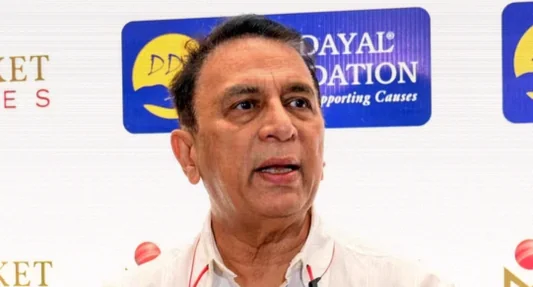
Sunil Gavaskar has cautioned IPL franchises against letting flashy displays in state and city T20 competitions shape their auction plans, warning that many big-hitting prospects from those leagues fail to cope once they face the quality and intensity of bowling in the IPL. The former India captain argued that the gap between the smaller circuits and the tournament remains wide, and that scouting driven by hype, player influence, and isolated standout outings can lead to expensive mistakes.
Gavaskar’s warning on local-league hype
In a column, Gavaskar said that several power hitters who have risen through various state and city leagues were “exposed” when they were tested against the international standard of bowling found in the IPL. He framed the issue as more than just a difference in conditions, pointing to a fundamental mismatch in the level of challenge.
- Gavaskar believes the standard of batting and bowling in state and city leagues is “nowhere near” the level seen in the IPL.
- He warned that franchises can waste money if their scouting approach is swayed by hype, agents, or single performances rather than repeatable skills.
- He highlighted that the IPL demands coping with pace, variation, and tactical pressure—areas where some local-league performers struggle to translate their form.
“Scouts and advisers have sold them a dummy”
One of Gavaskar’s sharpest points focused on how teams decide who to buy and how they evaluate that talent. He argued that unless scouts have the judgement to resist pressure from player representatives, franchises will keep selecting players based on inflated impressions from domestic T20 circuits.
Gavaskar wrote that scouts and advisers can end up “selling a dummy” to franchises when they allow agents and inflated performances to steer recruitment. In his view, the absence of careful evaluation leads to players being brought in for large sums only to be revealed as unsuitable once the IPL tempo rises.
Expensive buys, limited opportunity
Gavaskar also questioned franchises that spend crores on players but barely give them a meaningful run during the season. He suggested that this pattern signals a deeper problem in scouting and squad planning rather than just short-term team selection decisions.
- Gavaskar said that when a franchise pays crores for a player and uses them in only “a couple of games,” it indicates flawed judgement by scouts and advisers.
- He linked such cases to a broader failure in how squads are built and how players are assessed for IPL demands.
Not every pricey uncapped player fails
While Gavaskar’s criticism targets the broader pipeline of hype, he made it clear that his concern is not meant to apply to every expensive uncapped signing across the league. He cited examples to show that some high-priced players can still make an impact when given the chance.
- He pointed to Kartik Sharma as one of CSK’s better performers.
- He noted that Prashant Veer also showed promise, despite pressure that comes with a price tag.
Gavaskar’s underlying worry, though, is about the process feeding IPL squads—particularly local-league power hitters who do not convert dominance into tournament impact, players bought for large sums but not backed consistently by their own franchises, and those who secure contracts based on a single burst rather than sustained performance.
IPL’s ruthlessness and Pant’s captaincy change
Gavaskar added that the IPL has a way of quickly sorting out exaggerated reputations. He argued that the tournament “very quickly finds” players who are overrated and overvalued, particularly when their performances do not hold up under pressure and against superior bowling.
- Gavaskar said the IPL exposes players who are overrated or overvalued at a fast pace.
- He warned that franchises may still reward one standout showing in a low-stakes situation, even if the overall body of work does not justify the faith.
Why one-match performers keep getting chances
He said there are players who deliver a single notable effort during the tournament—often in a match that does not carry major consequences for their team—and then get re-signed for another year. Gavaskar argued that this happens often enough to create repeated cycles of selection.
He wrote that one could form at least four “teams” made up of such one-match performers who continue to be picked again and again across the IPL.
Rishabh Pant steps down as captain
Gavaskar also spoke about Rishabh Pant stepping down as captain after his team finished at the bottom of the table, describing it as the first major captaincy change ahead of the next season. He referred to Pant’s repeated comments about having “too many voices” around him, suggesting that it reflected poorly on the support staff.
- Gavaskar said Pant described having “too many voices” and “too many thought processes” around him.
- He added that such remarks are “definitely not a compliment” to the support staff.
Gavaskar concluded by stressing that franchise decisions must not confuse local-league noise with IPL certainty. In his view, the tournament’s standard is too high, auctions are too expensive, and the margin for poor scouting has become too thin to tolerate inflated reputations.
