
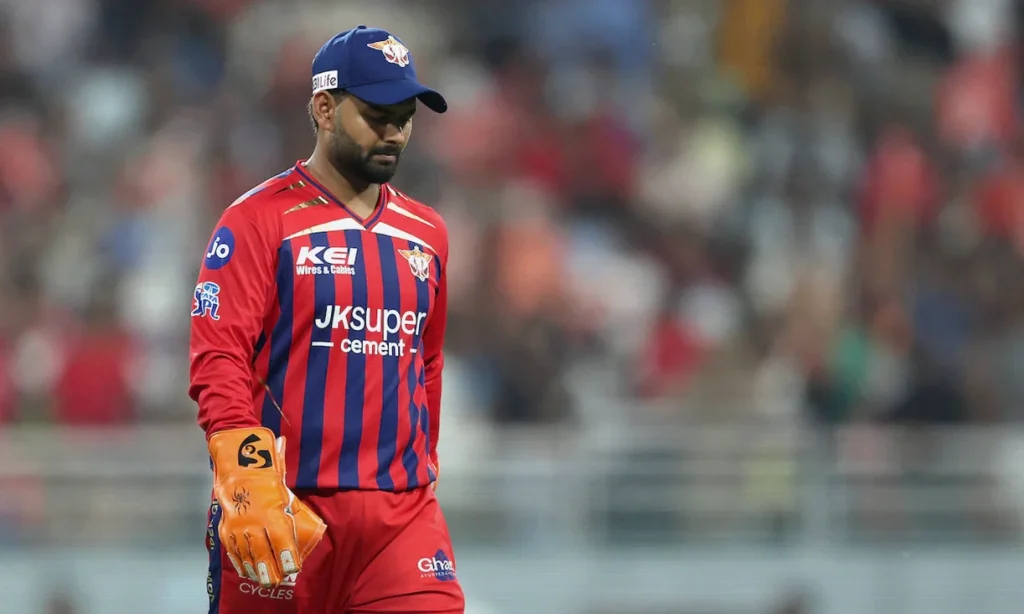
“Mahi, Rohit, Rishabh” — that was the legacy Sanjiv Goenka had imagined for his Rs 27 crore star following the IPL 2025 auction. The vision was to place Rishabh Pant in the same bracket as the league’s most decorated captains, and alongside two of India’s most revered white-ball performers. When it became clear that Pant would be part of the mega auction, expectations were largely unanimous that he would command the biggest price, given his role as India’s first-choice wicket-keeper in a T20 World Cup-winning campaign and his reputation as a fearless, crowd-attracting batter.
Yet, barely a year and a half into the Lucknow Super Giants experiment, the picture around Pant has started to look increasingly bleak. So much so that a premature halt to his white-ball career is no longer something that can be dismissed as unlikely.
The damning reality
Rishabh Pant’s numbers in the LSG setup raise uncomfortable questions. After his opening 21 outings for Lucknow, his strike rate may not be the headline, but his batting average is: it sits at 20.8 across those games. If you remove the standout knock of 118 not out that came in an inconsequential league encounter during IPL 2025, the figure falls further to 15.7.
Those are difficult statistics for any top-order batter, and especially for someone often regarded as one of the most gifted batsmen of his generation. The contrast becomes even sharper because Pant’s flamboyant approach has also been viewed by many as the style that could eventually establish him as India’s greatest-ever Test wicket-keeper batter.
However, what is happening in white-ball cricket looks worlds away from his Test journey. He hasn’t played a single T20 International since July 2024, and he also hasn’t featured in an ODI since August 2024. He was left out when Ajit Agarkar’s plans for the T20 World Cup 2026 squad were drawn up, and it is entirely possible that he could also miss the selectors’ thoughts when the 15-man Cricket World Cup 2027 group is assembled.
Steep competition for wicket-keeper places
One reason Pant’s situation looks so tight is the sheer depth of wicket-keeper batters available to India in white-ball cricket. The roles in the current setup appear broadly secured: KL Rahul holds the edge in ODIs for now, while Sanju Samson’s place in T20Is is similarly well established.
Ishan Kishan has also surged back into form and has forced his way into the T20I playing XI, while he could once again become a contender for ODI selection depending on how conditions and team combinations shift.
Meanwhile, Jitesh Sharma and Dhruv Jurel continue to wait for their break. Both have been consistently impressing through domestic cricket and the IPL. Jitesh, despite his efforts, missed out on India’s T20 World Cup 2026 squad, and the 25-year-old Jurel is steadily sharpening his skills and building versatility across multiple batting positions.
Even without factoring in the wider pool of talent such as Kartik Sharma or Mukul Choudhary, it is difficult to argue that Pant is ahead of the pack in white-ball formats anymore. In particular, in T20Is, he arguably finds himself behind five wicket-keepers already. Given the recent dip in his batting output, it becomes hard to see how the Ajit Agarkar-led BCCI selection group would be making an error by looking elsewhere.
LSG failure and the captaincy-price tag pressure
Pant’s Lucknow Super Giants assignment has not unravelled in a minor way — it has gone badly. He was handed the captaincy of a franchise that already has two prominent white-ball leaders in Aiden Markram and Mitchell Marsh. But the results under his stewardship have not matched the expectations that usually surround such appointments.
In the IPL 2026 context, LSG have managed only 8 wins from 21 games under Pant’s leadership. At the time of writing, the side sits just one position above the wooden spot in the points table. On top of that, his batting has not provided a consistent rescue act. Pant has shown signs of losing confidence at the crease too often for a player expected to dominate in high-pressure overs, and the free-flowing, unorthodox shot-making that defines his Test batting has not appeared with the same regularity in the IPL.
It is hard to judge whether Pant’s decline is purely a matter of not developing further as a white-ball batter, or whether captaincy responsibilities and the weight of his price tag have amplified the pressure. What is clear, though, is that the downturn in his white-ball trajectory has closely coincided with the mounting problems at LSG.
For now, matching the impact of Mahendra Singh Dhoni or Rohit Sharma — both in the IPL and for India in white-ball cricket — still looks like a distant, distant reality.
