
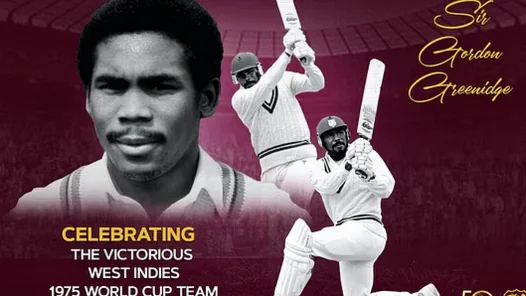
On May 1, 1951, one of cricket’s most stylish and influential batters was born, and across a career spanning international and domestic cricket he carried himself with the swagger and panache that defined so many West Indian performers of his era. Today, Gordon Greenidge is celebrating his 75th birthday, a milestone that invites fans to look back at a player whose batting looked effortless yet consistently punished bowlers. The right-hander came up in a period when the Windies dominated the world game in Tests and ODIs, and breaking into that class of players demanded genuine quality. Greenidge had it—especially in the way he played his trademark one-legged pulls and hooks, shots that still feel distinctive even decades later.
Greenidge was born at Black Bess in the parish of St. Peter, Barbados. However, his early life took a different turn before he reached his teenage years, when his family relocated to Reading in England. From there, he went on to represent Hampshire in county cricket, but despite the opportunity to pursue a path within English cricket, he chose to align his career with his homeland—the island nation at the heart of the West Indies story.
Over a 17-year playing career, Greenidge featured in 108 Tests and 128 One-Day Internationals. Across those matches, he amassed more than 12,000 runs for his country, including 30 centuries and 65 fifties. His first-class record was equally impressive: he compiled 37,354 runs with 92 hundreds and 183 scores of fifty or more, underlining that his class wasn’t limited to the international spotlight.
Greenidge’s talent did not take long to announce itself. In his Test debut against India at Bengaluru in late 1974, he struck 93 and 107—figures that immediately marked him as a serious force at the highest level. That match also saw Sir Viv Richards make his entry into Test cricket, but while Richards would go on to define an entire generation, Greenidge’s individual impact in that specific game came with a twist. He also produced low scores of 4 and 3 in the match, with both innings ending after falling to India’s spin specialist Bhagwath Chandrasekhar. Still, the broader arc of Greenidge’s career proved that his ability was never in doubt—he was simply operating in an era stacked with exceptional talent.
Greenidge’s legacy is also tied to major tournament success. He was part of West Indies squads that won the World Cup in 1975 and 1979. He was there again in 1983, when West Indies reached the final but ultimately went down to India. In 1991, he played for the West Indies for the last time, bringing the curtain down on a career that had already earned him the reputation of a true champion.
As an opener, Greenidge formed a powerful partnership with Desmond Haynes. Haynes later shared an account of how their discussions around the end of one player’s run became part of their on-field rhythm. “He told me he was coming to the end of his career, so I said, ‘Why don’t you give me the chance to face the first ball?’” Haynes recalled. “And he said, ‘Look at the scoreboard, they are going to have to change it, it will be too much work!’” The exchange captured the confidence and mindset of a batter who believed in making impact from the earliest phase of an innings.
After retirement, Greenidge moved into coaching and worked with Bangladesh. During the middle of the 1999 World Cup, however, he was dismissed by the Bangladesh Cricket Board. It has been understood that his stance on Bangladesh receiving Test status played a role in the decision, with Greenidge maintaining that the team needed to develop further before being granted that honour for the longer format.
