
Flat, batter-friendly surfaces have become a regular feature in modern Twenty20 cricket, turning many matches into high-scoring contests while creating fresh headaches for bowlers. That wider trend was thrown into sharp focus on May 12 at the Narendra Modi Stadium, when Gujarat Titans delivered a commanding 82-run victory over Sunrisers Hyderabad on a pitch that played tougher than the usual batting-friendly scripts. The result quickly sparked debate about how batters should approach unfamiliar, more difficult conditions—and how quickly they can recalibrate when the ball stops coming onto the bat.
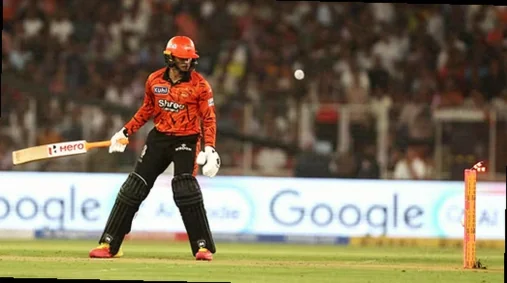
One name drew particular attention: Sunrisers’ 25-year-old batting star Abhishek Sharma. His stay at the crease ended in misfortune when Kagiso Rabada dismissed him for just six runs. The setback came after Abhishek had struck Rabada’s first ball of the opening spell for a six, only to lose his wicket soon after.
SRH’s collapse unfolded rapidly once their early momentum was broken. Abhishek was unable to read the pitch properly or steady the innings after his opening partner, Travis Head, departed for a duck early. With wickets falling in quick succession, Sunrisers were bowled out for 86 in only 15 overs. The defeat was damaging in multiple ways: SRH slipped off the top spot in the standings, and it also marked the franchise’s lowest total in the history of the IPL.
Ravichandran Ashwin, the former India spinner and a widely followed cricket analyst, took a direct look at Abhishek’s approach. While he acknowledged the fearless style that has brought Abhishek success in the IPL and earned him a place in India’s T20I setup, Ashwin argued that the same mindset must be paired with a stronger respect for conditions when pitches behave differently.
Ashwin’s central point was that attacking intent fits the modern format, but batters cannot treat every surface in the same way. He said Abhishek’s aggressive thinking from the start matches the direction Twenty20 is heading, yet stressed that hitters still need to judge the playing conditions rather than aiming to clear the boundary on every delivery. Ashwin also suggested that, if bowler-friendly surfaces become more common, openers such as Sai Sudharsan and Shubman Gill may be better equipped for those scenarios.
“Abhishek Sharma needs to work on this. T20 cricket has changed. Abhishek Sharma is picked in the Indian team because he plays a fearless brand of cricket. But if T20 cricket is given these kinds of pitches tomorrow, Sai Sudharsan and Shubman Gill will be more useful. I want T20 cricket to be played on such pitches. But not just these pitches, because the spinners were not in the game here. I want spinners to be in the game as well,” Ashwin said in a recent video on his YouTube channel.
The commentary landed after Abhishek faced Rabada in SRH’s chase of 169. On the second over, with SRH at 6 for 1, Abhishek tried to attack a delivery travelling at 139.2 kph that struck his chest. Instead of finishing the shot cleanly, the ball deflected onto the stumps, and his innings ended abruptly.
As Ashwin noted, the day’s contrast in batting styles mattered. Sudharsan showed patience and a composed technique, taking time early to understand how the pitch was behaving before adding acceleration later. His knock of 61 off 44 balls helped Gujarat Titans move past Sunrisers and seize top position in the table. Gill, however, did not get going for long—he was dismissed for 5 off 7 balls by Praful Hinge. Still, both Gujarat openers have broadly shared a similar philosophy: assess the surface first, then shift to a more aggressive tempo once the conditions become clearer.
Ashwin expanded on his argument using a simple analogy about driving. He explained that you cannot travel at the same speed in traffic as you would on a highway, and the same principle applies to batting on different types of cricket pitches. In his view, the shot Abhishek attempted against Rabada could have worked on the right kind of pitch, but it failed at that moment because the conditions did not allow for it.
He added that the young batter will need to be more alert to these situations going forward, especially when the match demands guidance through difficult phases rather than only power-hitting. “Abhishek Sharma hit a six off Kagiso Rabada with extension. This means that this guy has a lot of time and is very talented. His bat swing is very good. What did he do next? He exposed all three stumps. The ball came in, hit his chest, and he was bowled. Can’t Abhishek Sharma play that shot? He can. You can drive above 100 kmph on a highway and even up to 200 kmph, but you will die if you drive at the same speed in a traffic jam? Cricket is a game where conditions are the king,” Ashwin added.
Even with the criticism, Abhishek has continued to enjoy a strong season. After a slower start that followed a disappointing individual run during India’s T20 World Cup 2026 triumph, he has once again displayed his explosive capability. He remains in the race for the Orange Cap with 481 runs so far, and he will be looking to help Sunrisers Hyderabad remain in contention for the championship this year.
