
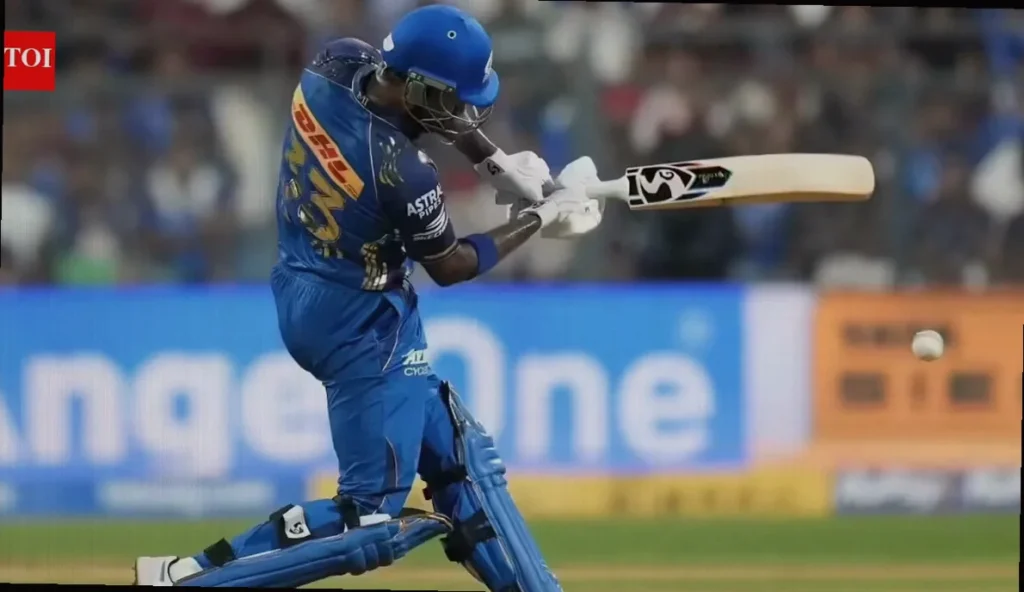
NEW DELHI: Sanju Samson was on 85 from 48 deliveries as Chennai Super Kings steadily pulled away at the Wankhede. For Mumbai Indians, there were still two overs left in Hardik Pandya’s spell, but the MI captain decided to hand the ball to Krish Bhagat, who was featuring in just his second IPL match. Bhagat went for 16 runs, and Mumbai Indians ultimately suffered the biggest defeat by runs ever recorded in IPL history—losing by 103 runs. That over, viewed in isolation, proved to be more a footnote than a turning point, yet the call to avoid bowling the final over himself triggered debate.
After the loss, MI head coach Mahela Jayawardene framed the decision as a chance for Bhagat “to step up”. The discussion, however, quickly moved to Hardik’s role at the death—especially against the backdrop of how he has performed for India in recent times. Since the start of 2026, Hardik has delivered 60 balls (10 overs) at the end of innings in eight India appearances, taking five wickets while conceding at an economy of 9.7. In the ongoing IPL, his death-over workload in that same phase has been far lighter: across seven innings, he has bowled only three overs, picking up one wicket and allowing 15.7 runs per over.
When Hardik wears India’s colours, he is often cast as the “crisis manager” who can be trusted to deliver in the final over. Two years ago, at the Kensington Oval during the T20 World Cup final in 2024—when India faced South Africa—he was entrusted with the final-over responsibility. He also bowled the 19th over at the Wankhede in the 2026 T20 World Cup semi-final against England. In T20 internationals, the label “Clutch God” fits Hardik’s reputation both with the bat and the ball. Yet for Mumbai Indians—since 2024—that clutch factor has appeared strangely absent, at least in how the numbers read.
Hardik with the ball since 2024: since returning to MI from Gujarat Titans in 2024, Hardik has bowled 108 balls in the first six overs for the franchise. In that period he has conceded 219 runs at an economy of 12.17 and averaged 73.0, with three wickets to show for it. For India in T20Is, the picture looks notably steadier. Across 31 innings and 290 deliveries in overs 1-6, Hardik has conceded 394 runs. His economy for India in those overs is 8.15 and his bowling average is 39.4, including 10 wickets.
The same trend extends to the “death overs” between overs 16-20. Since 2024, Hardik has delivered 179 balls in overs 16-20 for India, conceding 274 runs at an economy of 9.18. In that stretch, he has averaged 15.2 and taken 18 wickets. For Mumbai Indians, however, his death-over output since 2024 shows a wider gap: he has conceded 208 runs in 88 balls, with an economy of 14.18. The result is stark—Hardik gives away five more runs per over when bowling in the death for MI compared to his returns for India in T20Is.
The strike-rate contrast between “death” batting too: since 2024, in overs 16-20, Hardik has faced 302 balls across 26 innings for India, scoring 556 runs at a strike rate of 184.1. With the bat, he has averaged 29.3 in that period and has struck a six every 7.7 balls. For Mumbai Indians, though, his batting numbers in the same overs drop sharply. Since 2024, Hardik has faced 173 balls in IPL overs 16-20, scoring 270 runs, with his strike rate falling to 156.1. He has averaged 15.0 and has hit a six once every 11.53 balls.
Dig deeper and the issue becomes clearer. Since 2024, only five MI batters—Surya, Tilak, Naman Dhir, Tim David, and Pandya—have faced 50 balls or more in IPL overs 16-20. Among them, Hardik has scored the most runs for MI in that window, but his strike rate of 156.1 is the lowest among the group. The closest to him is Tim David, who scored at 181.42 when he played for MI in 2024. Surya has been the most aggressive in this phase, striking at 204.71.
For India, the pattern flips in Hardik’s favour. In overs 16-20 since 2024, he has scored the most runs for India—556—yet his strike rate rises to 184.11, the third-best mark among Indian batters who have faced at least 50 balls in that segment. Put simply: the “aura” Hardik carries in India’s setup appears much harder to find in Mumbai Indians’ innings during the same overs.
At the same time, the broader data doesn’t suggest that MI’s poor fortunes in two of the past three IPL seasons can be pinned solely on Hardik. That said, since his return in 2024, he has not consistently replicated the impact he has shown for India during the same period. Whether captaincy pressure is to blame is a question only Hardik can answer. But the numbers point to a clear conclusion: the player India relies on to deliver in difficult overs and finish matches with the bat has looked different when playing for MI since 2024. And in a league where late-innings contributions decide outcomes, that difference is being felt.
