
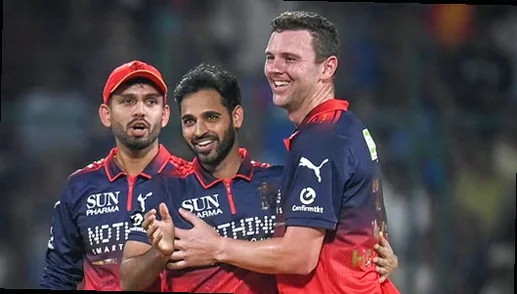
Delhi Capitals left the Arun Jaitley Stadium without a defeat, but they did not leave with control either. Royal Challengers Bengaluru’s nine-wicket victory was effectively decided before the chase even started, and it was orchestrated by two fast-bowling spells that attacked the DC batting order in distinct ways. Josh Hazlewood delivered 3.3 overs for 12 runs and picked up four wickets, while Bhuvneshwar Kumar returned figures of 3 overs for 5 runs with three wickets. Although the scorecard places both spells side by side, their influence was not identical—Hazlewood created the greater raw impact, whereas Bhuvneshwar offered the stronger return for the cost. That split captures the match far better than the wicket tally alone.
Delhi were dismissed for 75 in 16.3 overs. RCB then completed the chase in 6.3 overs. The game looked like a mismatch, but it was not a slow, steady domination. It was a demolition that began inside the first four overs. DC slipped to 8/6 after just 23 balls, and that moment became the point of no return. From there, the rest of the innings turned into a recovery show rather than a genuine contest.
Bhuvneshwar Kumar turned the innings into panic
Bhuvneshwar’s spell provided the first decisive cut. He wasn’t simply benefiting from pressure created by someone else—he actively manufactured the pressure that allowed the collapse to gather speed. His opening wicket arrived almost immediately, shifting Delhi’s innings from a straightforward batting start into damage control. In T20 cricket, the first over does more than add runs; it establishes the team’s mindset. DC’s approach changed from expansion to survival before they had even settled into the game.
The most damaging phase followed when Bhuvneshwar returned. He struck out Tristan Stubbs and then dismissed Axar Patel. Those were not wickets that merely pad a bowling card. Stubbs was among the batters capable of absorbing early damage and still rebuilding with power. Axar, operating as captain and a stabilising force in the middle order, was one of the few remaining routes back into the chase. Once both were removed, Delhi weren’t just five down—they were five down without any credible pathway to recover.
This is why Bhuvneshwar’s spell carries such a strong ROI value. The numbers were already impressive, but the timing gave them additional weight. In most matches, figures like three overs, five runs, and three wickets represent a highly valuable package. In this game, those wickets arrived while Delhi still had a theoretical chance to build something. Bhuvneshwar removed that possibility.
His match worth is calculated at INR 2.10 crore, while his match cost stands at INR 76.79 lakh. That produces a profit of INR 1.33 crore and an ROI of 173.49%. The takeaway is straightforward: Bhuvneshwar delivered elite control and decisive wickets at a lower match cost. His spell may not have been the most destructive by raw impact, but it was the most efficient investment.
Hazlewood produced the heavier cricketing impact
Josh Hazlewood’s spell worked differently. If Bhuvneshwar opened the crack, Hazlewood widened it until Delhi had nowhere left to stand. His 4/12 was the standout set of bowling figures of the match. He struck early, returned as the innings unravelled, and then completed the job to finish the innings. That sequence matters when impact is valued, because wickets do not carry the same weight when taken in isolation. A bowler who takes a wicket once at the start creates one kind of value; a bowler who keeps returning to remove batters across the innings creates another.
Hazlewood’s raw bowling impact registers at 80.87, while Bhuvneshwar’s stands at 71.41. In plain terms, it reflects what the game showed visually: Hazlewood left a larger footprint across Delhi’s batting.
He didn’t just contain the situation after it worsened—he extended it. Even once DC were already wounded, Hazlewood denied them the one thing a collapse needs: time to reset. Every possible batter who walked out arrived into an innings already under siege, only to find Hazlewood waiting with hard length, bounce, and disciplined execution.
This is where Hazlewood’s value separates from Bhuvneshwar’s. Bhuvneshwar was sharper in cost efficiency, while Hazlewood carried more total bowling damage. Hazlewood took more wickets, covered a wider portion of the innings arc, and closed out the contest. On pure cricketing impact, Hazlewood was ahead.
His match worth comes in at INR 1.976 crore, with a match cost of INR 1.136 crore. That leads to a profit of INR 83.96 lakh and an ROI of 73.89%. The return is still strong; it only appears smaller because it is being compared to Bhuvneshwar’s exceptional efficiency. Hazlewood generated higher impact but with a higher cost base.
Also Read: Axar Patel refuses to take defeat seriously after RCB beat Delhi Capitals to a pulp, broadcaster says ‘sorry’
Why impact and ROI tell two different stories
This is the central distinction. Impact measures what a player achieved in the match, while ROI measures how much return was generated after factoring in cost. Hazlewood wins the impact debate because his spell produced the larger raw bowling value. He took four wickets, kept Delhi pinned under continuous pressure, and brought the innings to an end with authority. His contribution also stretched across a broader match footprint.
Bhuvneshwar, however, wins the ROI argument because his value exceeded his cost by a wider margin. His per-match cost was lower, and his spell created high-leverage damage almost immediately. That strengthened the surplus generated from his performance.
A player can be the most impactful performer and still not be the top ROI performer, and that is not a contradiction. It is the difference between dominance and efficiency—between leaving the biggest mark and delivering the best business outcome.
In this match, Hazlewood carried the bigger cricketing weapon while Bhuvneshwar delivered the better business transaction. For a franchise, both matter. A high-impact bowler can swing matches even when the return percentage isn’t the highest. A high-ROI player provides surplus value that can reshape the economics of a campaign. RCB received both in the same innings, which is why the win looked so complete.
How the valuation works
The valuation framework uses match performance, role, the timing of wickets, phase pressure, economy, match situation, manual assessment, and player cost to estimate match worth. A wicket taken while a collapse is still live carries more value than a wicket taken after the game has effectively flattened. Similarly, a spell that produces control through wickets is valued more than a spell that only holds down runs. The model then compares the estimated match worth with the per-match cost to calculate individual profit.
This model is based on a program designed exclusively by the author. In it, cricketing contribution is translated into a match-value estimate, cost is subtracted, and the remainder becomes profit. ROI then shows how strongly the player has beaten his cost for that particular match.
In this game, both bowlers landed in the highest raw bowling value band. Hazlewood’s impact was higher because he took four wickets and influenced more of the innings. Bhuvneshwar’s profit was higher because his cost-to-return equation was stronger.
That provides the match’s real financial reading.
- Hazlewood’s raw bowling impact: 80.87.
- Bhuvneshwar’s raw bowling impact: 71.41.
- Bhuvneshwar’s individual profit: INR 1.33 crore.
- Hazlewood’s individual profit: INR 83.96 lakh.
- Combined profit: INR 2.17 crore.
The final score made it look like RCB won with ease, but the value sheet explains why that ease arrived. Delhi’s collapse wasn’t the result of a single spell. It happened because two different types of fast-bowling value came together. Bhuvneshwar offered RCB a cheaper yet cleaner opening blow, while Hazlewood provided the greater cricketing impact. One spell made the investment case; the other made the performance case.
Together, they turned a Delhi total of 75 all out into far more than just a bowling display. They turned it into an INR 2.17 crore statement.
