
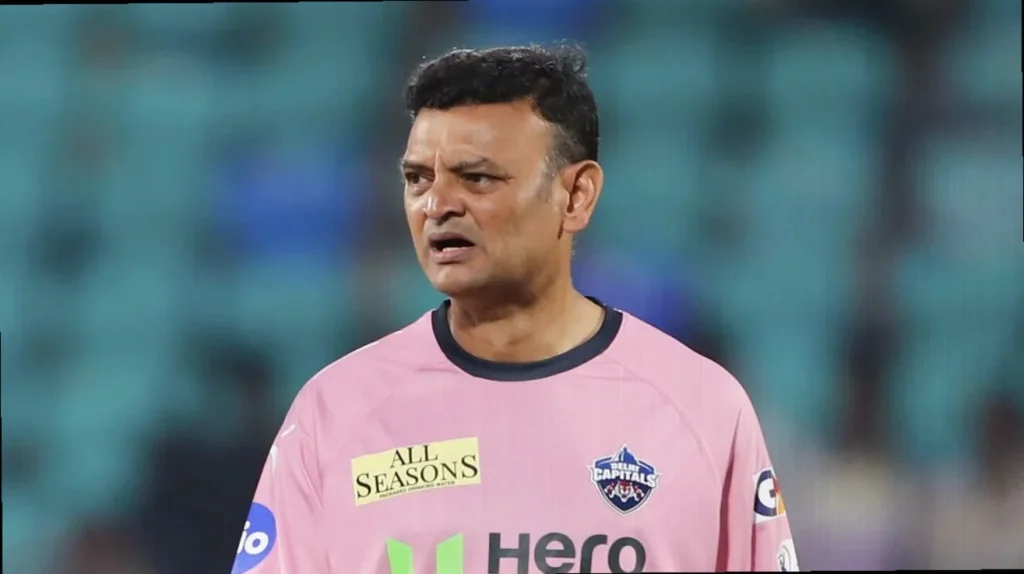
Delhi Capitals (DC) have been struggling in IPL 2026 at Arun Jaitley Stadium, where their home matches have often felt like a different challenge compared to those played away from Delhi. After DC beat Rajasthan Royals (RR) in Delhi on Sunday, head coach Hemang Badani said the team has stopped getting stuck in surface talk—insisting that, in practical terms, they treat the venue like an away ground.
Badani has made similar comments before, describing home cricket at the venue as an “up-and-down” experience, and urging the BCCI to take better care of the playing surfaces. With five defeats and only two victories at home this season, his complaint appears well grounded: DC have managed at least one remarkable chase of 264, finishing with seven balls to spare, but in the very next match they were dismissed for 75.
Speaking at the press interaction after the win, Badani tried to put the season into perspective by splitting their results into home and away. “If you’re able to break the season into two halves—what has happened at home and what has happened away—then we’ve had four wins from six games away, and we’ve mainly struggled at home [two wins in seven games],” he said. “From last year, we’ve had five wins at this ground and we’ve now added seven more games, taking it to 12 matches. In those, we’ve won only three times, and one of those wins came via a Super Over. That pretty much sums up what the surface has been like for us.”
He added that the conditions have not suited DC’s brand of cricket. “It hasn’t been conducive to our style of play. We’ve often not been able to read what the surface is doing, and that’s why you’re seeing those kinds of results and those numbers,” Badani said.
Badani also reflected on how teams usually plan based on the nature of the strip—grass available, surface texture, and even the colour. “Ideally, you’d look at the grass, the texture and the colour of the wicket. But every time we come here, we’ve been faced with something different. So it is what it is. We accept it and move on,” he said.
According to Badani, the three Delhi pitches used for DC’s matches have not repeated themselves consistently. “We are getting bowled out for 60; we are getting bowled out for 150; and we’re also scoring 260. We don’t know how Pitch No. 4 will play, how Pitch No. 5 will play, how Pitch No. 6 will play,” he explained. “We’ve played on three pitches and all of them have been different each time, so it’s hard to plan. When you know this wicket’s par score is 180, or 200, or 250, you shape the team accordingly. But here… whatever happens is what happens.”
Even with Sunday’s win keeping their playoff hopes alive, DC were not fully satisfied with the wicket they received. Badani suggested that RR’s innings showed how the track behaved as the game progressed. “Speaking about this game, I think even if you look at their innings, they were 160 for 2 [after 14 overs], and then they hardly got runs at the end. They probably scored about 33 in the last six overs, and we took [six more] wickets,” he said.
Badani said DC faced a similar rhythm shift but managed it by being careful, especially since they had a target to work with. “The same happened to us where we slowed down a bit, but we were cautious because we had a [target] in front of us. They had to set a target and we were trying to build the match because the ball was starting to do reverse,” he added. “It was holding a little in the surface as well. Once the ball got older, batting wasn’t easy, so we decided to carry the game deeper—go hard at the top, but then take it deep in the end.”
Badani was also asked again about a question that has come up before: should the BCCI allow IPL franchises to have input into pitch selection so that home advantage is more meaningful?
His response was cautious but clear. “If it has to be a consistent decision for all [then yes], but it should at least be something where you know what to expect,” Badani said. “Here, we don’t know what the surface will do.”
