
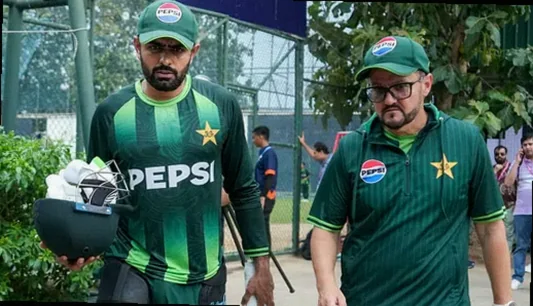
Pakistan’s white-ball batting and bowling setup has come under scrutiny over the nature of pitches being used at home, but spin-coach Mike Hesson has pushed back hard—arguing that the team is fully aware of the conditions awaiting them ahead of the 50-over World Cup in South Africa, Namibia and Zimbabwe next year.
Key takeaways
- Mike Hesson defended Pakistan’s spin-friendly pitch approach after the first ODI against Australia in the three-match series.
- He urged fans not to be concerned about Pakistan’s preparation plans for the next year’s 50-over World Cup.
- Hesson said Pakistan’s management has already carried out research and will tailor training for a range of conditions over the coming months.
- He dismissed the claim that South African pitches are uniformly quick and bouncy with little value for spinners.
- In the series opener at Rawalpindi, Arafat Minhas took five wickets on debut and helped Pakistan win by five wickets, while Babar Azam scored a half-century.
Hesson backs spin-friendly wickets ahead of the World Cup
Hesson, who has previously worked with New Zealand and Royal Challengers Bengaluru (RCB), made his case in a long post on social media, telling supporters they should not assume Pakistan’s home surfaces will leave the squad unprepared for the tournament in 2027. He insisted that the team is conscious of the playing environments it will face and that Pakistan will build its preparation accordingly.
Addressing the debate directly, Hesson noted that he had already discussed the subject on the latest PCB podcast. He also referenced ongoing chatter about whether pitches in Pakistan are suited for preparing for the World Cup in South Africa, Namibia and Zimbabwe—where the tournament is jointly hosted.
Why Hesson says “not all South Africa is pace-friendly”
Hesson pointed out that the World Cup is spread across three countries, with Zimbabwe and Namibia hosting venues where spin plays a major role. He also stressed that the tournament schedule will not be limited to quick bowler-friendly tracks, even if some surfaces in South Africa do offer pace and bounce.
He then highlighted the criticism that followed the Rawalpindi pitch used for the series opener against Australia, noting that it drew negative attention given the expectation that World Cup conditions will generally suit fast bowling. Still, he underlined that most of the tournament’s matches are set to be played in South Africa, including the final.
Hesson further argued that South African conditions can benefit a variety of roles, not just pacers. In his view, it is incorrect to assume that the entire country presents the same type of wicket. He said the premise that every pitch in South Africa is quick and bouncy “just isn’t true,” adding that conditions vary from place to place and even within the same region.
To illustrate his point, Hesson referenced Pakistan’s most recent ODI series in South Africa, which included Paarl—an example where spin had a decisive impact on the outcome. He expressed confidence that Pakistan has conducted significant research and will use the next 18 months to prepare for different scenarios and wicket behaviours.
What happened in the first ODI vs Australia
In the opening match of the three-game ODI series between Pakistan and Australia, Arafat Minhas made an immediate impression by taking five wickets on debut. His spell helped the hosts secure a convincing five-wicket win.
Babar Azam also made an important contribution with a half-century as Pakistan chased and completed the result.
