
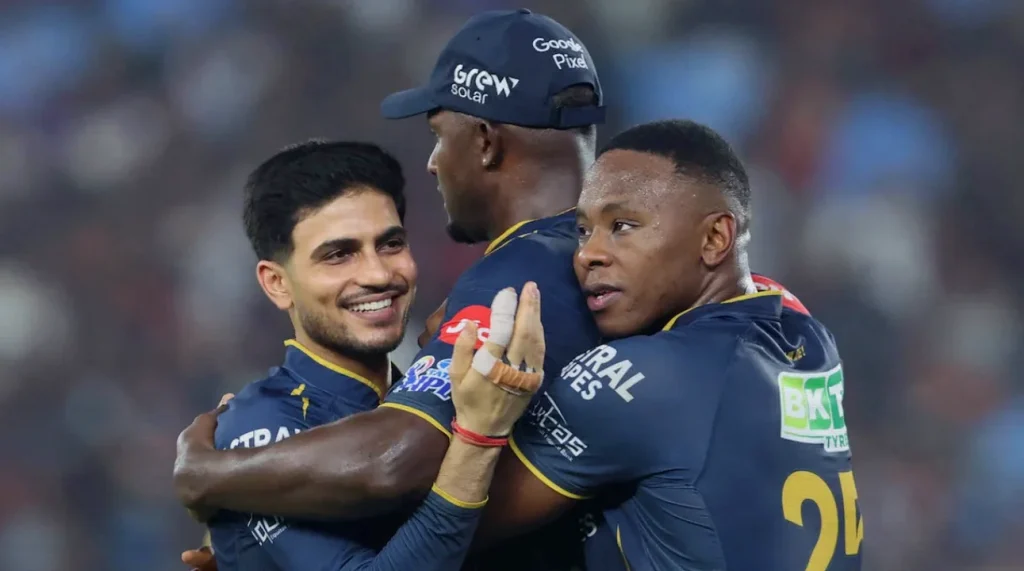
A flashpoint moment marred the Gujarat Titans (GT) vs Royal Challengers Bengaluru (RCB) encounter in Ahmedabad on Thursday night, after Jason Holder appeared to complete a stunning catch to dismiss Rajat Patidar. The controversy, however, quickly turned into a debate about whether the ball may have brushed the turf before Holder fully regained his balance—an issue RCB were not willing to drop.
Holder’s catch and the doubt over ball-to-ground contact
The incident unfolded when Holder sprinted across the playing surface and took a clean-looking catch while sliding. As he rose, replays became the key talking point for RCB, with their dugout questioning the legality of the moment.
Although the footage indicated Holder had collected the ball securely and kept possession while moving across the ground, the images also suggested the ball might have touched the grass as Holder got up. That uncertainty triggered immediate protests from RCB’s camp.
RCB protest: Kohli leads, Bhuvneshwar calls for a closer look
During the replay shown on the big screen at the venue, Virat Kohli and others in the RCB dugout launched animated objections. They directed their remonstrations towards reserve umpire Parashar Joshi on the field.
After the match, RCB pacer Bhuvneshwar Kumar explained why the side felt the decision deserved extra scrutiny.
- Bhuvneshwar said they believed the ball had touched the ground, but he was unsure what the umpiring instruction was in that specific situation.
- He added that RCB wanted the on-field process to involve a closer review, reflecting their doubt about what was ruled.
- He also noted that the outcome hinged on how the officials interpreted the relevant law during the catch and control phases.
TV umpire Abhijit Bhattacharya rules Holder was in control
RCB’s concerns were reviewed by the TV umpire, Abhijit Bhattacharya, who examined the replay and concluded that Holder had maintained control of the ball long enough for the batter to be dismissed.
With Patidar’s wicket confirmed, RCB slipped to 79 for 3 in the eighth over. The innings then continued steadily, with Bengaluru eventually reaching 155. GT managed to chase the total successfully, crossing it with 25 balls remaining.
Ian Bishop and Abhinav Mukund weigh in on the catch law
In the post-match discussion, Ian Bishop and Abhinav Mukund both sided with the idea that the catch should have been viewed more carefully, though their reasoning differed in emphasis.
Bishop’s “second look” argument
Bishop said Holder’s initial catch itself was not in question, but the subsequent sliding and body control warranted a further assessment.
- Bishop felt the catch initially was clean, but the sliding phase—especially after the fielder moved to get himself upright—should have triggered a second look.
- He argued that the determination should not only involve ball control, but also the control of the body while stopping the slide.
- He highlighted a concern based on the angle of the hand: with the back of the hand facing upward, the ball’s orientation appeared to be towards the grass, creating doubt about whether it had made contact with the ground.
- Bishop concluded that, in his view, there was enough evidence to rule the dismissal as not out.
Abhinav’s view: ball touching ground means not out
Abhinav was even more direct. He argued that if the ball touched the ground, the catch should be considered invalid.
- He stated that his position was “not out” because the ball should not be allowed to touch the ground for the catch to count.
- He reasoned that there are multiple ways for an elite athlete to regain balance after a slide, without needing their hands or the ball to touch the surface for the play to be completed.
- He acknowledged that the law contains ambiguity, but maintained that once ball-to-ground contact is observed, the dismissal cannot stand in his interpretation.
What the laws require for a fair catch
The discussion referenced the MCC laws of cricket, which state that a catch is considered fair only if the fielder has “complete control over the ball and their own movement before it [the ball] touches the ground”.
On that basis, the debate continued even after the official confirmation: Bishop believed there was sufficient doubt to call it not out, while Abhinav insisted that visible ground contact—if proven—should automatically negate the catch.
