
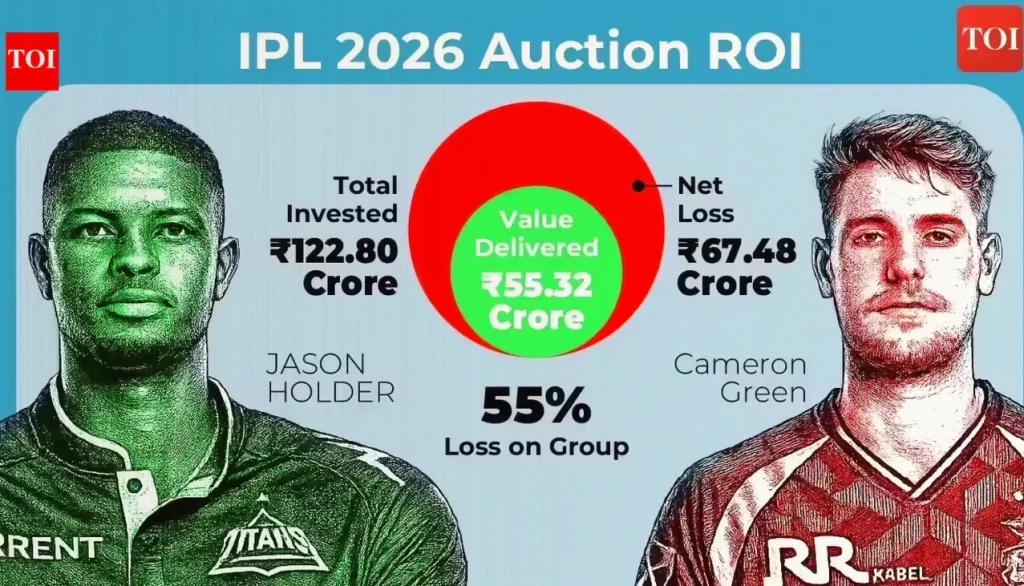
Franchises arrived at the IPL 2026 mini-auction in Abu Dhabi in December 2025 convinced they had solved their biggest problems before the competition even started. Big-ticket overseas bids promised immediate impact, while aggressive spending on uncapped Indian talent and role-focused picks was meant to shape each squad’s balance. Five months on, the final numbers suggest a very different auction story: not one defined by who dazzled most, but by how little value the group delivered collectively compared to what was paid.
Key takeaways
- Cameron Green became the highest-paid overseas buy in IPL history after Kolkata Knight Riders paid Rs 25.20 crore, yet his net rupee return was deeply negative in the value model.
- Jason Holder was the standout bargain: Gujarat Titans bought him for Rs 7 crore and he ended with an estimated Rs 11.98 crore in value, giving a net gain of Rs 4.98 crore.
- KKR and CSK’s expensive campaigns did not translate into league success, with KKR finishing seventh and CSK eighth.
- Across the ten priciest buys, franchises spent Rs 122.80 crore but the estimated rupee value returned was Rs 55.32 crore—less than half the auction outlay.
- Only two players posted a positive net return in the study: Jason Holder and Josh Inglis.
From auction headlines to league outcomes
In December 2025, Kolkata Knight Riders led the overseas spending wave by securing Cameron Green for Rs 25.20 crore, backing the idea of a genuine all-rounder who could anchor the batting while also contributing with the ball. KKR then reinforced the pace-and-power theme by bringing in Matheesha Pathirana for Rs 18 crore.
Chennai Super Kings took the uncapped-player ceiling to a new level, breaking it twice by signing Kartik Sharma and Prashant Veer for Rs 14.20 crore each. Sunrisers Hyderabad went after explosiveness by landing Liam Livingstone for Rs 13 crore. Meanwhile, other sides continued to chase high-ceiling overseas talent and specialist roles, including Impact Player flexibility as squads prepared for the season.
But by the time the league stage concluded, the returns looked mismatched to the outlay. KKR, despite their blockbuster spending, ended up seventh. CSK finished eighth. Several major purchases saw limited involvement, failed to settle into roles, or simply did not justify the price tags attached to them.
That shift in fortunes fed into the central conclusion from the auction analysis: the story was less about individual performances and more about the collective value delivered compared to what franchises paid.
How the value model landed: spend vs return
A rupee-equivalent framework converted on-field output into estimated financial value. Under this approach, franchises spent Rs 122.80 crore on the ten most expensive buys from the IPL 2026 mini-auction. Those same players were estimated to return only Rs 55.32 crore in value.
Put simply, the group delivered less than half of the rupees paid for them. Within that top group, only two names managed a positive return: Jason Holder and Josh Inglis.
Jason Holder: the clearest winner
Despite the attention surrounding the largest bids, the most effective purchase in the study was arguably the most “middle-tier” one. Gujarat Titans paid Rs 7 crore for Holder, and he became a case study in value. After beginning the season with time on the sidelines, Holder forced his way into GT’s plans and finished the league stage with 13 wickets across eight matches, maintaining an economy rate of 7.34.
In a season where the league average economy rate stood at 10.26, Holder’s control looked even more significant. Beyond the numbers, he provided Gujarat with tactical flexibility: bowling difficult overs, breaking partnerships, and consistently shaping outcomes in matches.
Using the league-wide value method, Holder generated an estimated Rs 11.98 crore worth of on-field value for GT against a Rs 7 crore investment. That translated into a net gain of Rs 4.98 crore and a multiplier of 1.71x, which was the best return among the top ten buys.
Josh Inglis: positive return, but late arrival
The other player to deliver a positive net return was Josh Inglis, a figure who may have left Lucknow Super Giants supporters wishing he arrived earlier. Available only for the closing stretch of the season, Inglis came in late and immediately appeared like the missing piece LSG had been searching for.
Across five matches, he scored 262 runs and was credited with an estimated Rs 9.01 crore in value from an Rs 8.60 crore investment. The margin was tight—net gain of Rs 0.41 crore—but it was still enough to keep him on the right side of the ledger.
His runs included 13, 85, 36, 60, and 72, with high-impact strike-rate contributions. The study also notes the counterfactual: had Inglis been available from the start, it is difficult to ignore how differently LSG’s campaign might have unfolded.
Cameron Green: the Rs 25 crore paradox
Among the ten priciest buys, Cameron Green stands out as the most intriguing figure in the analysis because his numbers support two opposing narratives. Depending on the lens, he was both a success and a disappointment.
Green recorded the highest absolute output in the group, with 322 runs and seven wickets. That output translated into an estimated Rs 12.71 crore of value, the most among the ten players—an impressive figure on its own.
The issue was the price. KKR paid Rs 25.20 crore for him, leaving Green with a net deficit of Rs 12.49 crore, described as the largest negative number in the entire study. The analysis stresses that this does not mean Green “failed” in performance terms; rather, mega-money signings are judged against expectations tied to their cost.
It also highlights another factor that shaped the season story: Green was not cleared to bowl at the start of the tournament, which affected KKR’s balance and use of his all-round skillset. Taken together, the season becomes one of the tournament’s biggest “what if” discussions.
The closer-to-break-even middle tier
Players whose performances came closest to justifying their price tags largely fell within the Rs 7 crore to Rs 9 crore bracket. Holder led the group, with Inglis next.
Ravi Bishnoi narrowly missed breaking even, delivering Rs 6.63 crore in value against a fee of Rs 7.20 crore. Venkatesh Iyer followed in the same tier. RCB bought Iyer for Rs 7 crore, and although he was used sparingly, he still generated Rs 5.23 crore in value despite playing only four innings. His unbeaten 73 off 40 against Punjab Kings in Dharamsala was singled out as one of RCB’s most important knocks of the season.
Notably, the analysis found that the four best-performing contracts among the ten were all below the Rs 9 crore mark, reinforcing the theme that the “sweet spot” for value did not belong to the highest bids.
Did the uncapped Indian gambles pay off?
When CSK spent Rs 14.20 crore each on Kartik Sharma and Prashant Veer, it carried the message of locking in young Indian talent before prices climbed further. The returns, however, were mixed.
Sharma, to a degree, supported the hype. He scored 295 runs, which translated into an estimated Rs 7.51 crore in value. Even then, the franchise still ended with a net deficit of Rs 6.69 crore on his contract.
For Veer, the outcome was harder to justify. Limited by injuries and opportunities, he generated only Rs 2.25 crore in value from the Rs 14.20 crore investment. Combined, the two players cost CSK Rs 28.40 crore and returned less than Rs 10 crore worth of value.
Rs 39.4 crore for almost nothing
The study also flags a group of contracts that became cautionary tales. Pathirana, Livingstone, and Dar collectively cost Rs 39.40 crore, yet their combined value return was effectively zero.
Pathirana played one match before injury struck. Livingstone managed only two appearances. Auqib Nabi Dar, meanwhile, never crossed the sample threshold required to produce measurable value. The analysis attributes the lack of output to a mix of availability issues, injuries, and team selection decisions.
That, the study argues, may be the most important lesson from the IPL 2026 auction cycle. For all the noise around mega bids and headline signings, the smartest deals of the season were not necessarily those with the biggest price tags.
Instead, value came from the middle tier—purchases made with a clear purpose and deployed in a way that matched the role they were expected to play. Holder became GT’s problem-solver with the ball. Bishnoi delivered consistent returns without needing constant spotlight. Inglis and Iyer made the most of their limited windows and impact opportunities.
By contrast, several marquee spends—compounded by injuries, role mismatches, poor form, and squad-balance constraints—became non-factors within weeks.
How value was measured for the IPL 2026 top buys
The methodology behind the value assessment used ball-by-ball information from all 70 IPL 2026 league-stage matches (up to May 24), sourced from Cricsheet, focusing on the ten most expensive buys from the December 2025 mini-auction.
Mustafizur Rahman was excluded because he was released by KKR, and Venkatesh Iyer replaced him as the next-highest mini-auction buy for the purpose of the study.
For each player, Value Points (VP) were calculated by combining batting and bowling contributions. To translate Value Points into rupee-equivalent value, an exchange rate was derived by dividing the total IPL salary commitment by the total Value Points generated by all 165 qualifying IPL 2026 players. Each player’s “Rupee Value Delivered” was then found by multiplying their Value Points by this exchange rate.
Net return was defined as Rupee Value Delivered minus the auction price paid. The multiplier measured Value Delivered divided by Price Paid.
Stay updated with IPL live score updates and the latest IPL news on Times of India. Follow the IPL schedule and track the race for the IPL Orange Cap and Purple Cap.
