
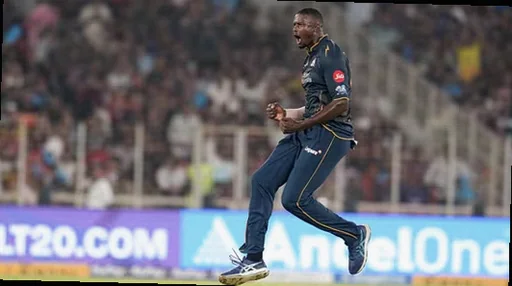
Jason Holder turned the spotlight in Ahmedabad on Thursday night as Gujarat Titans hosted Royal Challengers Bengaluru at the Narendra Modi Stadium. Wearing the GT colours, the West Indies all-rounder played a decisive role in the match, contributing to five dismissals and ultimately claiming Player of the Match honours as Gujarat overcame the defending champions by four wickets. Yet for RCB, the evening quickly became dominated by one moment in the field—an acrobatic catch that triggered immediate outrage and, even after replays, raised questions about whether the dismissal was taken within the proper laws.
The controversy began in the eighth over. On the fourth ball, Arshad Khan delivered a length ball when RCB captain Rajat Patidar went for a pull. He only managed a top edge, sending the ball skidding towards deep backward square. Holder, stationed in the vicinity, surged forward to close the distance, while Kagiso Rabada also charged in, forcing both fielders to adjust their paths. They avoided any collision, and Holder eventually pulled off a sharp low catch. However, RCB’s concern did not revolve around the difficulty of the take—it centred on what the replays appeared to show after the catch was completed.
When the footage was reviewed, RCB players felt that Holder had touched the ball down with the ground more than once while still in the act of catching and sliding. That perception sparked visible anger, particularly from Virat Kohli. Kohli stepped off the bench immediately, gesturing with his hand as if to indicate that the ball had hit the turf. He then was seen speaking animatedly to the reserve umpire in the dugout. Andy Flower, RCB’s head coach, also joined the discussion as the concern spread through the dressing room.
Patidar remained near the boundary during the commotion, before a final call came from the TV umpire, with the batter eventually walking off after the decision. The debate between Kohli and the match officials did not end quickly; it stretched on even after Patidar had already taken his place in the dugout and the immediate match situation had moved forward.
Several former players backed the protest. Irfan Pathan, Aakash Chopra, Abhinav Mukund and Dodda Ganesh all argued that the catch did not qualify as a legal dismissal, pointing to the same point RCB were making—that Holder appeared to have lost control as he slid, with the ball seemingly grazing the ground before the catch was fully completed. The comparison that added fuel to the debate came from an earlier incident in international cricket: a Mitchell Starc effort during an Ashes match at Lord’s three years ago. In that case, the third umpire overturned a decision for a similar reason, after replays showed the ball scraping along the turf while the bowler was sliding around the boundary. The explanation then was that Starc did not have complete control over his movement, and therefore the catch could not be considered finished in line with the laws.
That same principle was cited in Holder’s case as well. Under the Laws of Cricket, a catch is not treated as complete until the fielder has full control of both the ball and their movement. Put simply, if the ball touches the ground before that full control is achieved, the dismissal cannot stand. Law 33.3 states that a catch is only completed when the fielder has “complete control over the ball and his/her movement,” and it further clarifies that the ball cannot touch the ground before that point.
Even the way the MCC had previously explained the Starc incident was referenced in discussions around this match. The earlier clarification noted that the player was “still sliding as the ball rubbed the ground, therefore he was not in control of his movement.” Fans then shared clips from the GT innings to support their argument, showing the ball appearing to touch the grass on two occasions—once while Holder was sliding and again as he used support to push himself up.
So why did Patidar remain out despite the uproar? Two factors were pointed out in the analysis. First, the TV umpire was seen stopping the review at the instant Holder appeared to secure the ball, likely believing that control over ball and movement had already been established at that moment. Second, the key point of disagreement was how “control of movement” was interpreted. Control does not necessarily require a fielder to be stationary; a player can still be moving and yet remain in full command of their actions. In this instance, Holder did make an error in the way he rose—he took support from the ball as he got up—but it appeared the umpire had already treated the catch as completed before the slide ended and before the fall and recovery phase played out, effectively viewing the act of getting up as a separate event rather than part of the ongoing catch process.
