
Cricket has often acted as the great equaliser—one of the few sports where a player from a small cricketing ecosystem can, on the right day, remove a specialist with a World Cup pedigree for a duck. In the last few World Cups, the Netherlands have produced shocks against England and South Africa, while Italy—more famously linked with football—qualified for the T20 World Cup earlier this year and then edged past Nepal to claim their first-ever victory at an ICC event. Scotland have also taken down former T20 champions West Indies. These moments are not random headlines; they are the first chapters of a larger narrative that is still unfolding. And for anyone who grew up on Bollywood, the structure feels familiar: the underdog, the nearly impossible dream, the tense calm before the crowd ignites, and the breakthrough nobody predicted.
Abhishek Bachchan, who knows that kind of storyline intimately, is familiar with the emotional arc of “belief against the odds.” In 2023, he played Paddy in Ghoomer, a film about a broken-down, unsuccessful cricketer who finds purpose by coaching a one-handed woman to bowl for India. The movie was never only about cricket—it was about trust, and about backing someone the world had written off.
Three years on, Bachchan is no longer performing that character on-screen. Instead, he is attempting to live a version of it in real life—though his battleground is far from the dusty maidaan of Mumbai. His new “playing field” is Dublin, Belfast, Edinburgh, Glasgow, Rotterdam, and Amsterdam.
The European T20 Premier League (ETPL) is Bachchan’s boldest sporting move yet. With his earlier successes in kabaddi and football, cricket now joins the list of his “expensive hobbies.” ETPL is a six-team franchise tournament spread across Ireland, Scotland, and the Netherlands, designed using the IPL blueprint—something Bachchan describes as “a cornerstone moment in sportainment.” Already, Rotterdam, Amsterdam, Belfast, Edinburgh, and Glasgow have been secured by a group of cricketing icons, including Steve Waugh, Glenn Maxwell, Faf du Plessis, Jonty Rhodes, and Nathan McCullum. The sixth and final franchise—based in Dublin—received its new owner on Monday.
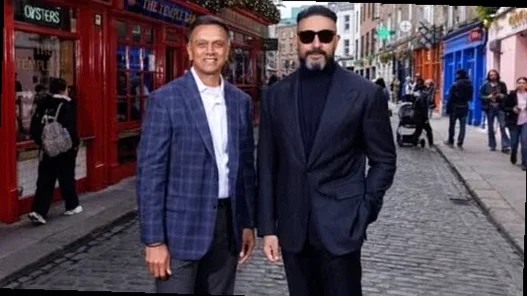
With the inaugural campaign scheduled to begin in August 2026, European cricket is finally moving toward its franchise chapter. And for this last franchise, Bachchan did not chase another global celebrity or a purely financial backer. He set his sights on Rahul Dravid.
Dravid—widely seen as one of Indian cricket’s most cerebral figures, a four-time World Cup player, the key architect behind India’s Under-19 transformation, and the coach who guided the team to a T20 World Cup title—has now taken ownership of the Dublin franchise. Dravid’s quick “yes” may be the ETPL’s most meaningful endorsement so far. As Bachchan frames it, legends like Dravid, Waugh, and Rhodes “don’t take these things lightly,” and their involvement is rooted in genuine commitment.
On a busy Monday in Dublin—where the city’s newest cricket franchise announcement brought a clear buzz—Bachchan sat down for an exclusive conversation with Hindustan Times Digital. He discussed why European cricket believes it is ready for franchise-level ambition, how T20 World Cup performances from associate nations have energized the ETPL vision, what it took to bring Dravid into the fold, and why he thinks top-tier cricket—not just marketing glamour—will decide whether the league truly lasts. Below are edited excerpts from the discussion.
Q) You’ve spoken over the years about your progression from kabaddi to football and now into cricket. You once called sports team ownership an “expensive hobby.” What made you believe this was the right moment to join cricket with the European T20 Premier League?
To be fair, I’ve always wanted to do something in cricket. Cricket is the gold standard for us Indians. Early in my journey as a sports entrepreneur, I wasn’t in a position where I could really take on something in cricket. More than that, I kept asking myself: what can I realistically contribute?
I also feel the BCCI already does a fantastic job back home, so I wondered what role I could play in the wider cricket ecosystem. ETPL looked like the one platform where I could make a real difference and contribute in a meaningful way.
Q) We’ve seen efforts to launch a European T20 league before. What gives you confidence that ETPL can work—and leave a lasting impact? You’ve also mentioned wanting to build a cricket legacy through this league. Did the recent T20 World Cup performances by teams like the Netherlands and Italy strengthen that belief?
Let me address the second part first—yes, absolutely. For European cricket, it has been the biggest injection of energy. Watching the Netherlands, Italy, Scotland, and even Ireland perform the way they did is exactly the kind of excitement that helps build a real buzz around ETPL.
At the same time, cricket is set to become an Olympic sport, and that has created enormous enthusiasm across Europe. When all these pieces come together, it’s genuinely exciting to witness—and even better to experience firsthand.
I’m in Dublin today to announce the sixth and final team, which Mr. Rahul Dravid has purchased. You can actually feel the excitement among the fans here.
As for whether the league can sustain itself, I believe firmly that if the cricket on offer is genuinely world-class, the tournament will succeed. I don’t think there is a substitute for that. The showmanship, the glamour, and the entertainment matter, but they can’t carry a league by themselves. It is competitive, high-quality cricket that will ultimately allow the project to grow.
Q) You mentioned glamour and razzmatazz, and the first comparison that comes to mind is the IPL—widely regarded as the top benchmark for franchise cricket. How much inspiration has ETPL taken from that model?
What Mr. Modi and the IPL achieved nearly two decades ago was truly a cornerstone moment in sportainment, and a defining moment for cricket. We’re all huge IPL fans, so it naturally serves as a major reference point.
To build something so distinctive and entertaining—and to still have it thriving almost 20 years later—signals what potential a league can have. So yes, the IPL is a wonderful source of inspiration for any sporting competition that wants to establish itself, not only in cricket.
Q) You also highlighted Rahul Dravid, another strong India connection for ETPL. How did you convince him to come on board?
Honestly, it didn’t require much convincing. That’s actually one of the most reassuring parts for us. Once he heard the vision that my co-founders and I have for cricket in Europe, he stepped in with full energy. He was genuinely excited about the project.
He has been extremely positive and has helped drive things forward. Rahul, Jonty Rhodes, Steve Waugh—these are legends of the game, and they don’t treat opportunities like this lightly. They are deeply involved in what they do.
What has been especially inspiring is seeing their interest in developing cricket across Europe. They’ve already put in a tremendous amount of effort, and their passion for how the sport should be played here has been outstanding. So Rahul didn’t need much convincing at all.
Q) In Ghoomer, you were part of an underdog cricket story. Now you’re helping build one in real life—across teams in Ireland, Scotland, and the Netherlands. What is the single story you hope ETPL creates in its first season?
That’s a great question. The most obvious answer is that I want people to watch the tournament and say, “Hey, did you see that? That was genuinely exciting. I can’t wait for the next season.”
You want the first season to deliver exciting, top-level cricket. Beyond that, as the league grows—adding more teams and, hopefully, reaching mainland Europe—I’d love ETPL to become one of the biggest T20 competitions in the world, not just in attention, but also in participation. In other words, a truly continental cricket tournament.
