
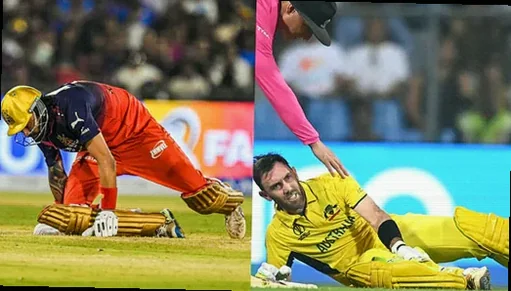
Krunal Pandya sprawled flat on the Raipur turf, his body seized with cramps, his breathing coming in heavy bursts, and his legs refusing to follow even the simplest command. Yet Royal Challengers Bengaluru’s chase refused to die. For long stretches the match looked like it might slip away, but the wounded left-hander kept finding ways to move the innings forward—until the end came from the field, not from his desire.
The moment carried players and memories back to Wankhede in 2023, when Glenn Maxwell’s legs were essentially ruined against Afghanistan and he still managed to haul Australia out of a World Cup collapse. Raipur, of course, did not offer another Maxwell 201 in the literal sense. What it produced instead was a smaller, tougher, IPL-shaped echo of the same impossible image: a batter trapped inside a failing body, still swinging hard enough to bend the contest in his team’s favour.
The night Maxwell turned pain into folklore
Maxwell’s 201* against Afghanistan already sits in cricket’s permanent archive. In that World Cup match, Australia were chasing 292 at 91/7, with the game already slipping toward Afghanistan. When Pat Cummins walked in, the immediate assignment was survival. But soon after, Maxwell’s body began to betray him in stages—calf, shin, hamstring, toes, then even his back. The innings stopped behaving like normal batting. He struggled to get set, he could barely move into position, and running became a constant negotiation with pain. Footwork disappeared, and the bat became the only part of him that still seemed to function.
And still, he kept hitting. Afghanistan bowled at a man who could hardly run, and watched him turn immobility into a threat. Glenn Maxwell found ways to create scoring arcs, cleared the ropes, refused the safe option of singles, and stitched an unbeaten partnership of 202 with Cummins. Cummins made 12 off 68 deliveries, a number that understates the role he played; he became the barrier that allowed Maxwell to become the storm. Australia won by three wickets, and Maxwell ended unbeaten on 201 from 128 balls. The innings propelled Australia into the semi-finals and also into that odd category of sporting moments that feel more remembered through sight than through statistics.
Krunal’s Raipur night found its own pain language
Krunal’s 73 against the Mumbai Indians unfolded on a smaller canvas, but it carried a similar physical grammar—control and violence mixed with a body that kept sending warnings. RCB were chasing 167, and the chase had already splintered early, reaching 39/3. Virat Kohli departed for 0, Devdutt Padikkal was dismissed, Rajat Patidar fell quickly, and the early cracks gave Mumbai the opening they needed to keep their playoff hopes alive.
Krunal stepped into pressure and rebuilt the chase with an uncommon blend of composure and aggression. His knock included four fours and five sixes, but the figures alone don’t capture the drama. The discomfort appeared early, and the physio came out. Stretching followed, and every attempt to run looked harder than the last. Then Deepak Chahar struck him on the stomach with a slower ball that stayed low. Krunal went down, and what started as discomfort deepened into a hamstring problem. The final phase arrived with RCB needing his bat, while Krunal needed his body to cooperate for just a few more minutes.
It didn’t. He tried to pull a ball to deep square leg, but once again he couldn’t run. Soon after, he went down again, flat on the pitch. The sight was both unsettling and gripping at the same time: a batter lying on the ground with his legs gone, the crowd pulled between concern and disbelief. Then, almost immediately, he rose and slog-swept Ghazanfar for a six. That was the Maxwell frame in T20 form—the ball vanished into the stands while the body remained broken, yet the contest still moved.
There was one miracle and one echo, but the same brutal cricket image running through both. Maxwell’s innings was the mountain; Krunal’s was the cliff-edge rescue. The comparison holds because cricket rarely gives the same kind of visual with such intensity. A batter loses the ability to run, the fielding side senses it, the required runs keep pressing, and each delivery becomes a private battle between timing and pain.
Maxwell pushed that image to its wildest conclusion in his chase—turning 91/7 into one of the greatest ODI innings ever played. His unbeaten double hundred exists outside ordinary comparison. Krunal offered RCB a version shaped by T20 urgency. He couldn’t finish the match; he was dismissed for 73 with RCB still needing 18 off 12. Tilak Varma’s boundary catch ended Krunal’s innings and reopened Mumbai’s opportunity. Bhuvneshwar Kumar then delivered the finishing impact with the six that Krunal later described as the shot of the match.
Even so, Krunal had already shifted RCB from danger to striking distance. He absorbed the early collapse, endured the body blow, fought through cramps in both legs, and left the chase close enough for one final attempt. That is where the parallel truly sits: in the image, in the stubborn refusal, in the strange power of a batter who can’t move freely anymore yet still continues to decide the outcome.
Raipur produced its own wounded hero story with the same haunting contrast of numbers. Maxwell left 201*. Krunal left 73. The better memory is the picture: Maxwell almost statue-still at Wankhede, launching Afghanistan into disbelief while Cummins guarded the other end and protected time itself. In Raipur, it was Krunal flat on the pitch, getting up and dragging his body into one more swing, sending the ball over the rope as Mumbai’s playoff chances tightened after every delivery.
Maxwell’s knock became folklore because it broke the sport’s usual limits. Krunal’s knock will live differently—inside RCB’s season, inside that late-ball chase, inside the night when Mumbai Indians were pushed out of the contest. It may not carry the same immortality in scale, but it is just as unforgettable in texture: a cramping batter transforming a chase into something superhuman, a wounded left-hander giving RCB enough air to survive, and a match that should have belonged to Mumbai’s late squeeze ending with Bengaluru stumbling, swinging, and somehow crossing the line. Wankhede had its miracle. Raipur delivered its echo.
