
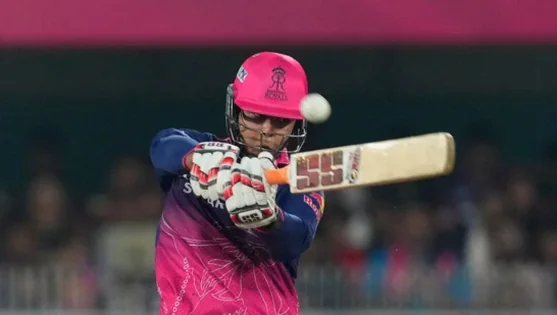
Vaibhav Sooryavanshi was always going to arrive with a built-in storyline. A franchise shelling out ₹1.1 crore for a teenager naturally turns even ordinary cricket moments into spectacle, and a 35-ball century only accelerated the attention. Yet the conversation around the batter has quickly outgrown the usual auction romance and age-tag excitement. After his early outings in IPL 2025 and IPL 2026, the focus has shifted: he is no longer simply a young hitter with fearless instincts. He is a powerplay threat that opponents have to neutralise from the very first overs, because if they fail to do so, the innings can disappear before it even truly takes shape.
The key change is how teams are being forced to think about him. Bowlers are not simply trying to dismiss a kid who is still settling in. They are attempting to stop a batter who already looks to seize control during the most valuable phase of a T20 innings. And the numbers from those two seasons suggest this is not random fireworks or a short-lived purple patch. It is a consistent scoring template that is showing up again and again.
Across the runs available from IPL 2025 and IPL 2026, Sooryavanshi has amassed 452 runs from 196 balls. That works out to a combined strike rate of 230.61. His boundary output is equally loud: 36 fours and 42 sixes, meaning he has cleared the ropes on 78 occasions in 196 deliveries. Put another way, 39.8% of the balls he has faced have ended as a boundary.
Split by season, the evolution becomes even clearer. In IPL 2025, he scored 252 runs off 121 balls, striking at 208.26. During that campaign he hit 18 fours and 24 sixes, while his dot-ball percentage stood at 37.2%. In IPL 2026, the aggression has climbed further: he has made 200 runs from just 75 balls, at a strike rate of 266.67, with 18 fours and 18 sixes. Just as important, his dot-ball percentage has fallen sharply to 26.7%.
That reduction in dots matters because it points to more than just more boundaries. It suggests he is getting stuck less often, and that is the difference between a dangerous hitter and a complete powerplay menace. When a batter can keep the scoring going while also maintaining boundary frequency, the early overs become a difficult equation for the bowling side.
The powerplay statistics underline the same reality. In IPL 2025, Sooryavanshi scored 144 runs off 70 balls in the opening phase, at a strike rate of 205.7. In IPL 2026, he has taken the same assignment to another level, blasting 179 off 65 in the powerplay at 275.4. Taken together, that’s 323 runs from 135 powerplay balls, with a strike rate of 239.26. This is where the alarm for opposition bowling plans begins: he isn’t only scoring quickly, he is front-loading damage into the segment of the innings when teams typically want early control.
There is another reason he feels disruptive early—his batting does not look crude. It has shape, and the ball-by-ball breakdown suggests he isn’t relying on one or two favourite swings. In IPL 2025, some of his strongest scoring shots included a back-foot pull (61 runs), a lofted on-drive (42), and a slog shot (39). In IPL 2026, the shot variety broadens further, with 68 runs coming from his drive, 43 from his pull, 30 from a slog sweep, and 26 from a flick. The implication is straightforward: he can hurt teams on the rise, he can access the leg side, and he can also punish attacks through straighter and off-side arcs. He is not waiting for a narrow kind of mistake to strike; he is able to manufacture damage from multiple angles.
Pace, in particular, has not bothered him. Across both seasons, he has scored 306 runs off 128 balls against pace at a strike rate of 239.1. Against spin, he has still been effective—130 runs off 68 balls at 191.2—but the gap is significant. In this matchup, pace appears to be where he looks most destructive, and that influences how teams structure their early bowling partnerships.
Even the way he attacks different lengths gives a tactical clue. In IPL 2025, full deliveries produced 62 runs off 24 balls at a strike rate of 258.3, while good-length balls returned 86 off 54 at 159.3. Yorkers have been far more difficult for him to convert, with 1 run off 5 balls and one dismissal recorded. In IPL 2026, the pattern tilts even more toward his comfort zone: full balls have yielded 63 off 18 at a strike rate of 350, good length has brought 69 off 31 at 222.6, and short of length has generated 57 off 19 at 300. The message for bowling sides is clear—if a seamer overpitches even slightly, the risk is immediate. He does not require many such deliveries to flip the momentum of an over.
Sooryavanshi’s risk is not just the generic cliché of “he plays spin well” or “bowl wide outside off”. The deeper issue is that the easy plans are the wrong plans. Width outside off is not a safe haven against him; it is fuel. In IPL 2025, he scored 119 runs off 52 balls outside the off stump at a strike rate of 228.8. In IPL 2026, that has risen to 112 off 38 at 294.7. Repeated width appears to give him extension, and once he can extend his arms, he can punish even when bowlers do not miss by much.
The more useful hint comes from how he behaves when the ball is kept tighter. In IPL 2026, deliveries on the middle stump returned only 12 runs off 10 balls at a strike rate of 120, with a 60% dot-ball rate. Narrowing it further, the data suggests that on a good length, middle stump produced just 1 run off 6 balls and a dismissal. That is not enough to label it a fully exposed technical weakness, but it is strong evidence of a tactical advantage for bowlers.
In practical terms, the best approach is not to chase a magic line outside off. The better method is to deny him extension, crowd his base, and force him to generate power rather than simply collect it. Spin demands a similar level of nuance. He can hit spin, and that part is obvious. But spin has still resulted in five dismissals, compared to four dismissals against pace, even though he has faced far fewer balls of spin. That makes spin a better wicket-taking matchup than pace—provided it is delivered flatter and tighter, rather than floated into a hit-friendly arc.
With all of that combined, the bowling brief becomes much more specific than the usual chatter around young batters. Do not serve him full balls. Do not keep giving him width. Do not allow him to see swinging lanes that open up too easily. Bowl hard and at a good length, target off-to-middle or middle lines, and use yorkers as a surprise rather than as something you search for from ball one. Most importantly, make him hit from a cramped base, not a free one.
This is why Vaibhav Sooryavanshi is already shaping up as a serious story in T20 cricket. Yes, his numbers carry the volume of hype, but beneath them sits something more unsettling for opponents: a repeatable scoring pattern capable of tilting the powerplay on its own. He is still a work in progress, and he is still showing signs of being too boundary-dependent at times. However, he has already progressed to the point where bowling sides may need to rewrite their opening script to survive the first phase. In this format, that is how real batters announce themselves.
