
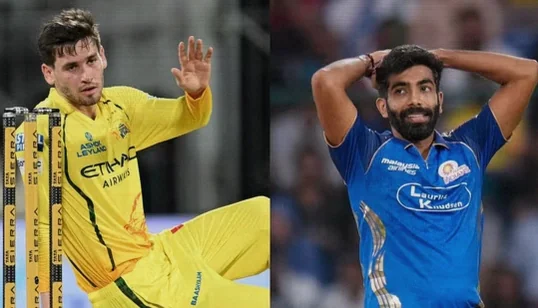
A wicketless opening burst from a star pacer often makes for dramatic IPL headlines. The tournament’s tempo is relentless, crowds are loud, and reputations are frequently judged on a handful of overs—especially when a bowler goes silent for a couple of spells. But after Match 13 of IPL 2026, the more revealing reality is that the league’s group of wicketless headline-makers is not one single problem. It is a bundle of separate situations, all showing up as the same empty wicket tally.
The list is eye-catching and hard to ignore. Jasprit Bumrah, Trent Boult, Arshdeep Singh, Harshal Patel, Noor Ahmad, Khaleel Ahmed, Varun Chakaravarthy and Anrich Nortje are all yet to take their first wicket of the season. On the surface, it looks like one massive coincidence. However, the figures point to a sharper split: some bowlers have delivered the kind of spells that typically produce wickets but simply haven’t been rewarded yet, while others have been costly during the exact phases where their impact is supposed to show. For several franchises already struggling early, those differences are starting to matter.
The wider context makes the pattern even louder. Mumbai Indians sit at 1-2, with a bowling economy of 10.84, while Chennai Super Kings have a record of 0-3. CSK’s position feels particularly unstable because their bowling economy has risen to 11.57. So when Bumrah, Boult, Khaleel and Noor remain wicketless, this is not only a personal stat quirk—it is beginning to influence the early narrative around team performances too.
Bumrah’s zero is the least concerning of the lot
Jasprit Bumrah naturally draws the biggest spotlight, because a wicketless Bumrah feels almost unnatural. He has 0 wickets across 3 innings and 11 overs, conceding 88 runs at an economy rate of 8.00. In most parts of an IPL season, 8.00 is not automatically alarming. With Bumrah, though, the concern is heightened simply because expectations are sky-high.
Still, once you move past wickets, the panic fades quickly. Bumrah’s dot-ball percentage stands at 33.3, and his boundary rate is 16.7. Those are not the hallmarks of a bowler losing rhythm. They suggest he is still exerting control over meaningful stretches of his spells. The phase-wise numbers back that up: he is at 8.50 in the powerplay, 6.00 in the middle overs, and 9.50 at the death. The middle-overs segment is especially reassuring, and even his late-innings economy—while not vintage Bumrah—does not look disastrous in a season where scoring has remained aggressive.
So Bumrah’s wicket drought is dramatic only if wickets are the only metric. The fuller picture indicates he is closer to being “unrewarded” than “ineffective.” He is not bowling like someone who has lost his edge; he is bowling like someone whose breakthrough has not yet arrived on the scoreboard. For Mumbai, that distinction is crucial: it is less about a specific Bumrah problem and more about a broader, collective bowling challenge.
Boult’s concern hits closer to his core job
Trent Boult’s case is more worrying, even with the smaller sample size. He has 0 wickets in 2 innings and 5 overs, has conceded 60 runs, and is averaging 12.00 runs per over—already a weak return. Yet the bigger issue is not simply that he is wicketless. It is that he has not yet made his presence felt in the opening phase where his value is supposed to be most visible.
Boult’s role is designed to reshape the first six overs of an innings. It is not just about being tidy; it is about doing damage early, disrupting batting pairs, and forcing a chase—or a platform—into an unsteady shape before it settles. When a bowler known for that early impact remains wicketless and also carries a double-digit economy, the concern goes beyond the surface.
This is why Boult’s start feels more troubling than Bumrah’s. Bumrah’s control still looks intact even without wickets. Boult’s influence has not shown up in either form yet—no wickets, and no clear evidence of dominance in the early phases. For Mumbai, that becomes a tactical concern that matters more than simply seeing an empty column.
Khaleel looks wicketless on paper, but the performance signal is different
Khaleel Ahmed is one of the easier names on this list to misread. He has 0 wickets in 3 innings and 10 overs, but he has conceded only 82 runs, giving him an economy of 8.20. Even more revealing is his dot-ball percentage of 43.3—among the strongest control indicators across this wicketless group.
His phase breakdown strengthens the positive read. In the powerplay, Khaleel has bowled at 7.38, which is a strong outcome in a tournament where openers look to attack from the first ball. The death-overs sample is less clean, but the overall picture still points in the right direction. He has not looked like a bowler without answers; rather, he has looked like someone who has asked enough questions without yet receiving the breakthrough.
That makes Khaleel one of the few names here whose wicketless run should not automatically spark alarm. Among the wicketless bowlers, he has probably been one of the better performers so far. Wickets are missing, yes—but the pressure numbers suggest he has not been letting batters settle. For Chennai, though, the bigger issue is not Khaleel staying wicketless. It is whether enough of the attack around him is compensating for the broader bowling weaknesses.
Also Read: Bring him on already, Agarkar: BCCI sitting on a Vaibhav Sooryavanshi goldmine; cotton wool no longer his place
Noor Ahmad’s numbers make this more than a slow start
Noor Ahmad’s name stands out because this is not only a wicketless start—it is wicketlessness paired with weak control. He has 0 wickets in 3 innings and 10 overs but has already conceded 111 runs at 11.10 per over. His dot-ball percentage is 21.7, and he has been struck for 10 sixes already.
For a wrist-spinner expected to act as a middle-overs controller, those figures are rough. A spinner can survive a short wicket drought if batters are still being forced to take risks and make mistakes. But when wickets do not arrive and runs flow too freely, the damage accelerates. Noor’s situation so far matches that exact pattern: too little squeeze, too much release.
And because Chennai’s bowling numbers are already under strain as a unit, Noor’s form hits harder than it might in a more stable attack. This is not a team carrying one underperforming bowler while the rest function strongly. It is a side already leaking in key areas, with a crucial middle-overs spinner failing to provide the control and strike power expected. That combination turns Noor’s wicket drought into one of the more consequential stories on the list.
Varun’s early numbers are alarming in quality terms
If Bumrah’s wicketless spell is the most misleading headline, Varun Chakaravarthy’s start is arguably the most concerning pure bowling story. He has 0 wickets in 2 innings and 6 overs, and has conceded 79 runs—an economy of 13.17. His dot-ball rate sits at only 16.7, while his boundary percentage is 36.1.
Those three numbers together are brutal. A bowler can survive being wicketless if the tempo is still controlled. A bowler can survive going for runs if wickets are still falling regularly. But being wicketless, expensive, low on dots, and leaking boundaries all at once is the danger zone.
For Varun, that matters even more because his role is built on disruption. He is meant to create hesitation, pull batters away from clean timing, and fracture the flow of middle overs. Instead, he has looked hittable too early in the innings. This is not a scenario of one missed opportunity or one chance that slipped away. It is a situation where both the wicket column and the control indicators are flashing warning signs.
Harshal is not waiting purely on luck either
Harshal Patel belongs in the genuinely worrying bracket as well. He has 0 wickets in 2 innings and 5.4 overs, has conceded at an economy of 9.70, and has a dot-ball percentage of 23.5. For a bowler whose value is closely tied to disrupting batters through variation, those returns do not look strong enough.
Harshal’s issue is more than just the first wicket not arriving. There has not been enough sustained discomfort for batters. His bowling style has often been slightly different from a straight powerplay swing bowler or a pure pace enforcer. He tends to make scoring awkward by altering pace and rhythm, forcing hitters into mistiming the shots they want to line up. So far, that type of consistent disruption has not shown up often enough.
That makes Harshal’s slow start feel more performance-driven than luck-driven. He is not yet in a full crisis, but he is carrying more pressure than someone like Bumrah or Khaleel. If the wickets stay away and the economy rises above 10, the scrutiny around him will sharpen quickly.
Arshdeep is mixed, while Nortje is too early to judge properly
Arshdeep Singh sits in an awkward middle zone. He has 0 wickets in 3 innings and 10 overs, has conceded 99 runs, and has an economy rate of 9.90. The additional concern is that he has already given away 13 extras, which points to looseness alongside the wicket drought.
Even so, Arshdeep’s situation is not as troubling as Noor’s or Varun’s. He has not looked consistently sharp, but he has also not looked completely without answers. He is in that uncomfortable space where the output is poor enough to notice, yet not poor enough to label as a major dip in form. What he needs is adjustment, not rescue.
Nortje is harder to interpret because the sample is extremely small. He has bowled just 1 over in 1 innings, has taken 0 wickets, and is currently going at 9.75. That is not ideal, but it is far too limited to build a meaningful narrative. He fits better on a watchlist than on a pressure list. Big names can attract big judgments quickly, and Nortje’s numbers so far simply do not provide enough material to conclude anything definitive.
One number, multiple stories
The real lesson in this trend is that the same “zero” can mean completely different things. Bumrah and Khaleel look like bowlers who have done enough good work to make wickets feel imminent. Nortje is still too early to place firmly in any category. Arshdeep’s start is mixed—neither disastrous nor particularly sharp. Boult, Noor, Harshal and Varun are the names facing more genuine pressure, because their wicketless starts are being accompanied by a loss of control in the very phases that define their value.
That is what makes this one of the more revealing early-season storylines in IPL 2026. A wicketless opening can be a mere quirk. A wicketless start paired with strong pressure indicators can be tolerated for a while. But once premium bowlers stop taking wickets and controlling games, it stops being trivia and becomes a structural issue. Across 13 matches, the strangest bowling theme is not simply that many big names are wicketless. It is that the empty wickets column is concealing two completely different realities—some bowlers are nearer to breakthroughs than they appear, while others are already showing signs of real strain.
