
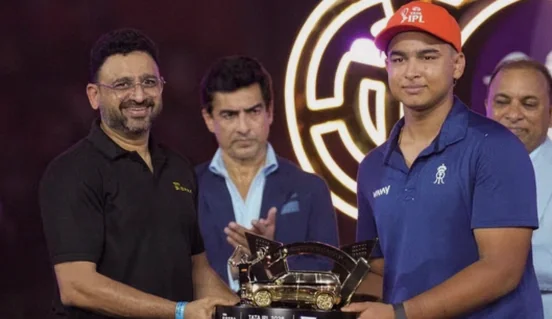
End-of-season IPL award nights are built on the idea of split glory: one star collects batting honours, another is celebrated for bowling impact, and the most valuable performer usually sits in a separate lane. IPL 2026 broke that pattern in a big way. Vaibhav Sooryavanshi walked up the stage five separate times and finished with ₹55 lakh in prize money, a Tata Sierra, and a simple takeaway—this season’s batting story belonged to him, and him alone.
Quick facts from the award night
- Vaibhav Sooryavanshi received five awards at the end of IPL 2026.
- Total prize money won: ₹55 lakh, plus a Tata Sierra.
- Orange Cap: 776 runs at a strike rate of 237.31.
- MVP: 436.5 points.
- Super Striker of the Season: ₹10 lakh and a Tata Sierra.
- Super Sixes of the Season: 72 sixes and ₹10 lakh.
- Emerging Player of the Season: ₹10 lakh.
- Notable records: 12 sixes vs Sunrisers Hyderabad in an IPL innings; 36-ball century vs Sunrisers Hyderabad; fastest to 1,000 IPL runs by balls faced in Qualifier 2 vs Gujarat Titans.
The Orange Cap was the most direct confirmation of what captains had been dealing with all season. Sooryavanshi struck 776 runs at a strike rate of 237.31, and the manner mattered as much as the output. This wasn’t a campaign built on cautious accumulation or matchup-by-matchup planning—it was a steady dismantling of bowling attacks from the very first over, with Powerplay overs turning into a phase opponents could not reliably manage.
The ₹10 lakh linked to the Orange Cap felt like a formal stamp on a reality that was already obvious to every captain who had tried to set fields against him. Even when bowlers adjusted length, angle, or pace, the damage often arrived in the same shape: aggression that stayed controlled enough to keep scoring, and ruthless enough to overwhelm any opening plan.
The MVP prize, worth ₹15 lakh, widened the lens beyond totals. Sooryavanshi won the Most Valuable Player award with 436.5 points—an index designed to reflect overall match influence rather than just counting runs. The size of the gap between him and the next contender underscored how completely he dominated the tournament’s terms of engagement.
Why 2026 looked different
Historically, the great IPL seasons tend to be defined by one dominant quality. Virat Kohli’s 2016 is remembered for sheer, relentless volume. Chris Gayle’s peak years carried the kind of crease presence that made bowlers fear contact. David Warner’s best stretches were built on consistency that opponents could anticipate and still struggle to stop. Those campaigns often owned a single lane.
Sooryavanshi’s 2026 collected nearly all of those lanes at the same time. The season didn’t just produce runs—it produced a complete batting profile: explosive output, repeated dominance, and the ability to turn high-leverage overs into decisive statements.
The Super Striker of the Season award—also tied to ₹10 lakh and a Tata Sierra—exists to separate real sustained aggression from a brief surge. It has a minimum ball requirement for eligibility, which makes Sooryavanshi’s strike rate across a full IPL campaign even more striking. A strike rate of 237.31 over the length of the tournament wasn’t a fluke; it effectively rewrote what long-term T20 batting aggression can resemble.
His six-hitting record reinforced that narrative in a different language. Chris Gayle’s earlier single-season benchmark had hardened into the kind of number people treated as a ceiling. Sooryavanshi didn’t just challenge it—he surpassed it. He finished with 72 sixes to claim the Super Sixes of the Season award and another ₹10 lakh.
Along the way, his 12 maximums against Sunrisers Hyderabad in a single IPL innings became the most sixes by an Indian batter in one innings, overtaking a record that had stood since 2010. Those figures weren’t isolated moments; they fit the same pattern—early intent, sustained hitting, and a rare ability to keep finding scoring options even when bowlers tried to clamp down.
The Emerging Player of the Season prize, carrying ₹10 lakh, came with the strangest contradiction. The award normally implies potential, a player still in the process of becoming, someone whose best years are still ahead. Sooryavanshi certainly has the “future” element in his profile, but the way he dominated the other categories made it hard by the end of the tournament to label him as merely emerging.
A 36-ball century against Sunrisers Hyderabad stood as the third-fastest of its kind in IPL history, adding another layer to his pace of scoring. Then, in Qualifier 2 against the Gujarat Titans, he became the fastest player to reach 1,000 IPL runs when measured by balls faced—an achievement that highlighted how quickly he converted opportunities into major totals.
Records kept arriving in succession, each one tied to a single theme: the campaign was owned by a 15-year-old from Bihar. The scale of impact—so much damage, so consistently, for an opener—also made the season feel like it was forcing IPL cricket to rethink what an opening batter is allowed to do.
In the end, the ₹55 lakh is only part of the story. Numbers cannot fully capture the shape of the tournament itself—an edition that repeatedly tried to find an answer to Sooryavanshi and ran out of time before it could. The auction detail adds a final twist: the Royals bought him for ₹1.10 crore, and the left-handed batter returned half of that valuation in prize money alone when the season’s awards were handed out.
