
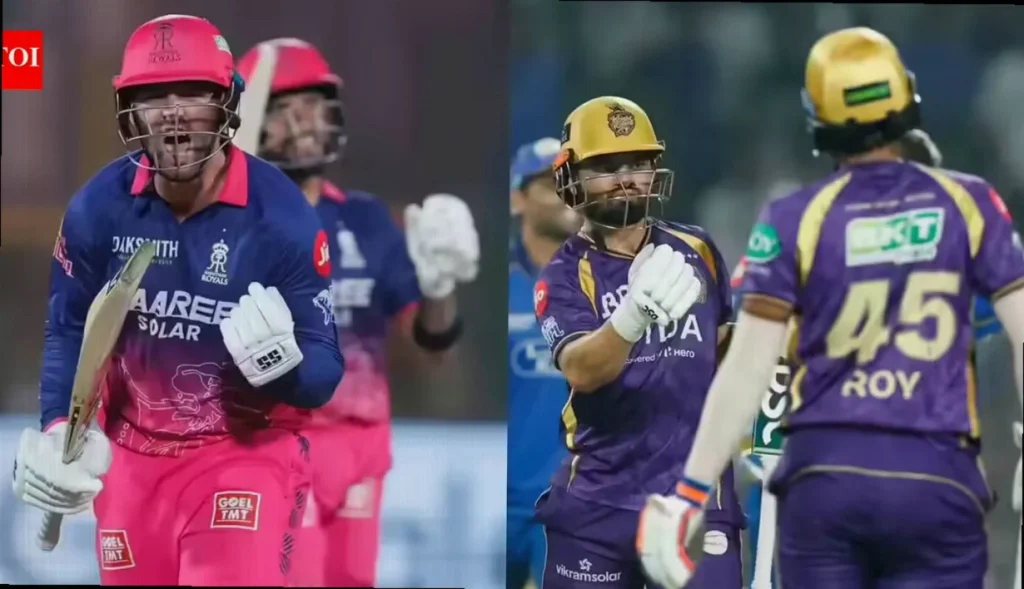
With just five matches left in the IPL 2026 league phase, the playoff picture has started to take shape — but the race for the remaining berths is still far from settled. Lucknow Super Giants and Mumbai Indians are already out of contention, while Royal Challengers Bengaluru, Gujarat Titans and Sunrisers Hyderabad have booked their places in the playoffs. Rajasthan Royals sit best among the teams still chasing a spot, followed by Punjab Kings and Kolkata Knight Riders. Delhi Capitals and Chennai Super Kings remain mathematically alive, though their paths now rely heavily on other results going their way. With 32 different combinations of results still possible across the final round of fixtures, qualification scenarios could swing quickly for the sides still in the hunt.
Who has qualified and who is still chasing
- LSG and MI: eliminated from playoff contention with five games remaining.
- RCB, GT, SRH: already qualified for the playoffs.
- RR: positioned best among the remaining teams, with PBKS and KKR next in the pecking order.
- DC and CSK: still in the equation only mathematically.
- Because 32 outcome combinations are still possible, no team outside the already-qualified group can feel fully secure.
Qualification paths: RR’s route in the final stretch
Rajasthan Royals’ position gives them a clearer path than most, but it still hinges on results in their final match. Their key requirement is to secure a win over Mumbai Indians in their last game.
- If RR beat MI: RR would lock in qualification.
- After an RR win over MI: the remaining permutations could leave RR facing a three-way tie for second place if SRH and GT lose their final matches.
- Alternative with RR win over MI: RR could also end up in a tie for third with SRH or GT, depending on how those final fixtures play out.
- If RR lose to MI: RR’s qualification would depend on Punjab Kings failing to beat LSG.
RR’s loss scenario becomes a multi-step chain that ultimately requires another result involving MI. If RR fall short against MI, then Punjab Kings must not beat LSG to keep RR’s chances alive.
- PBKS condition: PBKS need to beat LSG to maintain any realistic qualification opportunity.
- Then MI condition: even if PBKS beat LSG, RR’s qualification would require MI to beat RR.
- Crucial decider match: if those results line up, the KKR vs DC game would determine whether PBKS finish alone in fourth or tied for fourth with KKR.
- KKR’s requirement: KKR must beat DC, but that result alone would not be sufficient — MI also has to beat RR for this chain to hold.
- Final tie-breaker for this scenario: if the above happens, the PBKS vs LSG match would decide whether KKR finish fourth outright or tied for that position with PBKS.
- DC’s qualification mechanics: DC must beat KKR, and then two additional results must go in their favour — LSG beating PBKS and MI beating RR — for DC to even reach a level position for fourth with either RR or KKR and CSK.
However, even in the best-case sequences, DC’s net run rate is described as significantly worse than both RR and KKR, making qualification appear only theoretical for them.
CSK’s dependency and net run rate limits
Chennai Super Kings face an even tighter set of dependencies than DC. Their route requires a win in their own fixture followed by a cascade of favourable outcomes elsewhere.
- CSK’s must-do: CSK need to beat GT.
- Then the hope list: CSK would also need LSG to beat PBKS, MI to beat RR, and DC to beat KKR.
- If everything goes right: CSK would tie for fourth with RR and DC.
On the net run rate front, CSK are currently positioned worse than RR but better than DC, which adds another layer of complexity to their already narrow path.
