
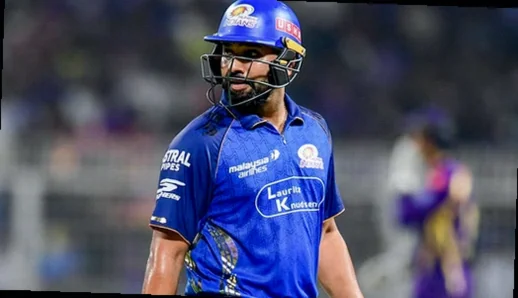
Mahela Jayawardene has moved to put the spotlight back on team planning, insisting that Rohit Sharma is completely fit and that Mumbai Indians’ continued decision to deploy him as an Impact Substitute is no longer a medical workaround. With MI’s injury-disrupted IPL 2026 season slipping into its post-season phase, the head coach framed the current usage of the former captain as a matter of XI balance and bowling strategy rather than any lingering concern about his body.
Rohit’s campaign had already been shaped by an early hamstring setback, which meant Mumbai had to be careful with how much he did over the course of matches. After returning from that injury, his involvement in the field was limited, and it naturally kept fresh questions alive about whether the franchise was still physically managing him. Jayawardene, however, said that doubt has now been cleared.
Speaking on Rohit’s role, Jayawardene said Rohit is available at full capacity from a fitness perspective and that the change in approach was mainly tied to the team’s immediate needs. “In my view, and based on what our medical team has told us, Rohit is 100%. When he came back after the hamstring issue, we were a little cautious in the first game. At the moment, he is used as an Impact Sub when we are bowling, simply as part of the team combination. He understands his role well and is a proper team man,” Jayawardene said.
The clarification lands at a time when Mumbai’s season has been defined by disruption. Rohit’s hamstring problem was one of the earliest hurdles, and MI also had to absorb injuries to other key figures across the tournament. That constant instability seeped into both selection and rhythm, leaving the five-time champions unable to find a consistent run of form even though their core talent base looked strong on paper.
Rohit’s deployment as an Impact Substitute had become a talking point because Mumbai had previously shown a desire to give him a more prominent on-field role during the season. His return functioning largely as a batting option, therefore, created a visible message that his workload was still being managed. Jayawardene’s latest remarks are aimed at separating the present decision from the original injury itself, with the emphasis shifting to how the franchise is constructing its playing group based on what it wants from the bowling side.
Alongside Rohit, Jayawardene also defended Suryakumar Yadav, whose form has been one of MI’s major concerns. Surya began the season with the status of a key batting pillar for the franchise, but his output has not matched either his reputation or what the team required—especially in a campaign where the middle order has repeatedly failed to sustain control for long enough to tilt matches in MI’s favour.
Jayawardene acknowledged the dip while insisting it is not something that should be treated as permanent. “Suryakumar is naturally gifted. Right now, it’s a mix of confidence and simply going through a patch. That’s part of cricket,” he said.
Even if that explanation is accepted publicly, the underlying concern remains. MI’s batting identity relies heavily on Surya’s ability to change the tempo, recover precarious starts and impose dominance during the middle overs. When that influence fades, Mumbai lose one of their most important tactical levers. Jayawardene tried to keep the message rooted in trust, presenting the current phase as temporary rather than a structural problem—an attempt to maintain belief within and around the team.
Jayawardene then turned his attention to Jasprit Bumrah, discussing how the franchise approached his workload and his return to competitive action. Bumrah’s fitness has been a major conversation across Indian cricket due to the impact he has in every format, and MI had to handle him carefully during a season already loaded with setbacks.
“It was a collective discussion with Bumrah and the training staff. We had a good conversation. We all learn from a season like this. Over the next six to eight weeks, he worked hard to come back to where he should be,” Jayawardene said.
That comment underlined that MI’s thinking around Bumrah was not a simple selection call—it involved the player, the support group and the coaching team working together. For Mumbai, though, even the return of their premier fast bowler could not fully repair a campaign where too many moving parts malfunctioned at once.
Jayawardene also pointed to the need for internal reflection, stressing that MI will have to review how the group responded to setbacks. Injuries affected the side, but he suggested that there were also moments where the squad did not manage to turn conversations into momentum. “It’s everyone’s responsibility. We have a core group. This year, injuries have affected us. We had some really good conversations within the group, but we haven’t been able to galvanise. That’s something to reflect on after the season,” he said.
For Jayawardene, that broader reality captures the season better than any single injury explanation. Mumbai had experience, leadership and match-winning quality, yet the team never fully connected into a settled unit for long stretches. Injuries played their part, but the larger issue was the inability to convert that senior core—featuring Rohit, Surya, Bumrah and Hardik Pandya—into a campaign that felt stable and consistently effective throughout IPL 2026. Now, Jayawardene’s post-season review will have to confront why that talented group never quite found its footing when it mattered most.
