
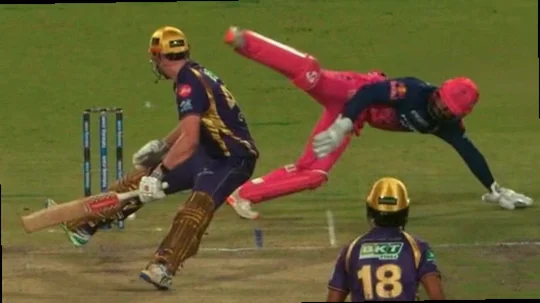
Rajasthan Royals suffered a setback in Match 28 of IPL 2026, going down to Kolkata Knight Riders at Eden Gardens. Yet one moment from Dhruv Jurel stood out for its quality: his stumping of Cameron Green, a key intervention during a chase of 156. Even though RR ultimately lost, the wicket itself carried weight in both cricketing terms and match-state context.
Quick facts
- Match: IPL 2026, Match 28 — Rajasthan Royals vs Kolkata Knight Riders
- Venue: Eden Gardens
- Chase: KKR chased 156
- Green’s spell: 27 off 13 balls (four fours and a six)
- Key moment: Jurel stumped Cameron Green off Ravi Bishnoi
- When it happened: third delivery of the fifth over
- Score at the time: KKR 36 for 2; still needed 120 from 94 balls
- Impact valuation (fielding): 5.0 impact points; about ₹7.02 lakh
- Impact valuation (batting lost): -7.839 impact; about ₹11.01 lakh to KKR
In the early chase, Green arrived with clear intent and instantly threatened to run away with proceedings. He moved quickly to 27 runs in 13 balls, striking four boundaries and clearing the ropes once. The pace of his innings suggested the target could be destabilised before the contest reached the middle overs.
The stumping that changed the tempo
The turning point arrived in the fifth over. With KKR sitting at 36 for 2 and needing 120 from 94 deliveries, Jurel produced a high-skill stumping off Ravi Bishnoi on the third ball of the over. Green had advanced down the track looking to press the attack, but he ended up stranded away from his crease.
Bishnoi delivered a shorter googly aimed down the leg side as Green came forward to hit through the line. Jurel had to shift sharply to his left, gather the ball cleanly, and dislodge the bails in one fluid movement. Green was already short of safety when the wicket fell, but the dismissal still demanded exceptional reaction time, steady balance, and precise glove work from the keeper.
This was not merely a wicketkeeping checkbox—it’s the kind of effort that relies on timing, body control, and execution under pressure. Jurel’s dismissal interrupted the momentum that Green had established and forced RR to take control of the chase’s direction at a critical stage.
Why the wicket mattered more than the scoreline
The value of the dismissal came from both timing and the match situation. With only 156 to chase, one innings built aggressively during the powerplay could have stretched the target into something KKR could chase with comfort. Green, at that moment, looked capable of driving exactly that shift.
Green’s boundary-heavy start had already provided 22 runs in boundaries alone, and his approach wasn’t about soaking up pressure after early wickets. He was attacking, and his scoring rate sat well above the required rhythm for the chase—especially when RR removed him with the asking rate at just 7.66.
In effect, RR weren’t just ticking off a batter. They cut off a chase-shaping spell before it could fully mature into a middle-overs surge. By doing so, they prevented KKR’s tempo from settling into a pattern that would have been difficult to disrupt later.
There was also an additional practical impact on the chase. KKR had already lost Tim Seifert and Ajinkya Rahane, and Green’s dismissal made it 37 for 3. That forced the batting side to reset and pushed more responsibility onto a lineup that suddenly wasn’t controlling the game in the way it had started.
How the moment was valued
Jurel’s stumping generated significant fielding impact in the valuation framework used for this analysis. His dismissal of Green carried a fielding impact of 5.0 on the ball, with each impact point estimated at roughly ₹1.4046 lakh. Multiplied together, that places the wicketkeeping contribution at about ₹7.02 lakh.
This is the figure to focus on when assessing Jurel’s skill. It isolates the quality of the intervention without exaggerating what happened after the wicket. RR eventually lost the match, but that outcome doesn’t reduce the value of a high-skill wicketkeeping moment—precision remains precision whether the team wins or not.
There’s a second, separate number that captures the immediate damage to KKR’s chase. Green’s dismissal carried a batting impact of -7.839, which corresponds to about ₹11.01 lakh in direct batting value lost by KKR on that delivery. That measure should be treated separately from Jurel’s fielding value, offering a parallel reading of the same ball’s effect.
What made the effort technically difficult
The dismissal stands out because of the difficulty it presented. This wasn’t a simple take where the batter was only marginally out of his crease. The ball was sent well down the leg side, Green had already advanced, and Jurel still had to remain composed enough to collect cleanly and complete the stumping without losing control.
There was no fumble, no second attempt, and no wasted motion—just a clean execution. The quality of the catch also matched the size of the wicket. Green was KKR’s biggest investment at ₹25.2 crore, and by that stage of the season, his rolling per-match cost was ₹180 lakh.
That doesn’t mean the stumping literally “earned back” the price tag. It means RR removed a premium batter who had the ability and the freedom to tilt the chase much earlier than KKR ultimately managed to do. With Green dismissed, RR disrupted the very phase of the innings that looked most dangerous.
That is why the wicket deserves a bigger reading than a routine line on a scorecard. Green had already been scoring freely, already operating ahead of the required rate, and already threatening to prevent RR from maintaining sustained pressure.
The wider match contrast
The broader narrative of RR’s evening also makes Jurel’s intervention even more striking. Later on, RR let the game slip when Rinku Singh was dropped on 8 in the 11th over, and he went on to finish unbeaten on 53. That missed chance reopened the chase and allowed KKR’s most valuable batting stretch to survive.
Still, that later error shouldn’t erase what Jurel accomplished earlier. If anything, the contrast captures RR’s evening in full: one moment of elite execution through the stumping, and one hugely costly mistake through the dropped chance off Rinku. One tightened their grip on the chase; the other allowed it to loosen.
Jurel’s stumping was a genuinely high-value wicketkeeping effort in both technical and match terms. But RR couldn’t build on that advantage strongly enough to turn it into a win.
How the numbers were derived
Under the valuation approach used here, the stumping’s worth comes from the fielding impact assigned to the dismissal ball. At 4.3 overs, Jurel’s stumping of Green registered a fielding impact of 5.0. With each impact point valued at approximately ₹1.4046 lakh, the calculation (5.0 × ₹1.4046 lakh) yields ₹7.02 lakh as the monetary value of Jurel’s wicketkeeping contribution on that delivery.
Separately, Green’s dismissal carried a batting impact of -7.839, translating to about ₹11.01 lakh of direct batting value lost by KKR. This second number is about the immediate damage done to the batting side, and it does not represent the value of Jurel’s action itself.
