
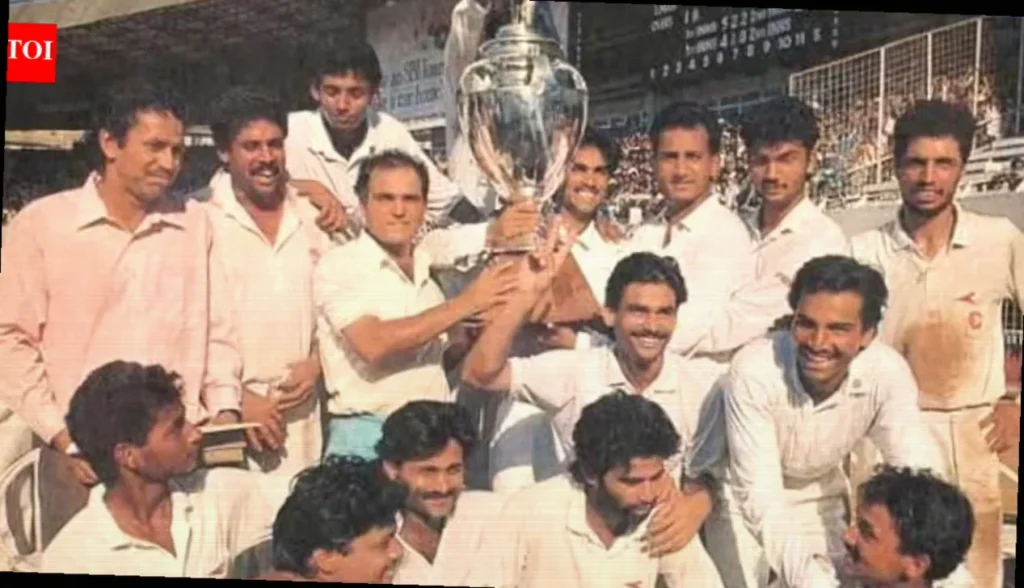
May 7, 2026, in Mumbai, marked 35 years since one of the most celebrated Ranji Trophy finals ever staged. In the 1990-91 season, Haryana—captained by India’s 1983 World Cup-winning skipper Kapil Dev—pulled off a stunning two-run win over the heavyweights from Mumbai at the Wankhede Stadium to claim their first-ever Ranji title. For cricket fans who grew up on IPL dramas, this was the kind of domestic thriller that refuses to end, with the contest swinging right down to the final delivery on the last day. The game, broadcast live on Doordarshan Sports, is still talked about for its twists and the quality of cricket on offer, even though the broadcaster later removed the footage.
Scheduled from May 3 to May 7, 1991, the final produced a high-scoring, pressure-packed set of innings that still stands out in Indian domestic memory. Haryana built a formidable platform with 507 in their first outing, driven by Deepak Sharma’s 199 and a sensational recovery late in the order, with Chetan Sharma striking 98 from No. 9. Mumbai responded with 410, despite Sanjay Patil’s top score of 85 and Lalchand Rajput’s 74. Kapil Dev finished with figures of three wickets for 54, while Yogendra Bhandari chipped in with five wickets to keep the contest tight.
Final-day chase and the turnaround
- After Mumbai reduced Haryana to 242, the hosts were left with a target of 355 to win, to be chased in 67 overs.
- On the final day, Mumbai stumbled early and were 35 for three at lunch, losing Rajput, Shishir Hattangadi, and Sanjay Manjrekar to the Kapil Dev–Chetan Sharma bowling combination.
- Dilip Vengsarkar and a teenage Sachin Tendulkar then formed a fourth-wicket stand that dragged Mumbai back into contention and completely altered the momentum of the match.
- Vengsarkar carried his bat through to the end of his effort, finishing unbeaten on 139, while Tendulkar produced a sparkling 96 off just 75 balls.
Even with that fightback, the margins were brutal. Vengsarkar later pointed to the fine edges that could have swung the outcome, saying that if Haryana had not been dropped as many as seven times, they would not have reached the 522 mark in the first innings. He also added that if Tendulkar had batted for another five overs, Mumbai would likely have crossed the line. Reflecting on the quality of Tendulkar’s knock, Vengsarkar said he did not recall seeing a better domestic performance from him.
For Vengsarkar, the pain of losing by a mere two runs never diluted the significance of the occasion. He described it as the greatest day in India’s domestic cricket history, recalling how crowds were unusually packed at the Wankhede on the final day of a Ranji Trophy showpiece—something he says is rarely seen now. “It is the greatest day ever in India’s domestic cricket history,” he said, adding that he could not remember any similar occasion with such a large audience at the Ranji final at the Wankhede after that.
Years later, Tendulkar’s emotions from the defeat were still vivid during a stand-naming ceremony at the Wankhede in 2021. He recalled that the final ended with Mumbai losing by only two runs on the last day, with Abey Kuruvilla run out. Tendulkar described Vengsarkar’s unbeaten 139 and remembered walking toward the dressing room to see Vengsarkar’s reaction—tears in his eyes—followed by him covering his head with a towel for a while inside the dressing room. Tendulkar said the moment made him understand the commitment, passion, and “khadoosness” that defined Mumbai cricket, calling the stand named after Vengsarkar a tribute to those tears.
Kapil Dev, who led Haryana in that campaign, later summed up the encounter as “the greatest match of my life.” Another key voice from Mumbai’s side, Sanjay Patil—now serving as Mumbai’s senior team chief selector—also revisited the story, underlining the intensity and dedication displayed by players of that era.
Memories from those who played it
Patil said it felt special that exactly 35 years had passed since what he called the greatest match of his life. He noted that he was on the field for all five days, but admitted he should not have been playing at the start because of a fractured finger in his left (bowling) hand. According to Patil, the injury happened in the quarterfinal against Delhi after being struck by a Manoj Prabhakar beamer. He was advised by the MCA doctor Arun Samshir to take seven weeks’ rest, yet his captain Sanjay Manjrekar asked him to play the semifinal against Hyderabad, causing him to set aside the injury.
Patil described how, after the semis, the final arrived soon after. He said he forgot about the fractured finger and bowled 50.3 overs in the first innings. Then, with Hattangadi dismissed at 4.15 pm, Patil found himself unexpectedly pushed into action again as the nightwatchman. He explained that Sameer Dighe, the 12th man, helped him get ready, and in the rush he even forgot to wear his guard—having to face Kapil Dev. Still, he said he was proud that as a No. 10 batsman, in a batting lineup featuring Tendulkar at No. 5 and Vinod Kambli at No. 6, he finished top-scoring with 85. In the second innings, Patil added that he bowled 34 overs and took three wickets for 65.
There was also a personal storyline of loyalty and timing around Vengsarkar’s involvement. Patil pointed out that this match should have been Vengsarkar’s final season. The former India captain revealed he had originally planned to retire after the 1991-92 Australia tour, but was persuaded by former India opener Sudhir Naik to keep playing in Mumbai’s Ranji Trophy knockout matches. Vengsarkar responded at the Wankhede with a memorable 284 in the quarterfinal against Madhya Pradesh, before going on to his last appearance for Mumbai in the semifinal defeat to Delhi—another reminder, as Patil’s recollection suggests, of the commitment shown by players to Mumbai cricket in that era.
Decades on, the 1991 Ranji final continues to be remembered not just for the scores and the stakes, but for how every turning point—from early collapses to late heroics—kept the result alive until the final day’s last moments.
