
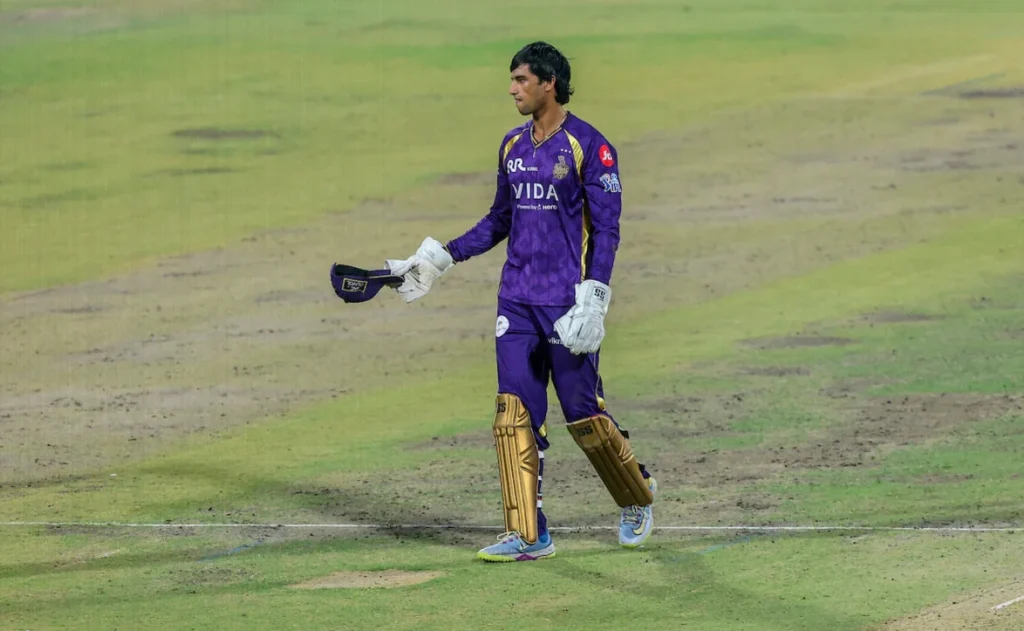
Angkrish Raghuvanshi’s lightning-fast removal of the bails to stump Pathum Nissanka off Anukul Roy’s bowling at the Arun Jaitley Stadium on May 8 effectively ended any remaining hopes Delhi Capitals had of pushing Kolkata Knight Riders all the way. The dismissal was the kind of sharp, technically correct wicketkeeping play that usually comes from experience—and it carried an extra layer of irony: until September last year, Angkrish had not been a keeper by trade.
From non-keeper to match-winning gloves
- The stumping overpowered Delhi Capitals’ last realistic chance in the match on May 8 at Arun Jaitley Stadium.
- Angkrish’s breakthrough behind the stumps in IPL 2026 arrived after a carefully planned transformation.
- Abhishek Nayar, his long-time mentor and the head coach of the franchise, mapped out the project that would change his role.
- Dishant Yagnik, the fielding coach, was the one who put that plan into practice through day-to-day wicketkeeping work.
Speaking ahead of KKR’s meeting with Royal Challengers Bengaluru in Raipur on Wednesday, Angkrish explained that the switch to a wicketkeeper’s responsibilities began when the team asked whether he could handle the job. He admitted that at first it felt daunting because he had never done it before and doubted his ability, but the constant coaching helped him buy into the process.
He also detailed how the pre-season work translated into measurable improvement. The fitness information gathered before the campaign highlighted his flexibility and quickness, while he topped Nayar’s circuit test—an assessment created to mimic the demands of high-intensity movement even when fatigue sets in. The early signs pointed to something important: the physical foundation needed for wicketkeeping was already there, even if the role was new.
With support from the KKR support staff, Angkrish has settled into his wicketkeeping duties and has also been a key contributor with the bat. In the current season, he is KKR’s leading run-scorer, tallying 269 runs across ten matches.
Inside the dressing room, Angkrish believes the environment has helped him stay composed. He said it matters to have calm voices among the group because adrenaline often takes over during games, making objective thinking difficult when emotions run high. In his view, those who can process the game clearly and communicate effectively make it easier for the team to adjust and respond.
He added that the tournament’s internal approach has been about reducing pressure rather than piling on more expectations. Angkrish described the message he often hears from the team as encouragement to avoid overthinking responsibility and instead focus on enjoying the game while doing what is right for the side. He said that mindset takes the weight off his shoulders and allows him to do his job with greater clarity.
When naming the coaches who have shaped his progress most directly, Angkrish pointed first to Nayar and Yagnik. He said that for Abhishek, it is not only his batting that has benefited, but every stage of learning on and off the field. He called Dishant Yagnik’s daily drill work crucial as well, noting that he rarely gets a day off from practice and that the work is helping him improve on the field.
Angkrish also acknowledged the lesson both coaches have reinforced: hard work must be constant because opportunities like his do not come to many players. That gratitude, he suggested, is part of what keeps him motivated to repay the chance with effort.
On the physical side, he did not hide that the workload is heavy. He described wicketkeeping and batting as already hectic in themselves, while still pointing out that he can enjoy cheat meals whenever he wants. He also praised the medical and training support around him, mentioning physio Dr. Prashant (Panchada) and Dr. Abhishek (Sawant), along with trainers CD (Chris Donaldson) and Sagar (VM), for giving him clear guidance on what he needs during a packed schedule.
According to Angkrish, the key is balance: you cannot over-train and under-train at the same time. He said he leaves the planning to the specialists and trusts them completely, because the schedule demands precision.
Moving from Delhi’s roots to Mumbai’s cricket culture
The franchise’s recent form has also provided context to his journey. KKR extended a winning streak to four matches after a challenging six-game spell earlier in New Delhi—where Angkrish spent his formative years. Before going to Mumbai to work under Nayar, he had experienced both cities, and he said the transition has helped him settle into a “Mumbaikar” identity.
Angkrish described the move to Mumbai as one of the most important decisions of his career. He said that when he played there, he saw how hard people work to succeed, which pushed him to improve every day—not just to match the standard, but also to appreciate the life he has. That perspective is why he embraces the label “Bombaywallah,” which he connects to the culture of cricket he grew up surrounded by.
Staying focused on the next game
Looking ahead, particularly with KKR still capable of a remarkable push into the playoffs, Angkrish said he keeps the ambition deliberately small. He does not like setting long-range targets; his focus is simply to win the next match. He believes that if the team concentrates on the immediate challenge, momentum builds naturally and special outcomes can follow.
He reiterated that his mindset is straightforward: concentrate on the next match, understand what he can do for the team, and work toward winning together.
The stumping of Nissanka may have been the moment that drew the most attention, but Angkrish stressed that it was the combination of Yagnik’s drills, Nayar’s quiet confidence, and Angkrish’s willingness to accept any role the franchise asked of him that turned the transformation into reality. For someone often tagged as KKR’s “starboy,” wicketkeeper’s gloves were never about simply adding another skill—it was about answering a call KKR needed, and delivering on it.
