
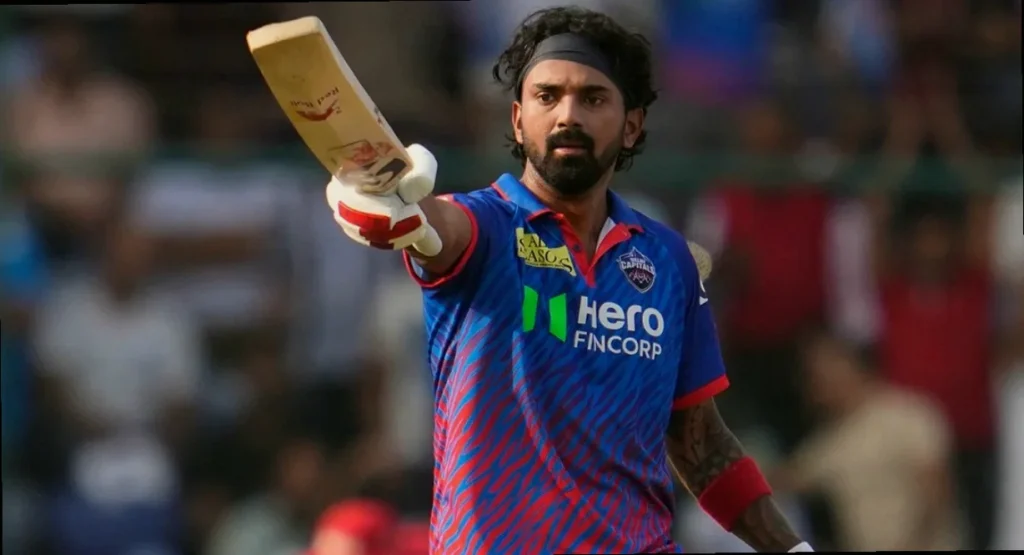
“I’ve taken a beating,” KL Rahul joked at the mid-innings break in Delhi, visibly dehydrated and drained. The twist, though, was that the punishment had mostly come from his own bat. In the 20 overs that followed, Rahul delivered a relentless display, finishing unbeaten on 152 off 67 balls. The knock has now been registered as the highest individual score by an Indian in T20 cricket, across leagues and international formats, and not just within the IPL.
Even with Rahul’s towering total, the result still slipped away from Punjab Kings. An error-prone Delhi Capitals effort, combined with Punjab’s dominant batting, meant the match story ultimately favoured the side that handled the chase and pressure better. Rahul still earned Player of the Match honours for posting the third-highest score in IPL history. His 152 sits just behind Chris Gayle’s 175* and Brendon McCullum’s 158*, and after the game he framed the innings as his way of catching up with the modern requirements of T20 batting—where waiting for “later” simply isn’t an option when sixes are available.
Speaking to broadcasters after the match, Rahul underlined how T20 punishes hesitation. “There’s no time in T20 cricket to say ‘later,’” he said. “In ODI cricket you can do that—maybe you hold back for a couple of overs and then attack at the back end. But as an opening batter in T20, that’s something I watched and learned from international guys who’ve been successful. There’s no time for you to think, ‘Okay, I’ll go next over.’”
Rahul also explained that he deliberately reassessed his approach after comparing his batting with the very best in the world. He realised that clearing the ropes had to move to the front of his priorities. On Saturday, he struck nine sixes and 16 fours, sustaining a strike-rate of 227. The century itself arrived at the speed of intent—his quickest IPL ton, completed in 47 balls, with nine deliveries shaved off his previous fastest.
He added that the shift came from stepping back to understand where the T20 game has gone. “Just had to step back a little bit and see where the T20 game has gone,” Rahul said. “And what the demand of T20 cricket is in today’s day and age—watching the T20 World Cup, watching some of the young guys coming in and smashing from ball one.”
Rahul continued by tying that evolution directly to his own preparation. “I’ve spoken about six-hitting, and that’s something I had to really work on and give myself that sort of freedom to go out there and take on the bowling from maybe ball one, ball two.”
The innings had a clear rhythm: Rahul reached his half-century in 26 balls, then surged again to add another 102 in just 41 deliveries. He said he stayed “true to his game for the first 70-80 runs,” selecting shots with purpose rather than forcing them, while also praising No. 3 Nitish Rana, whose 91 came off 44 balls. Together, Rahul and Rana stitched a 220-run second-wicket stand—the second-highest partnership in IPL history for any wicket—and, notably, the top shared effort between two Indian batters.
Rahul admitted that the late-stage acceleration carried a degree of premeditation, but only as the innings approached its finish. “Honestly, only towards the end was I premeditating,” he said. “I was just in a mindset to hit boundaries and put pressure on the bowlers. My strength is always to play proper cricket shots, and I was trying to back that and believe that was good enough to get my team past 250.”
On the partnership dynamics, he highlighted how Rana’s ability to score in the opening spells shifted the pressure immediately. “When you can hit proper cricket shots and get boundaries in the first six overs and continue to do that,” Rahul said, “then the bowling team feels a lot more pressure.” He pointed to the balance created by the right-left combination and said the pair kept finding ways to sustain momentum and continue testing the bowlers.
In the IPL studio setup, Deep Dasgupta described Rahul’s innings as the batter at “100%.” He said the previous hundreds had sometimes suggested there was still something “in the tank,” but this time it felt like KL Rahul had offered everything he had. Dasgupta acknowledged the inevitable talking points around missed chances or the opposition’s bowling performance, but stressed that Rahul’s spatial awareness—his ability to play into the gaps—was exceptional. He also suggested that Rahul could turn the page after this knock, believing he can maintain this tempo without slipping into conservatism, and that the innings could become a genuine game-changer for his future T20 batting.
