
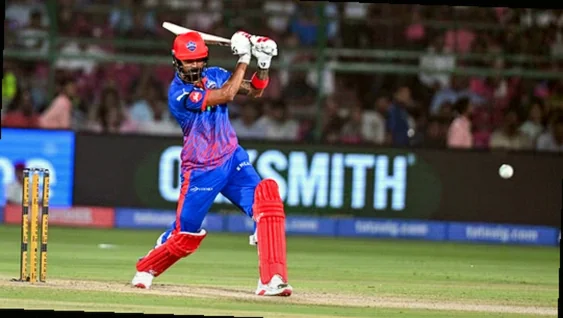
KL Rahul kept Delhi Capitals’ momentum moving forward in IPL 2026 with yet another decisive performance on Friday night. Chasing a formidable 227 against Rajasthan Royals, Rahul struck 75 to guide Delhi through a high-pressure run chase, while also regaining the Orange Cap. The wicketkeeper-batter played with a confident tempo, reaching the mark off 40 balls at a strike rate of 187.50, featuring six fours and five sixes. His innings reflected a blend of aggression and composure, keeping Delhi on the right side of the chase throughout. With the season progressing, Rahul’s approach has shown a clear shift—he is now striking at 185.84, the highest mark of his IPL career to date, highlighting how he has developed into a more forceful presence at the top of the order.
Key takeaways
- KL Rahul delivered a match-winning 75 to steer Delhi Capitals in a chase of 227 versus Rajasthan Royals.
- His innings came off 40 balls at a strike rate of 187.50, including six boundaries of the four and six types.
- Rahul’s knock helped him reclaim the Orange Cap during IPL 2026.
- His current IPL strike rate stands at 185.84, the best of his career so far.
- Former players Simon Doull and Shaun Pollock pointed to the impact of an attacking partner at the other end in shaping Rahul’s innings.
Rahul’s rising tempo and why it matters
Rahul’s performance underlined how his role at the top has evolved this season. Instead of starting with extended caution, he has shown a greater willingness to get moving early, which has contributed to a noticeable rise in his scoring speed. The numbers back that change: his strike rate is currently 185.84, marking the most efficient phase of his IPL career to date. For Delhi, that shift has been significant in run chases—particularly when the team is expected to accelerate without losing control.
In this innings, Rahul balanced intent with calculation, striking at a pace that kept the required rate within reach while still managing the match situation. The 75-run effort demonstrated that he can drive momentum without becoming reckless, a quality that tends to separate reliable top-order batters from those who can only perform in lower-pressure roles.
Doull and Pollock on how partnerships unlock Rahul
Simon Doull discussed Rahul’s approach and credited the presence of an aggressive partner—Pathum Nissanka—for enabling him to settle more comfortably. Doull suggested that when someone at the other end can repeatedly clear the boundary, it reduces the pressure on Rahul to manufacture every scoring shot himself. He emphasised that a calmer Rahul is often at his best from the team’s perspective, especially when the innings can be built with a free-flowing batter taking the initiative early.
Doull explained that while Rahul has not always been the quickest starter, he has done so more frequently this year. He argued that the reduced burden allows Rahul to ease into his batting plan, with pressure taken off him as Nissanka sets an attacking tone. Doull also highlighted how Nissanka’s early impact helps Rahul and strengthens the top-order dynamic, describing the complement between the two batters as particularly effective.
Shaun Pollock echoed similar ideas while expanding on Rahul’s adaptability. Pollock said Rahul appears to have added flexibility to his game while still leaning on the familiar “stock standard” role he has been known for in chases. He noted that criticism around Rahul often centred on whether he could raise his tempo when the team required a chase of 250 or more, but pointed to evidence that Rahul has previously helped teams post large totals, including an instance where he supported Delhi in reaching a score around 260.
Pollock further described how Rahul’s understanding of match situations and trust in his partner allows him to weigh risk and responsibility more effectively. He suggested that once the chase is underway and Rahul identifies what is required, he can revert to a default batting setting—playing his natural game without taking unnecessary chances. Pollock also pointed to the pattern of Rahul’s responsibility changing as wickets fall: early on he allows Nissanka (and the partner at the other end) to take the initiative, and once that partnership is broken, Rahul then chooses to shoulder more of the chase. Pollock summed up the latest evidence as a strong display of Rahul’s evolution and the way he adapts to the demands of high-pressure overs.
