
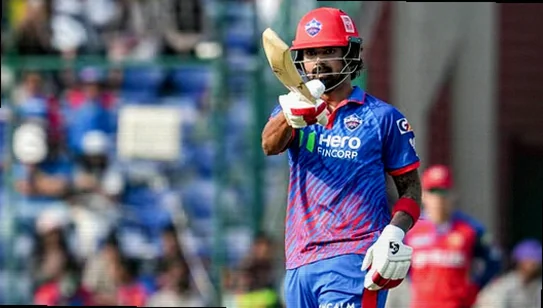
KL Rahul put on a historic display in the IPL, cracking an unbeaten 152 against Punjab Kings to etch his name into the record books. The Delhi Capitals batter showed trademark technique and calm, taking on his former franchise with the kind of control that has become his signature in T20 cricket.
Quick facts
- KL Rahul scored 152* versus Punjab Kings, remaining not out
- He became the first Indian to reach the 150-run mark in IPL history
- Delhi Capitals posted 262/2 in 20 overs, their highest team total of the season so far
- Rahul’s 152* is the third-highest individual score in IPL history
- That 152* places him alongside Chris Gayle (175*) and Brendon McCullum (158*) in the elite list
- Rahul moved ahead of Abhishek Sharma’s 141
- Rahul and Nitish Rana added 220 runs for the second wicket off 96 balls
- The 220-run stand is the second-highest partnership for any wicket in IPL history
- Rahul said he had “mixed emotions” due to heat exhaustion and hoped he wouldn’t cramp later
- Rahul received the Orange Cap after his 152* innings
Rahul’s innings was defined by timing and precision rather than brute force, and it lifted Delhi Capitals to 262/2 in 20 overs—the highest total of the season at that point. In the individual standings, his 152* landed in third place among the tournament’s biggest batting efforts, behind only Chris Gayle’s 175* and Brendon McCullum’s 158*.
Beyond the milestones, the knock carried a message for the current generation of T20 batters. With many younger players rewriting the pace of the format through fearless hitting, Rahul’s century-plus masterclass underlined the impact of class, composure, and a measured approach that still fits the modern tempo.
After the match, the batter admitted the circumstances had taken a toll despite the celebrations. Rahul said he felt “mixed emotions” after dealing with the intense heat in Delhi, adding that he needed to hydrate and recover, while also hoping he wouldn’t cramp later.
“I’m obviously happy. I’ve taken a beating due to the heat, just need to hydrate and recover. So it’s mixed emotions at the moment. I hope I don’t cramp later on,” Rahul said to broadcasters after receiving the Orange Cap for his 152-run* contribution.
Record stand powers DC
While Rahul anchored the innings with his landmark score, the platform was laid by Nitish Rana. Despite the record-breaking figure at the top, the bigger momentum-shift came from Rahul and Rana, who smashed a 220-run partnership for the second wicket after Delhi Capitals chose to bat.
The pair compiled those 220 runs off just 96 balls, setting it as the second-highest partnership for any wicket in IPL history. It was a brutal blend of aggression and shot selection, with boundaries arriving consistently even as the pitch and pace of play demanded execution.
Rahul praised Rana for the way he entered the contest and established the tempo early. He explained that their plan was rooted in playing proper cricket shots—rather than default slogging—which kept pressure on the opposition throughout the innings.
“Phenomenal knock from Nitish. The way he came in and you know, I think when you can hit proper cricket shots and get boundaries in the first six overs and continue to do that, I think the bowling team feels a lot more pressure when you’re when you’re trying to hit big sixes or trying to slog, then the opposition already feels like they’re in with a chance. But when you’re playing proper cricket shots and playing merit of the ball and still getting boundaries and still being able to score over 200 strike rates, it just puts a lot of pressure on them. And I think he did that beautifully, and I think the right-hand, left-hand combination worked as well. The wicket was on the on the slower side, but I think both of us were seeing the ball really well, so we just continued batting and continued putting pressure on the bowlers,” Rahul added.
How Rahul built his 152*
Rahul also reflected on what separated this innings from a typical T20 chase or power-hitting effort. He said he largely trusted his natural game, resisting heavy premeditation for the majority of his innings and leaning instead on orthodox cricket shots to stay on top of the bowling.
According to Rahul, the early stages—roughly the first 70 to 80 runs—were driven by a mindset of targeting boundaries and keeping the bowlers under constant pressure. He described his strength as playing proper cricket shots, aiming to move his team beyond 250, and said he stuck to that routine for most of the innings.
Only toward the back end did the approach become more pre-planned. As the field settings tightened and the bowling shifted into wider angles and spinner-specific patterns, Rahul said he understood what to expect and then adjusted accordingly to finish the innings strongly.
“I mean only towards the end was I premeditating. Early on, I think for the first 70-80 runs, I wasn’t really premeditating. I was just in a mindset to hit boundaries and put pressure on the bowlers. My strength is always to play proper cricket shots and I was trying to back that and try and believe that that’s good enough to get my team past 250 and I continued to do that. Only at the back end was I premeditating and when the field is set, when the bowlers go to the wide off-field or a spinner field, you know kind of what to expect,” he concluded.
