
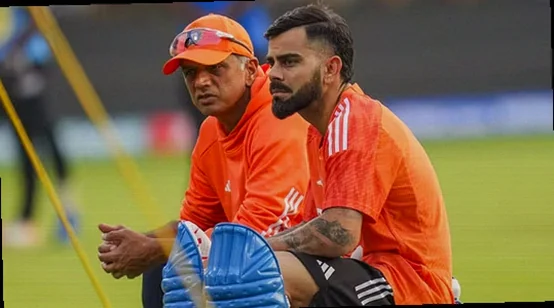
Even the most decorated stars can find it hard to stay mentally at ease when the weight of expectation refuses to lift. Virat Kohli’s post-captaincy stretch in international cricket became one such test, when the former India skipper admitted he started questioning himself—until Rahul Dravid and batting coach Vikram Rathour helped him regain the joy of playing.
Kohli shared these reflections at the RCB Innovation Lab Indian Sports Summit Powered by Leaders, hosted at the Centre for Sports Excellence in Bengaluru on Tuesday. He spoke about the difficult phase that followed the conclusion of his Test captaincy tenure in early 2022, a period that coincided with one of the most unsettled chapters in Indian cricket. During that time, Kohli was reported to be at odds with then BCCI president Sourav Ganguly, after he had stepped down from T20I leadership in late 2021 and—soon after—was removed as ODI captain.
The struggle also ran alongside one of the longest scoring droughts of Kohli’s career across formats, lasting from 2020 to 2022. Compounding the challenge was the fact that Ravi Shastri—India’s head coach during the earlier part of Kohli’s journey—had finished his term in 2021, leaving Kohli without one of his key support pillars from the coaching setup.
How support helped Kohli rediscover his cricket
- Kohli said he had to fight through a lengthy run without a century across formats between 2020 and 2022.
- He noted that Dravid and Vikram Rathour became critical figures as he tried to move past the toughest period of his career.
- Kohli credited their care and mentoring with helping him feel mentally settled enough to enjoy the sport again.
- He recalled that he only began to open up about his mental struggles after stepping down as India captain.
In his remarks, Kohli specifically praised Dravid and Rathour for how they handled him. He said that whenever he meets Rahul bhai and Vikram Rathour, he thanks them genuinely because they looked after him in a way that made him want to keep playing for them. Kohli added that the motivation came from a blend of encouragement and deeper understanding—reminding him of the work he had already put in as a player, something he said he rarely pauses to recognise during busy stretches.
Eventually, Kohli ended his barren run with a T20I century at the 2022 Asia Cup. He then followed it with two Test hundreds in 2023. A few months later, he delivered what he described as a standout showing during the ODI World Cup on home soil, a run that underlined how he had found his rhythm again after the mental turbulence.
Kohli also suggested that Dravid’s own experience at the highest level made it easier for him to relate to the fears and self-doubt that can affect even senior players. He explained that, for athletes, there is often a thin boundary between being cautious and feeling insecure, and that an “imposter syndrome” mindset can linger in the background.
He said that even today, when he works in the nets, a similar doubt can surface—particularly the thought that younger players may be watching. If he has a disappointing session, he feels they might wonder whether he is still the same established performer who has been around for years.
According to Kohli, both Dravid and Rathour understood what he was going through because they had lived through similar experiences themselves and they took genuine care of him mentally. That, he said, placed him in a better headspace to return to enjoying his cricket.
Why Kohli stayed silent for years as captain
Kohli said he began to talk about his mental battles only after stepping down from the captaincy role. He explained that leadership is typically handed out because people believe the person can shoulder more responsibility while still managing it well. In his view, leading a team is less about coaching tactics and more about management—understanding the individuals involved and finding ways to get the best out of them.
Looking back, Kohli admitted that during his captaincy years he became so consumed by the duties of leading the side that he stopped paying attention to his own emotional state. He realised that for nearly nine years, nobody truly asked him how he was doing mentally. He added that to do that kind of inward checking, a player has to be in a frame of mind that is not constantly absorbed by self-management and external expectations—meaning the thought of whether someone will ask “Are you okay?” simply does not cross the mind.
“I looked back and realised that no one had really asked me that question for almost nine years—‘How are you doing?’” Kohli said, underlining the central point of his reflections: even at the top, a player can go unheard while carrying a quiet struggle.
