
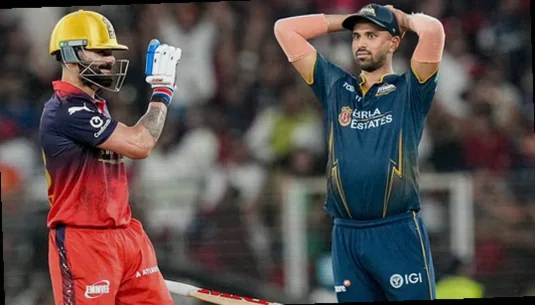
The 2026 Indian Premier League wrapped up in a rather underwhelming fashion, with Royal Challengers Bengaluru defeating Gujarat Titans to secure their second straight championship at Ahmedabad’s Narendra Modi Stadium on Sunday night. Even though it had been a season packed with runs, the final day offered little drama: GT were restricted to 155 for 8. In response, RCB chased with comfort, needing no real rescue act in the chase, as Virat Kohli led the way with an unbeaten 75. He and Venkatesh Iyer laid the groundwork by sharing a 63-run opening stand, setting the tone for a chase that never truly tightened. After that, RCB did lose three wickets in quick succession, but the absence of scoreboard pressure meant the target was always within reach, and they finished the job with ease. Kohli also reached his quickest IPL fifty to date, taking just 25 deliveries to get there—an ideal moment to peak on the grandest stage.
Kohli continued to control the proceedings, and when Tim David contributed 24 off 17 balls, the duo added 41 runs for the fifth wicket, quickly erasing any faint hopes GT still carried after RCB slipped to 91 for 4 at one point. A six from Kohli off Arshad Khan effectively sealed the contest, with RCB getting over the line with 12 balls remaining and five wickets in hand. With the title, RCB joined an elite list by becoming only the third franchise to win consecutive IPL trophies, joining Chennai Super Kings (2010 and 2011) and Mumbai Indians (2019 and 2020). The triumph also made Rajat Patidar the third captain to lift back-to-back titles after MS Dhoni and Rohit Sharma.
Earlier in the night, the story of GT’s downfall began with RCB’s bowling approach. Having opted to bowl first, RCB looked to unsettle the Titans’ batters by aiming to make their plans uncomfortable—especially through shorter deliveries that forced riskier decisions. The first breakthrough came when captain Shubman Gill fell to a slightly short ball from Australian fast bowler Josh Hazlewood. Gill tried to send it back through the line, but the ball ended up skying, and Patidar sprinted from mid-off to mid-on to take a straightforward catch. Gill’s stay lasted 10. Sai Sudharsan soon followed, dismissed by Bhuvneshwar Kumar with a short-pitched delivery that rose and disturbed his timing. Sudharsan went for a shot, but the ball took the top edge, allowing Jitesh Sharma to complete another simple catch while moving to his right. Sudharsan scored 12.
One surprise in GT’s batting order was Nishant Sindhu, arriving ahead of Jos Buttler. Sindhu did show some attractive strokeplay before his innings ended when he was caught by Rasikh Salam for 20 off 18 balls. The dismissal once again reflected RCB’s theme: another short ball that Sindhu tried to attack, but he couldn’t clear the deep midwicket boundary. Buttler, though, had been GT’s last meaningful hope. Yet he was undone by Krunal Pandya’s awareness and execution. Pandya bowled it wide, expecting Buttler to charge down the track. Buttler did commit forward as anticipated, but he couldn’t get enough connection, and Jitesh Sharma finished the work behind the stumps. Buttler made 19 off 23 deliveries.
As the innings progressed, GT never really found momentum. Without Washington Sundar’s composed resistance—an unbeaten 50 off 37 balls—GT wouldn’t even have reached the 150-run mark. Still, the final total offered no real challenge to RCB’s batting strength on the biggest night. For RCB, Rasikh Salam produced the most impact with three wickets, while Bhuvneshwar Kumar and Josh Hazlewood also grabbed two each as GT’s chase ended before it could truly begin.
