
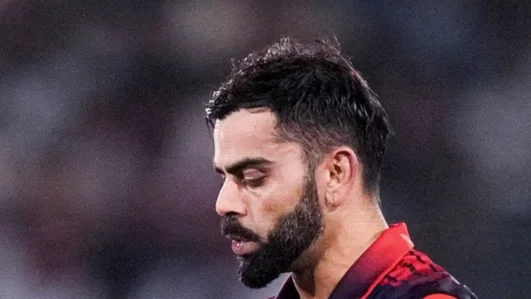
Virat Kohli’s recent podcast conversation with Royal Challengers Bengaluru has drawn widespread attention, largely because of the blunt way he spoke about his international ambitions. In the discussion, he said he is targeting the 2027 World Cup in South Africa and Zimbabwe, but he attached an important caveat: he does not want his importance or value to be questioned.
That kind of statement seldom lands for pure entertainment. When a player of Kohli’s stature feels the need to spell out what he brings, it usually points to an uneasy atmosphere—one where trust, backing, or clarity about his role may not be fully in place. It also raises doubts about whether the current setup, led by Gautam Gambhir, is fully aligned with Kohli’s World Cup plan.
Quick facts
- Virat Kohli’s podcast with Royal Challengers Bengaluru has gone viral.
- Kohli said he is looking forward to the 2027 World Cup in South Africa and Zimbabwe.
- He added a condition: his worth and value should not be questioned.
- The discussion suggests uncertainty about the backing Kohli feels he has for the World Cup.
- It also points to concern about whether the current team management led by Gautam Gambhir wants him for the World Cup.
The underlying question, though, is simple: why would any elite athlete keep throwing himself into the grind of cricket when the environment around him feels unstable? Kohli is not just a participant in the sport—he has been an all-time great for India since Sachin Tendulkar’s retirement in 2013. In that period, he has accumulated massive runs across formats, collected four ICC white-ball trophies, and served as India’s standout Test captain to date.
His captaincy also delivered a landmark breakthrough: India beat Australia for the first time in a Test series on Australian soil. That achievement carried extra weight because it was also the first time any team from the sub-continent managed such a feat in that setting. For a player with that legacy, the emotional and mental stakes of feeling “secure” in the next big phase become even more pronounced.
Why players can’t always walk away
But Kohli is not the only Indian cricketer who has stayed in the game despite sensing that things may not be ideal. The source of the issue runs deeper than one individual. It highlights a recurring pattern in Indian cricket: stars often continue for longer than expected, even when they feel they are not truly wanted anymore.
Tendulkar, MS Dhoni, and Kapil Dev are mentioned as examples of players who carried on through phases when they were no longer the same version of themselves at their peak. Dhoni’s case, in particular, is framed through his continued presence in the Chennai Super Kings squad—despite having left international cricket years ago and, at times, appearing to have lost some of the sharp edge and drive that once defined him.
This mindset is described as deeply rooted in the way many careers evolve in India. A large number of cricketers come from backgrounds where education and broader opportunities are limited. For many, cricket becomes the most visible route to respect and recognition, and letting it go can feel like losing the only ladder they have.
There is also a wider social reality at play. In a society where recognition tends to follow wealth or fame—two forces that often move together—people without that privilege rarely receive the same level of acknowledgment. In that context, commoners have little room for hope, and cricket becomes the stage that forces the spotlight onto those who might otherwise remain overlooked.
Once players get used to that spotlight, walking away becomes harder than it sounds. The piece suggests that even when a player’s time should logically be ending, they may not choose to exit on their own terms. More often, they are pushed out—by form, by selection decisions, or by the changing demands of the sport.
Another factor is the lack of dependable career options after retirement. Commentary is often the most familiar path, but not every player has the temperament or skill set required for it. Coaching is another route, yet even when it is available, there’s no guarantee it matches what most former cricketers actually want to do—because the job can be exhausting and demanding in its own way.
With few stable alternatives, cricketers end up staying within cricket for as long as they can. And the final stretch can be brutal. The source describes the reality of the twilight years as a period when a player is no longer the same dependable performer from a few seasons earlier, and failures start arriving more frequently.
Those struggles then trigger criticism not only inside the team but also from fans and the media. Still, the conclusion is that there’s often no easy exit. It becomes a trap of circumstances rather than a matter of personal blame—an outright tragedy for the individuals who have given their best to the sport but find themselves fighting to stay relevant when the game moves on.
