
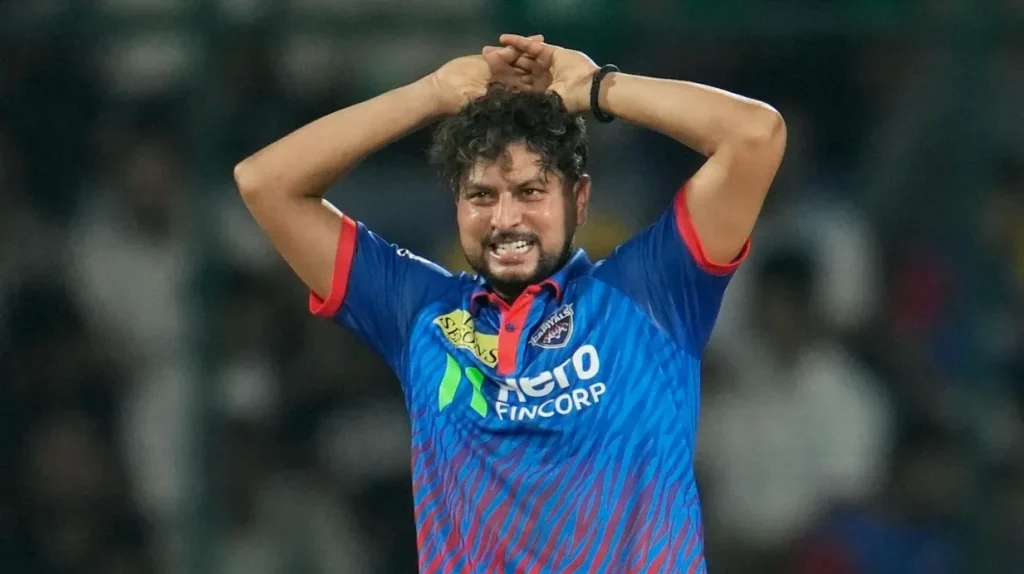
Delhi Capitals’ IPL 2026 campaign has had its share of problems, and one recurring frustration has been Kuldeep Yadav. The left-arm wrist spinner has become a frequent talking point, with his struggles now stretching across six matches without a breakthrough, including his most recent three appearances.
After DC went down to Kolkata Knight Riders (KKR) on Friday, DC’s director of cricket Venugopal Rao addressed the issue at the post-match press conference. Kuldeep returned 0 for 41 in his three overs, with every delivery coming after the powerplay. The defeat was DC’s seventh of the season, leaving them with four wins from the campaign so far.
Quick facts: Kuldeep’s IPL 2026 numbers
- Matches: 11 IPL 2026 appearances (all DC games)
- Wickets: 7
- Economy rate: 10.66
- Average: 50.28
- Comparison: Among IPL 2026 bowlers bowling at least 30 overs, only T Natarajan has a higher economy (11.18)
- Against KKR: 0/41 in three overs
Across those 11 outings this season, Kuldeep has taken seven wickets, but the run flow has been steady enough to keep his overall figures under pressure. His economy sits at 10.66 and his average at 50.28. There’s also a telling comparison: among bowlers who have delivered 30 overs or more in IPL 2026, only T Natarajan—who is heavily used at the death—has managed a worse economy than Kuldeep’s mark.
Against KKR, Kuldeep was struck for at least two boundaries in every over, with five of the total sixes landing during his spell. The damage included two big shots off short balls and three more off full deliveries. Finn Allen struck four of those blows, while Cameron Green accounted for one, as the lengths and lines often failed to stay in the right areas.
Deep Dasgupta, analysing the bowling, pointed to a pattern: it wasn’t only the length that went astray, but the line too. When the ball is pitched in the wrong channel, batters in T20 cricket can turn even ordinary deliveries into clean strikes—especially when the boundary options are set up early in an over.
Dasgupta explained the issue in a simple way on ESPNcricinfo’s TimeOut show. “With Kuldeep, you can’t allow sixes over square leg off a short ball and also over long-off and long-on [as well],” he said. “Yes, you’ll get hit in this format. But I’d prefer him get struck with the ball going down the ground—rather than getting thrashed from square of the wicket or extra cover. Anything off the front foot is fine. You get hit off the front foot, fair enough, but not off the back foot.”
That is precisely what happened on Friday. Kuldeep’s first six came off a flighted delivery that went straight. The second was a short ball—again punished—this time a googly that raced to midwicket. The third, bowled to Green, was short and slow off the pitch and cleared the boundary over midwicket as well.
The fourth was another googly, this one flighted and placed in the hitting zone outside off stump. The final ball could have been met with similar resistance, but Allen chose the slog sweep instead, turning what might have been a more manageable matchup into another boundary.
Why a slip changed the plan
KKR’s chase was always in reach, and that likely influenced DC’s tactics around Kuldeep’s second and third overs. He was given a slip for those stages, and Dasgupta said he liked the idea. In his view, a slip doesn’t just create a fielding option—it also nudges the bowler’s mindset toward the kind of delivery that brings wickets.
“The moment you put a slip in place, from a bowler’s point of view, you’re thinking, ‘I need to pick a wicket,’” Dasgupta said. “You’re not picking a wicket off a short ball, right? You’re picking a wicket off a fuller delivery. So straightaway, mentally, you’re bowling fuller. That’s the space you’d rather have Kuldeep in. Even if he gets hit, it’s more likely to be off the front foot down the ground rather than square of the wicket.”
Still, the bigger picture shows why this is such a difficult conversation for DC. ESPNcricinfo’s data suggests Kuldeep has already bowled 70 full-length deliveries this season, and batters have scored 178 runs off them at a strike rate of 254.28. That tally includes nine fours and 18 sixes, and the strike rate is noticeably higher than last season’s 133.65, and well above IPL 2024’s 168.88.
On those full-length balls, Kuldeep has managed just two wickets. For everything else—other lengths combined—batters have scored 171 runs in 128 balls, a strike rate of 133.59, with five wickets in that split. The concern, then, is not only about choosing the right lengths, but also about sticking with them long enough to build pressure and then finding the right line to match.
McClenaghan, also on TimeOut, underlined what he saw going wrong against KKR. “I saw a lot of deliveries between fourth, fifth, sixth, seventh, eighth stump, just in that nice hand-freeing arc,” he said. “Whether he was a little bit shorter or a little bit full, there weren’t many balls that were landing on the top of leg stump or three-quarters of the way up leg stump, or [were] outside the wide line, when you know guys are trying to go after you.”
He added that effective T20 bowling often comes from attacking the edges of the batter’s scoring base. “You have to play the corners of the base,” McClenaghan said, describing how the ball needs to be positioned so hitters can’t comfortably free their hands.
DC’s recent form also offered context to the criticism. In DC’s previous match against Chennai Super Kings (CSK), Kuldeep went for 11.33 per over as the innings scoring rate reached 9.08. After that game, captain Axar Patel said, “When we were bowling, I missed my partner Kuldeep.”
On Friday night, Rao’s tone suggested the team is frustrated but not ready to abandon the bowler. “We are facing it, and we are receiving it,” he said. “People like him, with Axar and all—if these two continue in good form [it helps]. But one is doing well, one is not, it hurts in a bowling group. So we are facing that failure. We always want him to do well.”
