
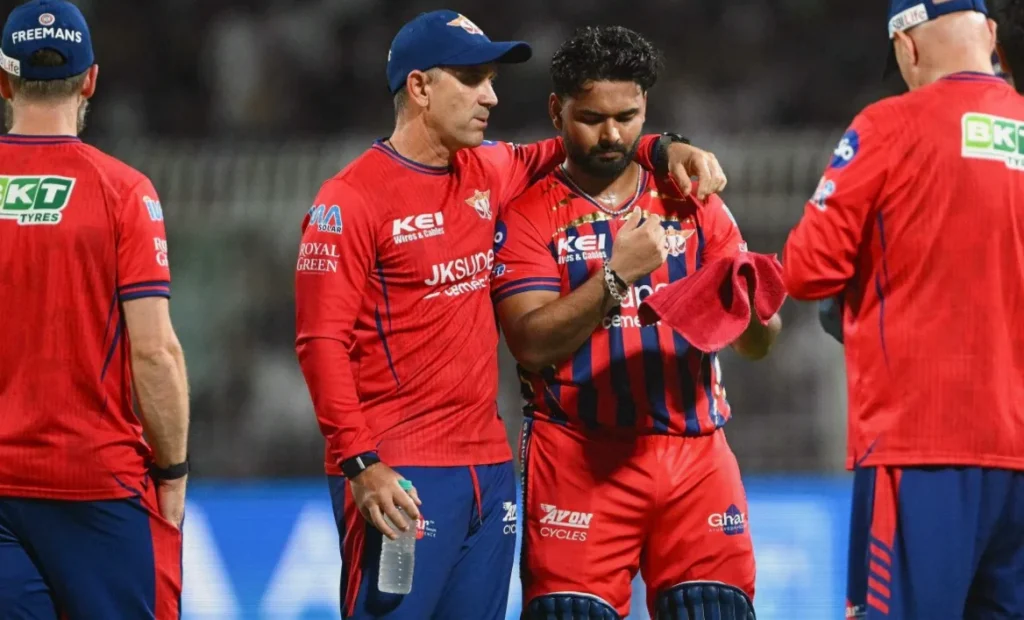
When Lucknow Super Giants put together a support setup led by former Australia coach Justin Langer and IPL veteran Tom Moody, the franchise’s message was clear: this was the season they would move beyond flashes of talent and become a proper title challenge. Instead, the year turned into a frustrating sequence of unclear team choices, awkward combinations and a recurring sense that the side never fully nailed down what its best starting XI—and overall plan—should look like.
At several points in the tournament, it felt as though the head coach and captain Rishabh Pant were not fully aligned on the tactical direction. The tone after defeats, the constant reshuffling of players, and the uncertainty around batting order decisions all suggested a team searching for answers rather than executing a settled blueprint.
The loudest headline naturally came from owner Sanjiv Goenka’s bold call to secure Pant for Rs 27.50 crore. Pant is undoubtedly one of India’s best-known cricketing names and has repeatedly shown he can swing matches with his impact. Still, such a heavy investment can tilt the squad’s balance, and it raises the question of whether it also contributed to avoidable gaps elsewhere in the playing group.
One of the most noticeable weaknesses was the shortage of proven overseas pace. Apart from South Africa’s Anrich Nortje—who managed only a single appearance—LSG did not appear to have a foreign fast-bowling strike option capable of turning games during the middle overs or at the death. The consequence was that the majority of the pressure inevitably landed on a relatively inexperienced Indian bowling line-up.
Among the domestic bowlers, Mohsin Khan (11 wickets) and Prince Yadav (16 wickets) were the ones who showed steady signs of promise. Mohammed Shami looked useful, but only in bursts rather than consistently across spells. Outside of those names, the supporting cast struggled to consistently offer the control and wicket-taking threat required in high-pressure T20 matches.
After surgery, Mayank Yadav returned as a speedster but featured in only four games and did not claim a single wicket, while also conceding runs at an economy rate above 11. Young left-arm pacer Akash Singh produced a promising showing in one match, yet was heavily punished in the next and never truly found his footing again.
Even with these issues, Lucknow kept leaning into combinations that raised more doubts than confidence. Nicholas Pooran, despite enduring repeated failures across the tournament, continued to receive an extended run in the side. In T20 leagues, teams often back proven match-winners—but there comes a stage where loyalty can start to resemble stubbornness rather than strategy.
Then came perhaps the most puzzling element of LSG’s campaign. Once the team was effectively out of playoff contention, it would have made sense to use the remaining matches to evaluate fringe talent. That naturally leads to a bigger question: why did Langer and Moody never give Arjun Tendulkar even one game? Would he really have performed worse than Akash Singh—or even Avesh Khan, whose IPL career stretching over nearly a decade has not shown a clear pattern of improvement in high-pressure moments?
There was, however, a curious contrast off the field. LSG’s social media team pushed an “Arjun Tendulkar yorker package” narrative online, drawing significant attention and engagement. If those yorkers were truly effective enough to be marketed with confidence, the next obvious issue is why Arjun was not considered suitable for an actual match situation. The irony is difficult to miss: in a cricket culture where debates around nepotism are never far away, Tendulkar junior almost looks like a reverse example—picked repeatedly by franchises, yet not trusted enough to earn consistent first-XI chances.
One can also wonder whether Langer or Moody ever explained to the youngster why a player like Arshin Kulkarni—who made a painstaking 17 off 24 balls and appeared entirely out of place in that role—could still be pushed forward as an opener, while Arjun was not even given the responsibility of the new ball in a dead-rubber game.
By the time the season closed, Lucknow’s storyline might not only be about defeats. It could be remembered as a campaign in which the management was unable to settle on a coherent cricketing identity.
