
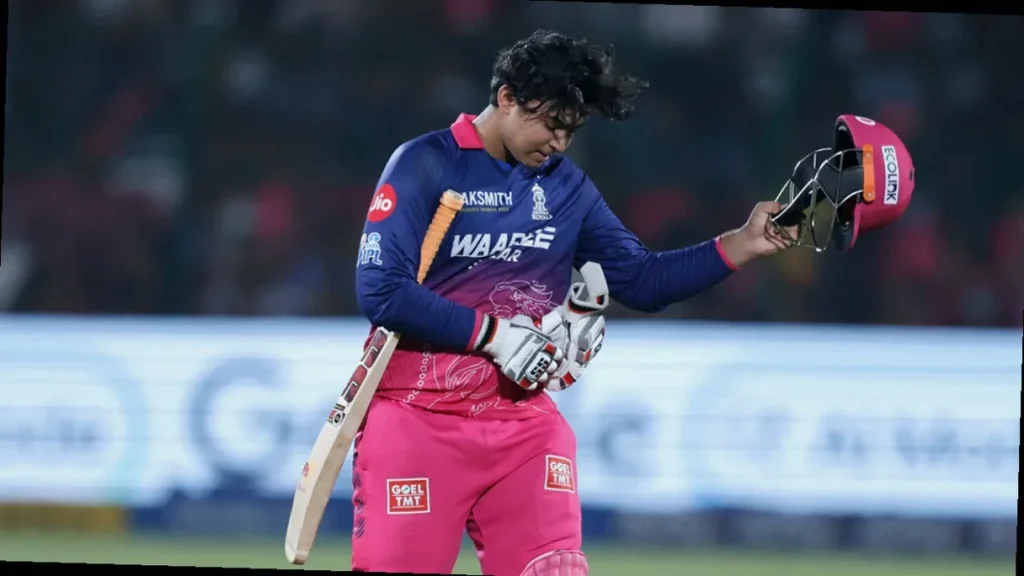
Justin Langer has added another name to his growing list of marvels—this time, it’s IPL batting prodigy Vaibhav Sooryavanshi, whose latest big knock left the former Australia great visibly awestruck. Langer, a former batter with more than 100 Tests and later a coach who delivered Australia a T20 World Cup triumph, also enjoyed success with Perth Scorchers in the BBL.
Sooryavanshi turns the chase into a formality
Rajasthan Royals needed to post 221 against the Langer-coached Lucknow Super Giants to keep their IPL destiny in their own hands. Instead, Sooryavanshi’s 93 came off just 38 balls, transforming the pursuit into a controlled march.
By the time he departed, RR’s target had shrunk to 41 runs from the final six overs—an outcome that underscored the impact of his acceleration at the right moments. The innings did more than lift the scoreboard; it also set the tone for how opponents were forced to rethink their plans.
Quick facts
- Rajasthan Royals required a score of 221 versus the Lucknow Super Giants to keep their IPL hopes in their own hands.
- Vaibhav Sooryavanshi scored 93 off 38 balls to dominate the chase.
- After Sooryavanshi’s dismissal, RR needed 41 runs from the last six overs.
- Justin Langer praised Sooryavanshi’s batting across the series and warned world cricket to expect more.
- Riyan Parag said the innings was Sooryavanshi’s best and highlighted his calm approach even when runs were hard to come by.
Langer’s warning: bowlers look genuinely baffled
Langer’s admiration wasn’t limited to the single performance. He pointed to the way Sooryavanshi has batted—not only in that match, but across the series—suggesting that his approach has created confusion that’s difficult to explain.
“In all my time, I’ve seen some incredible players in 35 years,” Langer said. “To watch a young batter go about it like that, not just tonight but throughout the series, is genuinely breathtaking.”
He then described what he saw in the expressions of elite bowlers. Langer referenced Mitchell Starc as one of the all-time greats in white-ball cricket, noting how the bowler’s look seemed to say “what is happening here?” Langer also singled out Anrich Nortje, calling him a world-class international operator, and again stressed the same sense of disbelief from the other end.
Why it’s scary: the learning is still ongoing
As a former batter, Langer said he understands the difficulty of batting, which only makes what he witnessed feel more striking. He argued that if batters are thinking “what is going on here?”, bowlers are likely asking an even sharper version of the same question.
In Langer’s view, the IPL version of Sooryavanshi’s batting is already extraordinary, and it’s been delivered under pressure. He also tied the performance to the broader theme of risk: sometimes big-run batting comes with high volatility, yet Sooryavanshi has kept doing it across formats while piling up runs consistently.
The former coach added the “scary” part is not just what Sooryavanshi can do now, but how he is learning. Langer suggested that the best route to building innings is not chasing quick fireworks, but repeating the process of making runs—something Sooryavanshi has done again and again.
He then posed the unsettling question for opponents: if the faces of Starc, Nortje and the rest of the bowling unit tell a story now, what happens when Sooryavanshi refines even further? Langer finished by stressing that the youngster’s age makes his rise even more remarkable, calling it a real privilege to watch him bat.
Langer: he hasn’t shown his ceiling yet
Langer also felt bowlers haven’t yet seen Sooryavanshi’s full best. He compared the situation to the argument about whether legends like Bradman would have produced the same numbers in different eras—especially when conditions were different and even helmets weren’t part of the equation.
His response was that the greats would adapt. Langer believes Sooryavanshi is in that category: wherever he plays, he’ll adjust his game because the question of where teams will bowl him is one he doesn’t believe is settled. “He’ll adapt,” Langer said, predicting that he will only get better, calling it alarming for world cricket.
Parag’s take: a calm plan after an early wobble
Riyan Parag, however, offered a slightly different angle—suggesting he has already seen the best side of Sooryavanshi, even if the innings took time to bloom. Parag pointed to a period of relative difficulty, particularly against Mohsin Khan, who had struck with a wicket-maiden in the reverse meeting.
Parag noted that Sooryavanshi’s start in this game looked far from explosive: he was 1 off 5 and 5 off 10 before he found his rhythm. From there, the innings took off, with him smashing 88 off the next 28 balls. The surge was enough to send him to the top of the charts in this IPL both for the volume of runs and for the pace at which he’s been scoring.
Parag on the mindset: no ego slog, just execution
Parag said he felt the same thing he was seeing in the dugout when the early numbers were still small. In his assessment, there are two typical routes for a batter stuck in that kind of phase: either seize the moment and let frustration or ego take over—leading to blind slogging—or remain composed and let the plan evolve.
He praised how Sooryavanshi handled that moment. Parag highlighted that when Sooryavanshi was on 15, he didn’t rush the next phase; instead, he took his time and selected a first major shot over covers that gave Parag confidence in the bigger understanding of the game. Parag added that even if the youngster is “small,” his cricketing awareness is clearly bigger than his frame.
Parag also compared it with what senior batters, including himself at times, might do in a similar situation—trying to fight through rather than staying calm. In his view, Sooryavanshi’s execution was commendable, and he felt that over the last two years, this was the finest innings he has seen from him.
