
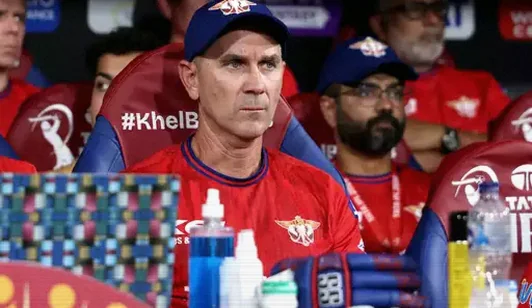
Lucknow Super Giants head coach Justin Langer compared the Ekana Stadium surface to Perth’s WACA, saying his side has struggled to adapt to the pace and bounce that come with the wicket. LSG’s home campaign has been a major issue, with the franchise losing three matches in a row at the venue this season.
The most recent setback came on Wednesday, April 22, when Rajasthan Royals handed them a heavy defeat. It further dented Lucknow’s already lopsided record at home: since 2024, they have managed just six wins from 17 games played in Lucknow.
“Playing at the WACA” — Langer’s pitch verdict
- Langer said the Ekana pitch plays “like playing at the WACA”.
- He believes LSG have not adjusted to the extra pace and bounce.
- LSG’s losses at home this season have come in three straight matches.
- The club’s home record since 2024 stands at six wins in 17 games.
- Venue totals so far this season have been 141, 164/8 and 119.
Speaking after the loss, Langer did not question the quality of the wicket, calling it “brilliant,” but pointed to a clear gap between the pitch’s demands and his batters’ preparation. He said Lucknow’s early bowling efforts were encouraging, yet the batting unit repeatedly struggled to handle the sharper bounce and the short ball.
In Langer’s view, the problem was not just technique but also timing—his batters were getting caught out against a ball that comes on faster and rises more than many traditional Indian surfaces. He noted that the team has been repeatedly “out to the short ball,” which he felt was the recurring theme across their batting collapses.
Chasing a target of 160, Lucknow were in trouble almost immediately, slipping to 11/3 within the first three overs. The damage in the powerplay was inflicted by Jofra Archer and Nandre Burger, whose new-ball spell set the tone for Rajasthan’s control.
Rishabh Pant fell while trying to swipe the ball to the leg side, only to receive a thick edge behind the stumps—an outcome Langer suggested could have been influenced by the extra bounce. Aiden Markram then got out to Archer, top-edging a back-of-a-length delivery that was aimed at his body.
Langer’s message was blunt: Lucknow were not adapting quickly enough. He reiterated that the pitch is unlike most grounds across India, offering pace and bounce that force batters to adjust their shot selection and respect the rising ball.
Bowling praised, adaptation questioned
While the defeats have piled up, Langer credited his pace attack for keeping their head above water during a difficult run. He singled out Mohsin Khan as “outstanding” again and backed Prince Yadav as well, suggesting both have the potential to earn places in India’s setup.
Langer contrasted the current season with last year, when Lucknow’s numbers were impressive but several bowlers were either injured, returning from injury, or not fully fit. This year, he said, the bowling group has been a “real credit” and has given the team better performances even when results have not followed.
Asked whether the franchise has any influence over pitch preparation in Lucknow, Langer pushed back on the idea. He repeated that the grounds staff have produced one of the best surfaces in India and stressed that the wicket itself is excellent—the issue is how quickly the batting side learns to play it.
He also highlighted the context around the venue, including a large outfield and a bigger ground, before insisting that the match-by-match challenge remains the same: every game is exciting, but Lucknow have simply been on the wrong side of the equation so far.
Jadeja: not a typical T20 wicket, but fair for both
Ravindra Jadeja, named Player of the Match for an unbeaten 43 off 29 balls and for taking the wicket of Nicholas Pooran, felt the surface was not the usual T20 track. He argued that the wicket offered enough balance for both sides, which made the contest tougher and more skill-dependent.
The match was played on pitch four, a red-soil surface that was reportedly the same kind of wicket used when Lucknow faced Delhi Capitals in their season opener. Jadeja said there was grass on the surface, giving it bounce, while the four fast bowlers from both teams were able to generate swing and seam alongside real pace.
He added that it was not a wicket where batters could simply clear the ground and hit through the line. Instead, fast bowlers from both sides would have enjoyed the conditions, because the ball was behaving in a way that rewarded those who could pitch it correctly and let the surface do the rest.
Jadeja’s key point was fairness across innings. He said both teams lost two or three wickets in the powerplay, and the match did not follow the familiar pattern of one team getting an easier first innings before conditions slow down completely in the second. In his assessment, it was a challenging T20 game that tested mental strength and required sharp execution rather than just fireworks.
