
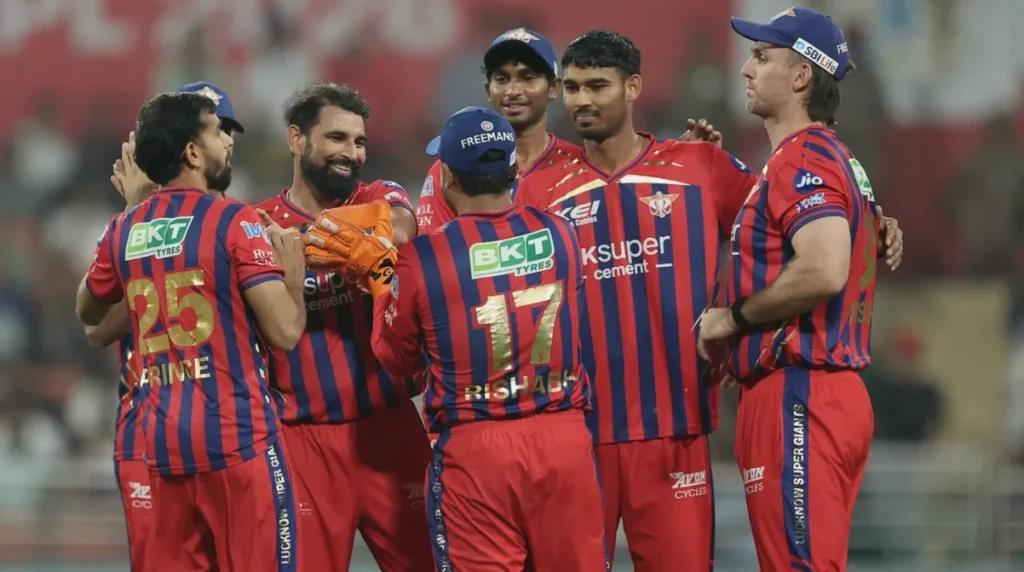
Lucknow Super Giants (LSG) have been going through a tough time with the bat in this IPL, but their bowling has repeatedly delivered the kind of control that turns close chases into defendable targets. In the two league games they have won so far, LSG’s bowlers set the tone by holding opposing teams under 190, giving their batters a platform to complete the job.
Several performances have stood out along the way, including the way LSG managed the threat of Rajasthan Royals’ opening duo Vaibhav Sooryavanshi and Yashasvi Jaiswal, as well as their ability to keep Sunrisers Hyderabad’s batting unit quiet. The pace core of Mohammed Shami, Prince Yadav and Mohsin Khan has been central to those efforts, combining for 29 wickets this season.
LSG’s overall bowling numbers also underline their discipline, with an economy rate of 8.9 across the season. Their fast bowlers, meanwhile, are operating at 8.45—best among pace units in the league.
How LSG’s pacers are winning phases
-
LSG’s success has been built on variety inside their attack. Shami brings more than just his usual swing and seam, mixing in yorkers and well-disguised slower deliveries to stay dangerous in every part of the innings.
-
Prince has impressed with his line and length and the way he adapts his variations as the match progresses, giving LSG options whether batters are aggressive or looking to settle.
-
Mohsin has provided the backbone through control and discipline, anchoring the attack with tight spells and pressure-building sequences.
Shami’s impact has been clear in raw output as well: he has taken seven wickets in eight matches at an economy rate of 8.06. Even that figure, however, does not fully capture how he controls the ball—especially in the powerplay—while continuously altering his approach through the use of his variations.
His standout showing against SRH highlighted that evolution. Shami conceded only nine runs in his four overs, sent down 18 dot balls, and produced one of the most economical spells in IPL history-level terms. He accounted for Abhishek Sharma with an offcutter, then dismissed Travis Head using a scrambled-seam delivery—proof of how his game has kept adapting to the demands of modern T20 batting.
Speaking on the pace group’s rise, LSG bowling coach Bharat Arun said that Shami’s experience and the bowlers’ understanding of their strengths have been key. He added that Arun’s job is to reinforce those strengths and keep challenging the unit to execute the plans they’re given in matches.
Arun also touched on Shami’s intent to return to international cricket, noting that Shami last played for India in March 2025. Arun said Shami’s mindset is focused and straightforward: selection is not in his hands, but performing is. With the form Shami has shown, questions have naturally grown around why he is not yet part of the international setup, and Arun stressed that Shami himself enjoys bowling and believes in what he is doing.
Prince has been LSG’s leading wicket-taker, with 13 scalps so far, and he has added another dimension to the attack. He has adjusted his lengths quickly, built a broader set of skills that includes a deceptive slower bouncer, and has been especially effective at nailing yorkers towards the end of innings. In the powerplay, he has picked up five wickets at an economy of 7.9. In the middle overs, he has been even sharper—economy rate of 6.83 with six wickets, which is also the best among fast bowlers in the league so far (minimum 50 balls bowled). At the death, his economy has risen to 10.52, though he has still managed two wickets.
Mohsin’s season has been shaped by fitness timing as well. He missed four games after the opening match of the campaign against Delhi Capitals, but in the four matches he has played, he has made a significant impact. His ability to pile on pressure through dot balls has been crucial, and he has the best powerplay economy rate of 6.33 among all bowlers this season (with a minimum of 50 balls bowled).
This control also showed up in wicket-making bursts. He produced wicket-maiden overs three times this season, including a notable spell against Rajasthan Royals where he repeatedly hit a hard length, forced Sooryavanshi into a mis-hit, and then followed it up with a career-best 5 for 23 against Kolkata Knight Riders. That five-wicket haul came even though the result did not go LSG’s way, with Mohsin’s change of pace proving useful during the chase.
Injuries have previously restricted Mohsin’s ability to sustain long runs of appearances, but LSG have managed his preparation better this year to help him return in stronger shape.
On the fitness turnaround, Arun said injuries are an inherent part of a fast bowler’s career and can be delayed, but not fully avoided. He explained that the team understood Mohsin’s recovery process and planned accordingly. Arun said they ran camps two-and-a-half months before the current window, with the strength and training coach and physios working on him at least three months in advance so he could come back ready to peak. He added that the work put into fitness is now paying off.
Across the board, LSG’s fast bowlers have stood out for precision, particularly in yorker execution. Their yorkers have gone for an economy rate of 3.48, the best mark in the league. Slower balls have also been a key weapon, with an economy rate of 9.9—the second-best in the competition, just behind Mumbai Indians’ 9.8.
That makes the collective influence of Shami, Prince and Mohsin even more significant in a season where LSG’s lead spinner, Digvesh Rathi, has struggled for rhythm. LSG have also kept out threats such as Mayank Yadav and the experienced Anrich Nortje from their playing XI, a sign of how strongly this pace unit has performed. With their bowling doing the heavy lifting, LSG will now be hoping for their batters to step up and turn their flickering chances into lasting momentum.
