
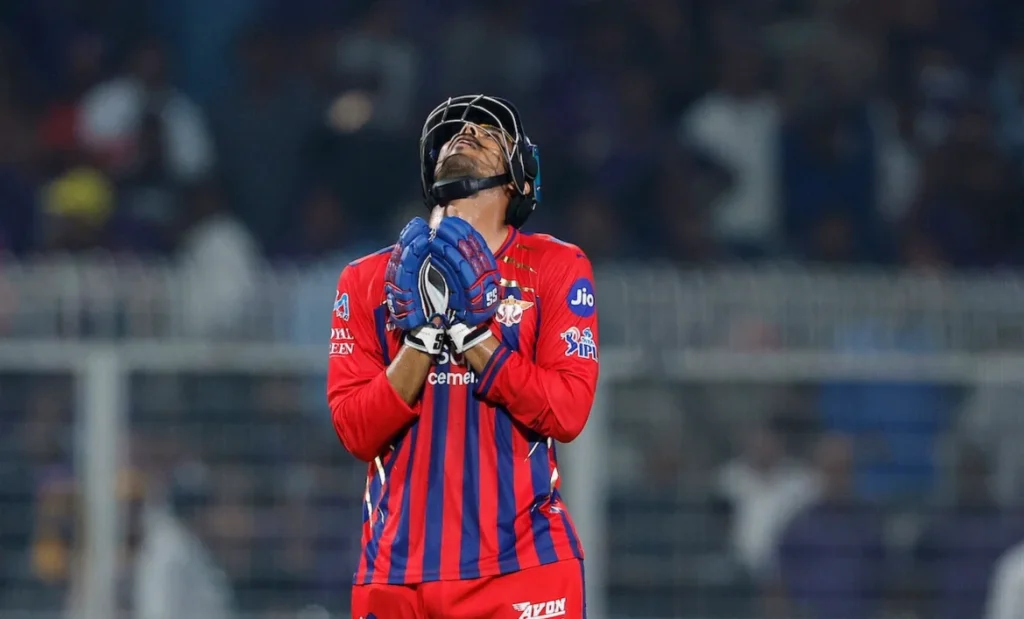
Lucknow Super Giants were staring at the edge of defeat at Eden Gardens when they were required to chase 54 runs from 24 balls against Kolkata Knight Riders. In Udaipur, Rajasthan, however, LSG’s batting coach Nikhil Doru was having dinner with friends outside the cricket bubble—people who told him the game was effectively finished for the visitors. Doru’s response was firm: he insisted that Mukul Choudhary would take the match away from KKR, and his confidence proved well founded as the batter delivered a calm, boundary-packed finish to guide LSG to victory.
Key takeaways
- LSG needed 54 runs off 24 balls against KKR at Eden Gardens, yet the chase stayed alive until the final overs.
- Nikhil Doru, watching the game from Udaipur while dining with non-cricket friends, predicted Mukul Choudhary would be the decisive factor.
- Choudhary struck a decisive flurry, ending unbeaten on 54 from 27 deliveries.
- Doru links Choudhary’s mindset to a similar breakthrough performance in the Syed Mushtaq Ali Trophy, where a late surge transformed a near-certain loss.
- Much of Choudhary’s reputation in T20s is built around a helicopter-style striking game, supported by intense six-hitting practice.
- Doru believes Choudhary’s temperament and risk appetite point to a future India call-up.
Doru’s prediction and the finishing spell
Before the match, most people had already written off Lucknow’s chances. At the Eden Gardens, the equation was not just tough—it looked close to impossible for a chase of that size with only 24 balls remaining. But Doru, in a restaurant in Udaipur, refused to concede the contest. Over dinner with friends, some of whom were not part of the cricket world, he heard the same refrain: that LSG could not win from that stage. Doru didn’t just disagree—he named a player. He told them that Mukul Choudhary would “win the match from here,” arguing that he had seen Choudhary play before and that the batter would deliver when it mattered.
In Doru’s telling, the turning point began almost immediately after he voiced his view. Choudhary started slowly—scoring only a single run from his first five balls—before accelerating quickly. Boundaries followed in clusters, including a helicopter shot that mirrored the recognizable stroke associated with MS Dhoni. With eight needed from three deliveries, Doru told his friends that a six was coming next, and Choudhary delivered on cue—sending a wide yorker from Vaibhav Arora over extra cover for a maximum.
Once LSG crossed the line and Choudhary finished unbeaten on 54 off 27 balls, Doru’s mood changed from conviction to celebration. He later spoke with Choudhary on Friday morning, focusing on the way the innings was played without unnecessary fear—how the talk shifted from not taking risks or worrying about getting started, to showcasing the shots in the last two or three overs.
The earlier template: how the mindset was built
To understand why Doru was so unshaken during the Eden Gardens chase, it helps to look back at last year’s Syed Mushtaq Ali Trophy. In that tournament, Rajasthan’s match against Delhi in Ahmedabad played out in a strikingly similar pattern. Rajasthan’s dugout had effectively lost hope, but Choudhary produced a whirlwind innings of 62 not out off 26 balls, featuring seven sixes. That surge turned what looked like a certain defeat into a remarkable win.
Doru remembered the final-over mathematics from that game: when Rajasthan needed 25 runs in the last over, Choudhary smashed four sixes off Ayush Badoni. Then, with the equation shrinking to six runs off the final ball, Choudhary cleared the ropes again to complete the heist.
After that Syed Mushtaq Ali Trophy match, Doru sat down with Choudhary to understand what was going through his mind when the situation appeared too difficult to win—and particularly when he wasn’t striking freely early. Doru says the answer has stayed with him ever since, because Choudhary repeats it almost word-for-word when speaking to broadcasters after pulling off wins, including the later triumph over KKR.
“If I play till the last ball, I will win the match for the team. My aim was to play till the end because if that happened, I would win the game.”
Doru views those words as the key to reading Choudhary as a cricketer. He adds that when the Syed Mushtaq Ali Trophy began, Choudhary wasn’t even in Rajasthan’s playing XI. Only after Kartik Sharma injured his finger—despite the coaching staff pushing for Choudhary’s inclusion from the selectors before the tournament started—did the opportunity open up.
Choudhary’s preparation for that match also came with its own twists. He tried to travel from Sikar to Ahmedabad by train, but believed the timing might cause him to miss the game. So he attempted to fly instead. The plan collapsed due to operational issues with IndiGo and a lack of seats on other airlines. Eventually, he reached Ahmedabad at 4am by driving with a friend, slept briefly, and then walked into action against Delhi—where he became an instant standout.
Following that match, Doru sent Choudhary’s statistics and video clips to Vikram Solanki, the Director of Cricket at Gujarat Titans, and to V Cheluvaraj, a scout for Chennai Super Kings. When the auction took place in Abu Dhabi last year, LSG secured Choudhary for Rs 2.6 crore, outbidding interest from Mumbai Indians and Rajasthan Royals.
From a family’s sacrifice to a training pathway
Choudhary’s story is rooted in Jhunjhunu district, hailing from the village of Khedaro Ki Dhani in Rajasthan. Doru traces his rise as a process that began around 12 years earlier. According to the account, his father Dalip had decided even before marriage that his firstborn would become a cricketer. When Choudhary arrived in 2004, Dalip began the long-term pursuit of shaping him into a professional.
That journey demanded major sacrifices. Dalip gave up a teaching job, put aside ambitions linked to Rajasthan Administrative Services (RAS), and sold his home. He then moved into the more volatile real estate and hospitality sectors, all while debts climbed to Rs three crores. Choudhary’s mother, Sunita, handled her own share of the grind—preparing meals by 4am and tracking Mukul’s progress from her classroom window before leaving work.
Choudhary was enrolled at the SBS Cricket Academy in Sikar, roughly 80 km from Jhunjhunu, and he attended coaching clinics organized by Yograj Singh and Dinesh Lad. The next step was a permanent base at Jaipur’s Aravalli Coaching Centre, where coaches Vikas Yadav and Vijay Golada shifted him into the batting group after identifying him as a pacer.
Today, Choudhary’s family—including a younger sister who is a Civil Services aspirant—remains in Jaipur in a rented home. Doru points out that even before Choudhary’s breakout moments, there was an indicator of his temperament during a Rajasthan probables camp for the 2025/26 season.
A red-ball challenge that revealed his nerves
At that Rajasthan camp, the selection panel named only two specialist openers in a 25-member group, which meant the plan could not cover a full Ranji Trophy workload. To plug the gap, Doru asked established middle-order batters whether they would consider opening the batting.
Doru describes opening in first-class cricket as one of the hardest roles: a settled middle-order batter can struggle when facing a new ball that swings and seams. Even though Choudhary had debuted in 2023 and was still finding his footing at senior level, he was the only one to accept immediately.
“Everyone said no, but he said, ‘Yes, I am ready to do whatever you ask me to do. If you want to prepare me as an opener, I am ready to be one.’ I requested him only once, and he was ready to open the batting. Now think how much mentally strong he is when he said ‘Nahi sir, mei karunga. Aap mujhe taiyaar kariye (No sir, I will do it. You prepare me for it).’”
Doru added that for a middle-order player to take on opening duties in red-ball cricket is among the toughest tasks, yet Choudhary accepted the demand without hesitation. Doru says the attitude was evident—Choudhary appeared prepared for any difficult scenario and ready to take on tough challenges.
After that, Doru started working with Choudhary right away, spending two full months on intensive preparation. The work wasn’t limited to white-ball power-hitting; it also included the technical demands of opening in red-ball cricket—handling the new ball, dealing with seam and swing, and learning how to adapt to different field placements.
He also had to present a case study at the BCCI Centre of Excellence on any batter he worked with for those two months, and Choudhary became his subject. Doru’s assessment began with video analysis and initial review, where he identified that Choudhary’s power-hitting and ability to pick up and clear the ball for sixes were already strong.
Then, Doru says, he refined that base further for T20 cricket—especially against pace, dealing with the new ball, and tweaking shot choices according to whether the ball was coming with fielders in and out. Doru believes the extended work improved Choudhary’s confidence and also sharpened his shot selection.
Building the numbers and refining the technique
As an opener, Choudhary scored 44 against Chhattisgarh. He later became the top run-getter in the Under-23 List A trophy, collecting 617 runs at an average close to 103 and a strike rate above 142. His run haul came with 39 sixes and 34 fours.
After Rajasthan lost to Jammu and Kashmir during a Ranji Trophy match in two days in Srinagar, an optional training session was organized the next morning. Out of 15 squad members, only two turned up—Choudhary and Sumit Goddar.
Doru also offers a technical explanation for why Choudhary plays the ball the way he does, emphasizing the role of flexible wrists and bat speed. He says the batter’s stance is more sideways with shoulders closed, and that as the ball comes in, his shoulders don’t open naturally. That forces him to use the helicopter shot because he needs to open his body toward the leg side to play it properly.
Doru adds that Choudhary’s body being closed helps him in another way too: it gives him the full bat arc, letting him generate power for the helicopter shot and to use his wrists to clear the boundary. Doru claims Choudhary understands those strengths well and has significant power through his wrists.
Beyond the helicopter shot, Doru notes that Choudhary has also hit a slower bouncer on the off-stump for six, typically a delivery that batters might attack over slip with an uppercut, yet Choudhary sent it over cover. He has also struck a wide yorker for a six over extra cover, which Doru says reflects strong reading of the bowler’s intent based on the field. Doru frames it as preparation—Choudhary knows what is coming according to the setting, readies himself accordingly, and that is his specialty.
Doru further recalls that for the last 18 months Choudhary has been practicing hitting between 100 and 200 sixes daily, particularly after recognizing the realities of modern T20 cricket. In Doru’s view, the current pathway for players is tightly linked to six-hitting ability, and those who can clear the ropes earn opportunities in leagues like the IPL.
“He practiced hitting sixes relentlessly and all of that is paying off now,” Doru said. He also compared Choudhary with other batters of a similar age group, arguing that Choudhary’s strength is why he generates such quality power for his sixes. Without wrist strength and a powerful physical build, Doru believes it is difficult to hit sixes with real force.
Confidence, risk appetite, and the India pathway
In a recent report sent to the RCA, Doru wrote that Choudhary has a very good attitude, is highly confident, and is ready to take on any challenge—always willing to do whatever is asked and unlikely to refuse. Doru’s conviction that Choudhary will play for India “very soon” is portrayed as rooted in a rare appetite for risk: repeatedly volunteering for challenges others avoid and finding ways to win from precarious situations.
Doru also discusses how difficult it is to bat at number six or seven, noting that a finisher who can actually execute in those roles can accelerate a team’s turnaround. He references Justin Langer’s point that playing in those positions requires you to bat through the end and still hit the right shots. Doru adds another layer of difficulty—managing partnerships when there is a tail-ender—and says that makes Choudhary’s temperament even more valuable.
He then highlights a moment from the match scenario where Avesh Khan came out to bat. Doru felt, from Choudhary’s body language, that the batter was signaling confidence to the bowler that the chase could still be won. With the current style and mindset, Doru says he is certain Choudhary will play for India.
In the Udaipur restaurant, the scepticism Doru’s friends had shown toward his confidence faded as they witnessed Choudhary’s clinical finishing. On that day, when Choudhary came under a broader spotlight, it simply reinforced the belief Doru had identified long before Eden Gardens’ floodlights made it impossible to ignore.
